
STIHL TIMBERSPORTS conducted a nationwide, representative survey to examine Hungarians’ attitudes toward extreme sports in light of the upcoming World Trophy international woodcutting competition, which will be held from June 5–6, 2026, at the City Park Ice Rink in Budapest. The survey revealed that while the spectacle of extreme sports impresses many, far fewer think that they would try them. At the same time, it also emerged that Hungarians hold physical performance and challenging activities in particularly high regard.
The survey also asked about exercise habits; about one-third of Hungarians exercise regularly, several times a week, while nearly one-quarter do not exercise at all. This data is particularly important if we want to understand how the population views non-traditional forms of physical activity.
63% of respondents do not dispute that physically demanding manual labor can be considered the same kind of physical activity as sports, and 17% believe that manual labor is fully equivalent to the physical activity performed during sports. However, an interesting dynamic emerges when it comes to the perception of physical labor:
the vast majority of Hungarians, 71%, highly value the work of people who perform physically demanding manual labor. The result is most striking in the 50–59 age group, where 81% of respondents highly value physical or manual labor.
The study also examined Hungarians’ attitudes toward sports based on traditional, physical labor. Thirty percent of respondents, and nearly forty percent of those aged 16–29, tend to appreciate these sports, and more than half of the population has already heard of woodcutting, which falls into this category.

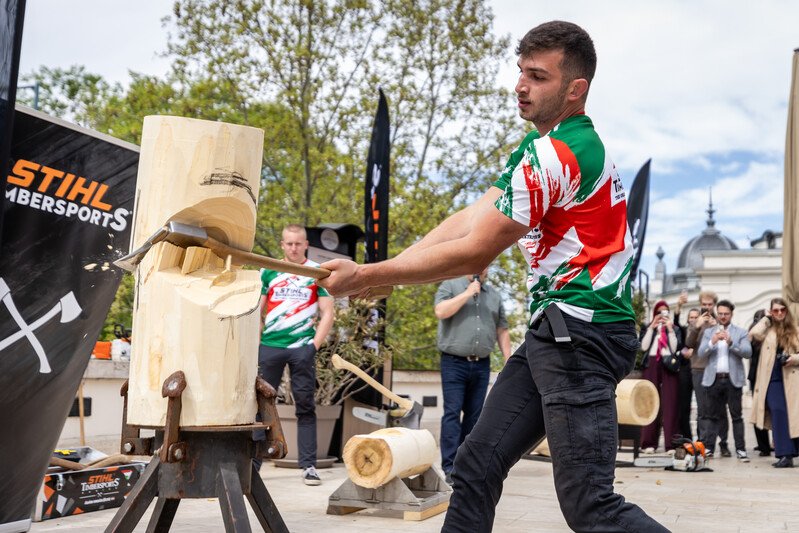
Ádám Urbán, Photo: STIHL TIMBERSPORTS
One thing is certain: nearly 60% of Hungarians believe that manual labor and extreme sports alike can be considered genuine, hard physical feats.
One of the most important findings of the research is that Hungarians have a fundamentally positive attitude toward extreme sports. While 40% of the population finds them exciting and spectacular, the willingness to try them is higher among younger age groups; 66% of those aged 16–29 and 30–39 would definitely or probably try some form of extreme sport if given the opportunity, while older age groups tend to view them primarily as spectators.
Those who would try them cited the opportunity to push their limits and personal development as important factors.
For those interested in extreme sports, the experience is clearly the most important motivation. Respondents cited excitement, adrenaline, and challenge as the main attractions; however, only 17% of the population regularly follows extreme sports on television, online, or in other formats.
The results revealed that extreme sports are not merely physical activities, but a complex experience: they involve mental strength, courage, and concentration all at once.
The majority of Hungarians (57%) have “cut wood with an axe or chainsaw,” and in many (26%) families or households, there is someone who “regularly cuts wood”; this figure is higher in rural areas, as well as in western and eastern Hungary, at around 30–30%. Respondents believe there are four key criteria for becoming a successful competitive woodcutter: 71% say technical skill is the most important, followed by great physical strength (67%), endurance and stamina (65%), but many (62%) also consider experience a decisive factor.
This is confirmed by STIHL TIMBERSPORTS competitors as well as Hungarian competitors, including Ádám Urbán, who will represent the country in the “Rookie” category at the age of 17 on the first day of the World Trophy in June, but is continuously preparing for the competition. Meanwhile, Bence Strúbel, the 23-year-old three-time Hungarian champion in sports woodcutting, will compete in the men’s adult category on Saturday.
Fact
The STIHL Group is an internationally active, global market and technology leader. As a sustainable, family-owned business, STIHL has been making it easier for people to work in and with nature since 1926. It serves its customers with innovative battery-powered and gasoline-powered tools in the fields of forestry and agriculture, as well as in landscape maintenance, the construction industry, and household use. Its global network consists of manufacturing companies in eight countries, 44 in-house sales and marketing companies, approximately 120 importers, and more than 52,000 authorized dealers. Since 1971, STIHL has been the world’s best-selling chainsaw brand by unit sales. The group’s headquarters are located in Waiblingen, near Stuttgart, Germany. In 2024, STIHL employed 19,732 people worldwide, and its revenue reached 5.33 billion euros.

Via Press Release; Featured photo: STIHL TIMBERSPORTS