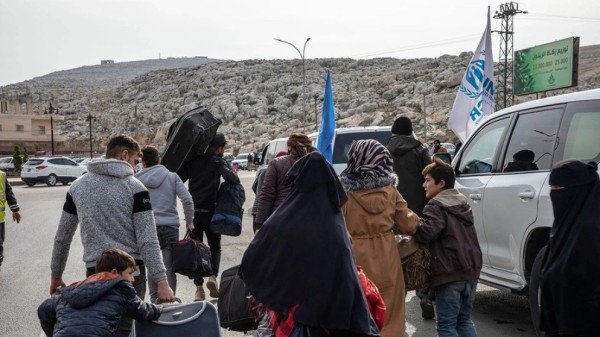
The spokesman for the United Nations High Commissioner for Refugees in Jordan, Yousef Taha, said that more than 190,000 registered Syrian refugees from Jordan have returned to their homeland since December 8, 2024, with the fall of the Syrian regime, until Monday.
He added that 16,000 Syrian refugees have returned to their homeland since the beginning of this year. They were divided into 4,000 in April, 3,400 in March, 3,900 refugees in February, and 4,500 refugees in January.
Regarding the nature of the returnees, Taha explained that 58% of the returnees to Syria returned to Syria as families, and 42% were individuals, noting that 46,000 Syrian returnees were from the refugee camps in the Zaatari and Azraq camps, representing 24% of the total returnees.
He revealed that the current number of Syrian refugees in the Zaatari and Azraq camps reached 81,000 refugees, including 33,000 in the Azraq camp, and 48,000 refugees in the Zaatari camp.
He indicated that 76% of the remaining Syrian returnees were from urban areas, from the governorates of the capital, Irbid, Mafraq, and Zarqa, indicating that most of the Syrian governorates to which the refugees returned; They are Daraa, Homs, Rural Damascus, Halaf, Damascus, and Hama.
For his part, security and political expert Ahmed Bani Hamdan said that the number of refugees registered with UNHCR in Jordan before the fall of the Syrian regime reached 700,000 refugees, including 550,000 Syrian refugees, while the total number of registered and unregistered Syrian refugees reached approximately 1.3 million refugees.
He added that the current Syrian regime presents a new vision for creating a new environment that guarantees a shift from a regime of revolution and total war to construction, relative stability, and integration into the international community.
Bani Hamdan revealed that the main challenge in Syria internally is the Israeli presence in the south of the country, and later security control in the areas of Suwayda and Al-Hasakah, explaining that the Syrian state is working to rebuild its economy and work on reconstruction with the support of Arab and international countries.
Meanwhile, a researcher at the Omran Center for Strategic Studies, Muhammad Zakwan Kuka, from Damascus, said that a number of security concerns dominated Syrian refugees when they thought about returning to their areas, including previous fears of arrest warrants being issued against them, in addition to other obstacles related to housing and the availability of basic necessities.
He pointed out that the security fear of return has decreased to a large extent, with the exception of those with ties to the regime of former President Bashar al-Assad, while he explained that the economic challenge is also still a major obstacle to return.
Director of CARE International in Jordan, Malek Abdeen, said that the organization provides programs that work to network returning refugees with families residing in their areas of origin, to provide accurate and correct information from inside Syria, to increase reassurance among the returnees.
He explained that this information makes the refugee in Jordan who is thinking about returning make his decision correctly, and think carefully about the matter before returning, so that he is not shocked by reality when he arrives in his area, with the different changes that have occurred in society and the differences between the two times (the year of asylum and the year of return).
Abdeen stated that most of the Syrian refugees in Jordan do not have owned land or a home, and they must start their lives from scratch and work to secure their basic needs of housing, food, health, and education, in light of a significant decrease in funding to cover the response to refugee crises.