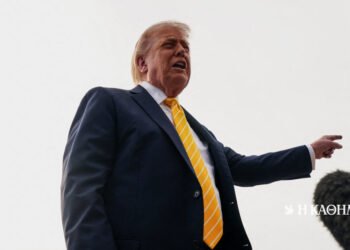
LONDON – CORRESPONDENCE. A year ago, Mr Keir Starmer she tries, by stomping, to appease him Donald Trump. The British Prime Minister, as the Cabinet Secretary said Darren Jonespractices “characteristically discreet British diplomacy” towards the US president. The effort doesn’t seem to be paying off. Trump is attacking her Britain all at once. He described as “stupid” the British concession of sovereignty over the Chagos Islands to Mauritius, threatened the British with tariffs in retaliation for their stance in Greenland, called their aircraft carriers “toys”, while he was equally disparaging of Starmer, when the latter refused to help in the Iran war: “He is not Winston Churchill».
The big idea
In any case, despite Starmer’s efforts, it is hard to believe that the British prime minister in particular is whispering in Trump’s ear, or that the latter holds his country’s infamous “special relationship” with Britain in high esteem. The obsession with the term special relationship it’s British, Churchill coined it, and Americans have been repeating it ever since, with the acquired quickness of returning a compliment.

The constant invocation of the phrase by the British reveals a creeping bigotry, not so much towards the relationship itself which is historical and existing, but more about their country. Just as British diplomacy is supposed to be practiced in a special, skilful way, in relation, say, to German, so the British expectation that they have a current, privileged relationship with the Americans is chimerical.
Many in Britain have the unacknowledged feeling that America, although this year celebrates 250 years of independence from the Kingdom of Great Britain, has not yet been weaned from the “mother country”. They believe that Washington is still expecting some kind of diplomatic “with my wish” from London in order to move forward with its plans. THE Christopher MeyerBritish ambassador to the US from 1997 to 2003, says in his memoirs that he had banned the use of the term in the embassy because it “gave our diplomats the illusion that the Americans would grant us special privileges and therefore we would not have to work for our influence”.
Brits opposed – For some time now, Britons have reached their limit with Trump: 49% (vs. 33%) favored canceling King Charles’ visit to the US.
In fact, Starmer knew nothing about the US intervention in Venezuela – it took him 16 hours to make a statement – and eventually said he was trying to find out about everything from people close to the president (not even himself). Something similar happened in Margaret Thatcher with the American intervention in Grenada in 1983, when the Ronald Reagan he had brought her to completion. At least he was gallant enough to call her twelve hours before the attack. How many generations of Brits will it take to ingrain that the Americans don’t really care, unless they want specific things, like, say, using bases for their attacks on Iran?

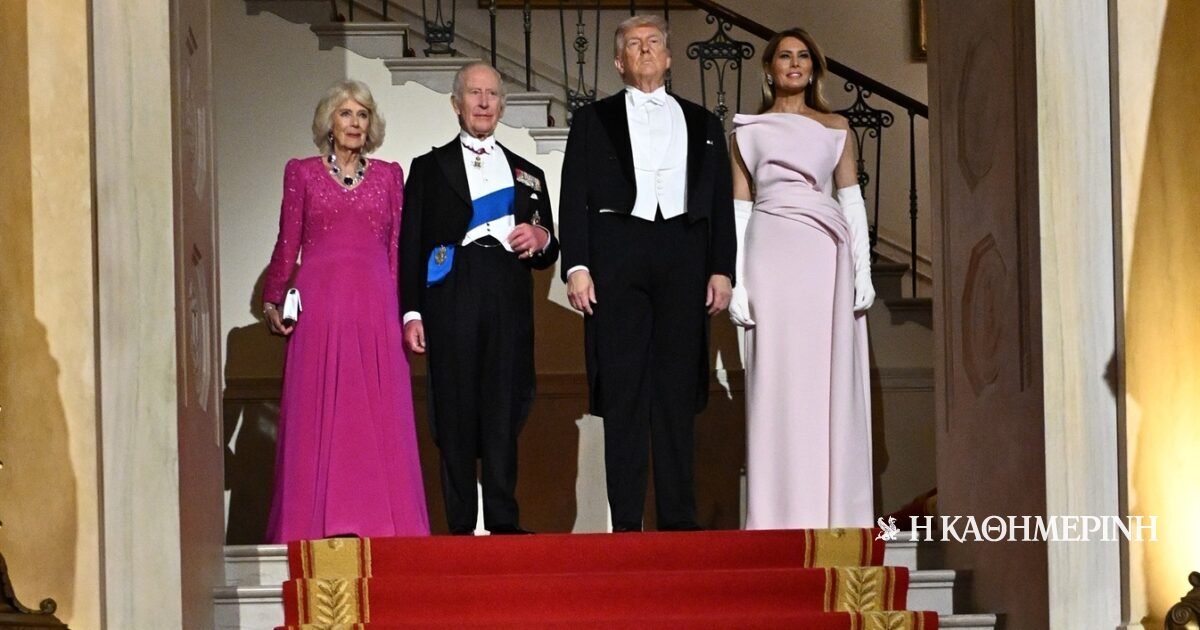
The crisis in US-British relations is this time generalized and when a problem arises with Washington, the Palace appears, almost comically, in the foreground as the necessary glam soothing for the exasperated Trump. In February 2025 we had Starmer’s on-camera royal invitation to the US president to be welcomed to Britain by King Charles. This time the mountain went to Muhammad, on the occasion of the 250th anniversary of American Independence.
The timing for Charles could not be worse. A few days before the visit, an otherwise confidential US Pentagon email said the US could reconsider its stance on British sovereignty in the Falklands in retaliation for London’s stance on Iran. There was no guarantee on the British side that the king could not find himself in a historically unprecedented situation, where the out-of-control US president would challenge British territories in front of him and in front of the cameras, or throw a tearful comment about Prince Andrew’s fallout with his involvement in the Epstein scandal.
Statements under surveillance – The times when the microphones would be open for both were few and far between – Secretary of State Yvette Cooper was tasked with stepping in if Trump strayed.
Trump’s unpredictable behavior was the reason the palace was wary of the first invitation in 2025 as well. Even now, concern was widespread among Buckingham officials. The times when the microphones would be open for both were strictly counted and the foreign minister Yvette Cooper she was charged with the task of stepping in at the drop of a hat if Trump strayed. Just before Charles got on the plane to Washington, The Times wondered if the Elizabeth would have canceled the visit.
They didn’t want the visit
This was also the popular sentiment in Britain: 49% to 33% preferred the cancellation of Charles’ trip to the USA. The British, for some time now, have reached their limit with Trump. Six in ten had called on Starmer to respond harshly with his own tariffs to the US president’s threats.
55% agreed with the revolutionary “Off the bases” chanted by the populist leader of the Greens Zak Polanski after the US threats to annex Greenland. Even the participation of England and Scotland in the World Cup entered the public conversation, with the leader of the official opposition Cammy Badenoch to request that “everyone come to their gatherings”, since “the organization is global and not American”.

Andrew’s shadow
Charles had to seek to improve the relationship with Trump, without ignoring the popular feeling of disdain towards the American president. And all this with a great personal burden on his back: his brother. Democratic lawmakers are urging the Palace to hold a symbolic meeting with his victims Jeffrey Epstein. The pressure on Charles for Andrew is also exerted within Britain. “What Andrew has not yet done – and which I think we all feel the royal family has the leverage to get him to do – is testify in the United States. To say what he really knows about the Epstein case. This is the big pending issue”, the former leader of the Liberal Democrats tells “K” Vince Cablethe man who effectively fired Andrew as the government’s trade envoy in 2011.
But it is precisely Andrew who exerts an underground, collateral pressure on Charles: to prove that the Palace, in the midst of a family scandal, does not withdraw into the interior. On the contrary, precisely at the moment when this culminates, and indeed at the scene of the crime, the monarch can rise above the circumstances and show that the monarchy has another role to fulfill.
The crisis as an opportunity for political presence
Charles works on a national mission as the silent hero who knows how to get the job done. And he really knows her. He has acted as the government’s diplomatic representative for over half a century, visiting around 100 countries, “our most experienced living diplomat”, as the former foreign secretary put it William Hague.
In a way, the more difficult the condition, the more ideal the occasion for him: a unique opportunity, at the request of others and not of his own initiative, to realize his burning desire: to have a political presence. His desire as well as his competence were evident during his masterful address to Congress. It was an allusive, tongue-in-cheek and humorous denunciation of Trumpism.

His careful but surprisingly politically charged references to “the West’s unwavering determination to defend Ukraine,” to NATO’s presence on the US side after the Twin Towers, to the battle over climate change, roused MPs 12 times from their seats and at times floored him. Jay Dee Vance in his own place, just behind the king.
There were moments when Charles seemed to enjoy his historic speech, although in his deadpan and imperceptibly distorted style it is hard to show that he was really enjoying it.
A certain role
“I don’t think it’s in Karolos’ system to enjoy things,” he says smiling to “K” o Daniel FinkelsteinTimes columnist and former adviser to the prime minister John Major. “From the very brief contacts I have had with him in the past, I believe he will certainly feel satisfied that today, finally after so many years, he has some role in the affairs of the government.
I’m sure that gives him a lot of satisfaction, but I don’t think he enjoys it.”
As with the special relationship, so with the diplomatic contribution of Karolos, we must keep a small basket. The fundamental dynamics in UK-US relations will not change easily. It was summarized on the BBC by Dickie Arbiterformer Palace spokesman: “There is a limit to what Charles can do. The restoration of relations is the work of the two governments and not of the monarch.” Perhaps this is the biggest paradox with the historic visit of Charles to the USA: he was there on a special mission to save a special relationship, without really being true of either.