Synopsis: Government boosts housing and aid for border families who remain stranded because of Thai blockades or the presence of unexploded ordnance in their villages and farms.
The government is accelerating the construction of temporary housing and broader support measures for displaced families along the Cambodia-Thailand border, as tens of thousands remain homeless because of Thai blockades or the destruction of their properties. Villages and farmland in last year’s conflict zones have also been contaminated by unexploded ordnance after the Thai side took aim at populated areas during clashes with Cambodia.
Under the orders of Senate President Hun Sen and Prime Minister Hun Manet, the government is constructing temporary housing in the border provinces of Banteay Meanchey, Oddar Meanchey, and Preah Vihear.
Nearly 3,000 housing units have been completed in Banteay Meanchey, while work is underway to build around 600 units in Preah Vihear and more than 200 in Oddar Meanchey.
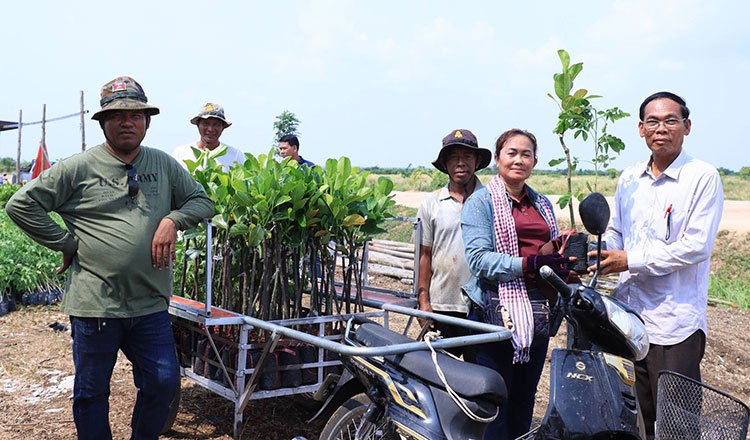
Mr Hun Manet said the government’s provision of temporary housing to the displaced does not mean it is abandoning efforts to reclaim territories under illegal Thai occupation. He assured the displaced people that the government is also working to restore their livelihoods.
Banteay Meanchey Provincial Governor Oum Reatrey outlined the situation in the province, which shares a 153-kilometre border with Thailand and has been among the hardest-hit by the border conflict.
He reported extensive damage to infrastructure, including transport networks, water and electricity systems, schools, health centres, pagodas, homes, and farmland, as well as the lingering presence of unexploded ordnance (UXO), particularly cluster munitions, in border districts.
Deputy Provincial Governor Khlok Nuoy said 2,805 families are living in temporary shelters in Svay Chek district after moving from the refugee camps, which have now been closed.
Two rounds of heavy assaults by the Thai military on Cambodia killed nine civilians and wounded 77 others. More than 2,000 houses were damaged or destroyed. Six villages remain inaccessible after Thai troops seized control of the areas, preventing residents from returning with fences made of containers and barbed wire.
The provincial administration is improving the living conditions of displaced households, including by allocating each of them a housing unit that comes with a 20-by-30 metre plot of land.
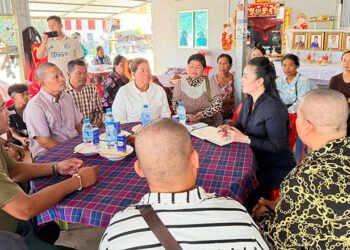
Reatrey recently hosted a visit by a senior US Embassy official to a shelter in Svay Chek district, highlighting humanitarian challenges and recovery efforts in the border province.
Rona Rathod, Head of the Political Department at the US Embassy, visited a shelter in Sla Kram village, where families affected by border tensions were housed.
The US side reaffirmed its focus on peace and a sustained ceasefire along the border, while also highlighting support for mine clearance and humanitarian assistance.
Funding has been allocated to assist affected communities, with aid for displaced people delivered through the International Organisation for Migration (IOM).
She added that she had also held discussions with the ASEAN Observer Team (AOT) on peace in Cambodia as well as the wider ASEAN region, aimed at supporting the group’s ongoing mission and operations in Cambodia, according to the provincial administration.
Government spokesperson Pen Bona said Cambodia is addressing the welfare of displaced people with temporary housing while the border issue is being fully resolved.
In a statement on the Cambodia-Thailand border situation yesterday, Bona said the government, under the leadership of Prime Minister Hun Manet, is also considering the welfare of veterans’ families, both in the present and the future, including the provision of accommodation.
He added that the government is taking into account debt burdens, establishing support funds for veterans’ families, creating livelihood opportunities, and providing scholarships for their children.
“The Royal Government has also taken care of the displaced, from their livelihoods to temporary housing for them, and plans to hand over these houses to them once they return to their original homes after the border issue is resolved through diplomatic means,” he said.
The Ministry of Interior said the situation of displaced persons along the Cambodia-Thailand border continues to improve, with the vast majority of affected residents having returned home, although disruptions to essential services persist in several provinces.
In its latest update, the ministry reported that 49 more displaced persons had returned home, bringing the total number of returnees to more than 610,000 out of over 640,000 displaced. It said 33,328 people remain displaced, including 17,261 women and 11,325 children.
Despite the improvement, a number of schools and health facilities in border areas remain closed. The ministry said eight schools and five hospitals or health centres in Oddar Meanchey province, five schools and one health facility in Banteay Meanchey, and seven schools and two health facilities in Preah Vihear are still not operational.
The ministry reiterated that since the ceasefire came into effect in December last year, the Thai side has not fully adhered to the joint statement of the 3rd Special General Border Committee (GBC). It said Cambodia continues to document alleged violations while pursuing legal and diplomatic measures.
At the same time, the ministry called on Thailand to halt unilateral actions affecting Cambodia’s sovereignty and territorial integrity and urged the resumption of survey and demarcation work through the Joint Boundary Commission in line with agreed frameworks and international conventions.
The government also reaffirmed its commitment to addressing the humanitarian impact on affected communities and called on Cambodians at home and abroad to support Mr Hun Manet’s efforts to resolve the issue peacefully, with the aim of restoring stability and livelihoods along the border.