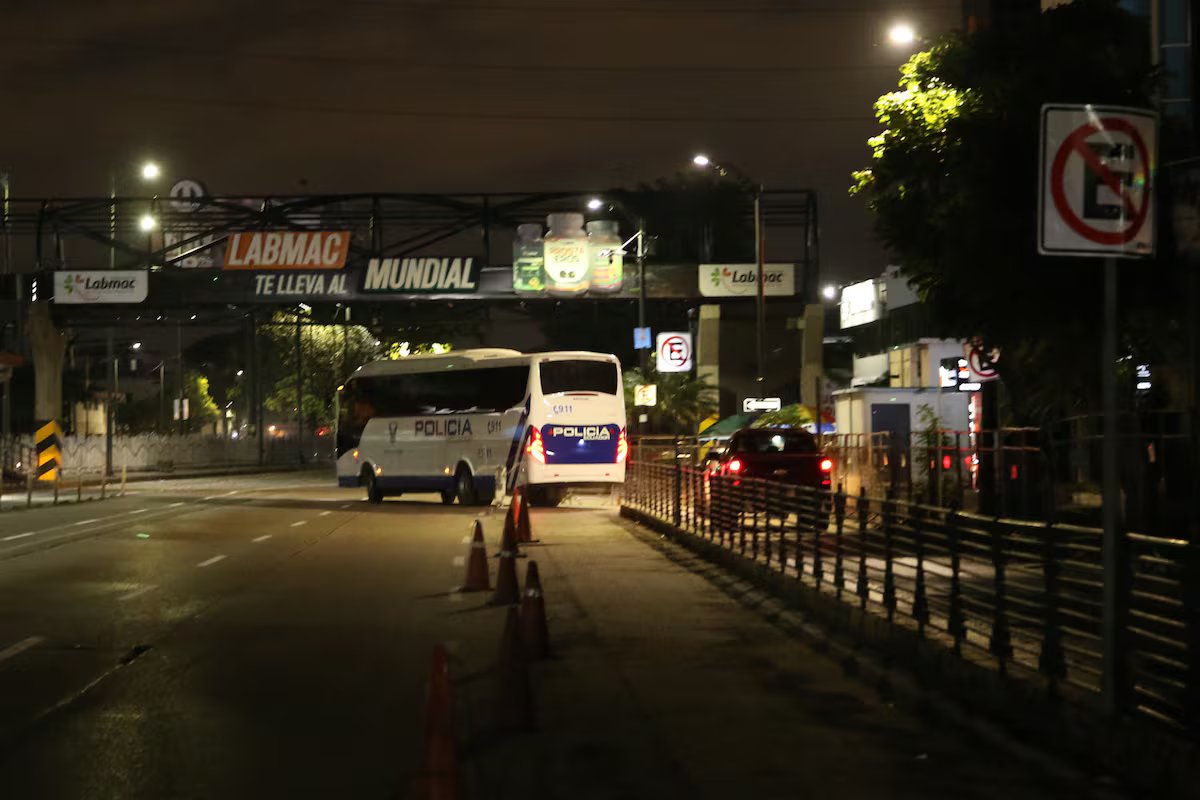
The Government of Daniel Noboa has decreed 15 days of night restriction for 12 million inhabitants living in nine provinces and four cities, including the capital, as part of its strategy to contain the escalation of violence. The decision, which does not contemplate safe passage for productive or tourist sectors, has set off alarms in the business community, which fears a new brake on activity in a country exhausted after years of chained crises.
The decree establishes limitations on circulation at night between 11:00 p.m. and 5:00 a.m., starting May 3, in territories considered critical by the authorities: Guayas, Manabí, Santa Elena, Los Ríos, El Oro, Pichincha, Esmeraldas, Santo Domingo de los Tsáchilas and Sucumbíos, as well as in the cantons of La Maná (Cotopaxi), Las Naves and Echeandía (Bolívar) and La Troncal (Cañar).
This is the second time in just over a month that the Executive imposes mobility restrictions. The first curfew, in March, was applied to four coastal provinces that account for almost half of the country’s violent deaths. According to Noboa, the results—a 33% reduction in violence indicators—motivated the measure to be expanded to five other provinces.
However, the official data on the measure raises doubts about whether it is a sufficient argument. The Ministry of the Interior bulletin reported that during the fifteen days of curfew in March, 1,283 people were arrested for disobedience, but only five were considered security targets; one of them was murdered days later in prison. Limited media coverage showed raids where, according to intelligence, dangerous criminals were expected, but the houses were empty as the police contingent broke down the doors.
Security analyst Michelle Maffei questions the effectiveness of the measure. “70% of violent deaths occurred at dawn, but criminal groups adapted and changed their schedules to daytime.” According to official data, 90% of the violent deaths that occurred during the curfew period were recorded during the daily shift. Of 229 homicides in 15 days, 26 occurred during the hours of restriction.
The absence of exceptions for economic activity has generated immediate rejection. Sectors such as production, commerce, tourism and transportation warn of significant losses. The Ecuadorian Federation of Exporters (Fedexpor) has presented proposals to achieve “coexistence” between productive activities and the security strategies that the Government constantly implements, but the answer remains the same: there will be no exceptions.
“During the first curfew, we managed to contain employment thanks to the rescheduling of shifts, routes and transportation schedules. This made it possible to meet international commitments and protect perishable products,” explains Xavier Rosero, president of Fedexpor.
Rosero warns about the impact of the measure in March. “Around 85% of our companies faced cost overruns of more than 20%. Now, with the expanded measure, the situation is complicated by external factors: war in the Middle East, lower availability of containers, increased transportation and supplies, and the closure of the Strait of Hormuz.”
The private export sector invests one million dollars a day in security to protect the production chain against extortion, road robberies and contamination of containers with drugs. After almost five years of crisis, it has managed to map vulnerable points and coordinate strategies with authorities to maintain fluidity from the transfer of collaborators to loads. “We have perceived that the set of actions we have carried out, and in coordination with the authorities, have begun to give better results,” says Rosero, who believes that these results should not be “sacrificed.”
The productive sector warns about economic and criminal risks. “Strengthening the formal economy is key to reducing the space of the illicit economy,” says Rosero. Analyst Michelle Maffei agrees that limiting the economic capacity of the private sector can encourage part of the legal economy to lend itself to money laundering schemes. Therefore, maintaining operations is not only an economic issue, but also a tool to combat organized crime. “Money laundering represents almost half of our economy. Discouraging the legal economy could normalize illicit practices under the premise of security,” adds Maffei.
This will be the seventh curfew that Daniel Noboa has decreed since he assumed the presidency in November 2023. Since then, Ecuador has remained under a state of emergency for more than 800 days as the main strategy to combat insecurity. Despite the military presence in the streets, 9,200 violent deaths were recorded last year, making it the bloodiest period in the country’s recent history.