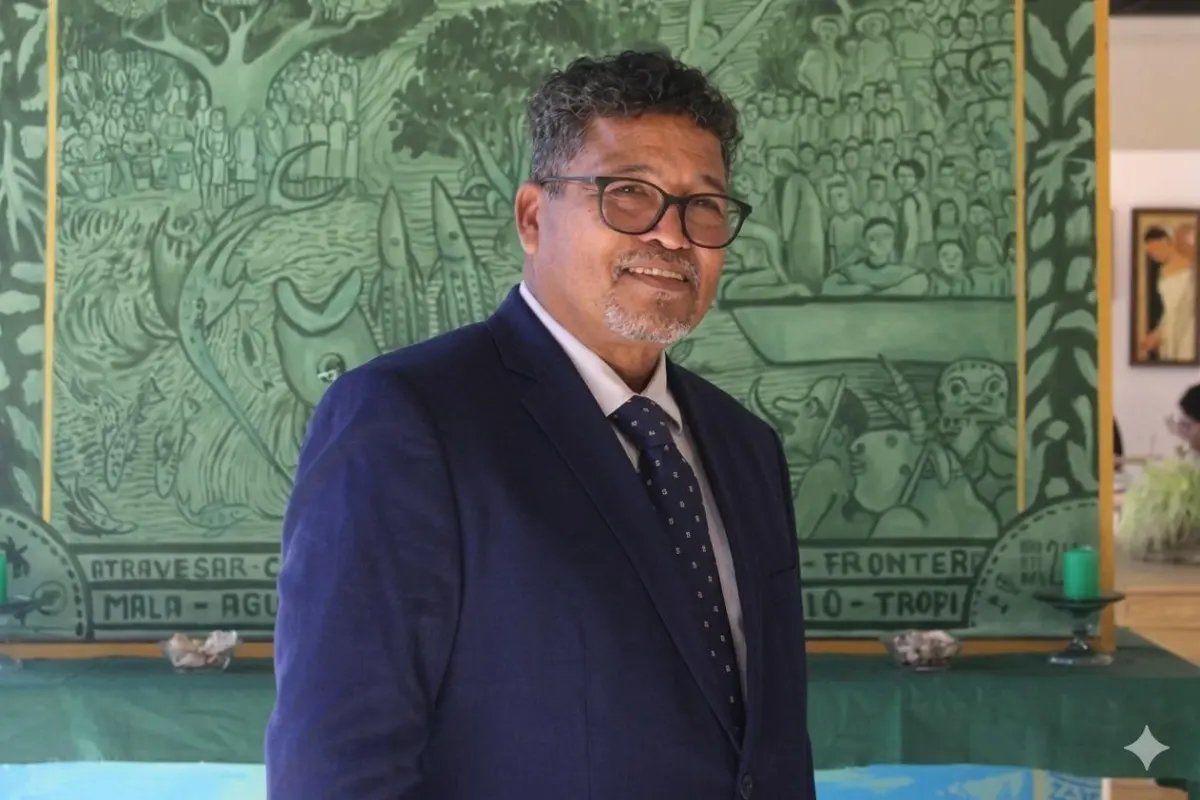
The multidisciplinary contemporary artist Aristides Ureña Ramos continues his work to continue contributing to the artistic and cultural scene in the country. He will soon carry out a task of accompanying the Panamanian delegation that this year participates once again in the sixty-first edition of the Venice Art Biennale (Italy), which will begin its journey this coming May 9.
The Panama pavilion – which is curated by Ana Elizabeth González and Mónica Kupfer, and commissioned by the Director General of the Arts of the Ministry of Culture Gianni Bianchini – will present the proposal ‘Tropical Hypertition’ by the artistic duo made up of Antonio José Guzmán and Iva Jankovic, who bring together textiles, sound and memory in a single project in a multidisciplinary approach that aims to revisit the routes and imaginaries of the Black Atlantic, a hybrid and transnational culture that arises from the historical experience of the African diaspora.
Ureña will also travel to Italy in the coming days to establish an alliance between the Aristides Ureña Foundation and the private institution Polillo Art Container (PARCO) in Milan, in order to continue expanding its work as a non-profit organization which consists of both the creation of social and cultural meeting spaces as well as the innovation and promotion of contemporary arts at a national and international level. Likewise, its objective is to strengthen cultural identity, develop excellent knowledge and promote its dissemination in highly prestigious settings.
La Estrella de Panamá had the opportunity to talk with the artist – also known as the ‘cholito veraguense’ – about various topics that concern him both about the current state of the Panamanian cultural system and the establishment of a clear differentiation between modern art and contemporary art.
Regarding the current state of the Panamanian cultural system, Ureña considers that it experiences “a general apathy towards contemporary arts as a result of an education that is not adequate to the new challenges and an anesthetized attention towards this issue.”
“The problem is fundamental, many understand ‘the contemporary’ taking as reference the definition given to us by the Royal Spanish Academy, which describes its meaning as “everything that is happening today” and that is true. The problem is that, for contemporary art, it is not the same, because it falls within the definition of artistic languages,” argued Ureña, when asked by this newspaper about how one should begin to think about a deep analysis of the Panamanian cultural system rather than merely focusing on the concept of the contemporary art.
In another order of ideas, Ureña expressed the following regarding the differentiation between modern and contemporary art: “Modern art is that artistic fatigue to create a masterpiece that encloses itself. Contemporary art is that operation that needs a space or territory where through the multidisciplinarity of techniques you analyze possibilities to evoke, select, document, its artistic operations.
Giving more freedom to the artist, contemporary art includes modern art techniques and broadens them to new horizons.” Next, he stressed that the value of knowing this distinction is of utmost importance since we are currently talking about post-contemporary art, which is an improvement on contemporary art.
To put the current panorama for the Panamanian artist in perspective, the multidisciplinary contemporary artist first contemplates a disharmony in artistic thought at a global level. Something that is generated in a context in which the institutions in charge of the administration of everything related to the arts and culture face increasingly reduced budgets, which – in their point of view – forces them to rethink how art is financed and valued.
“Museum budgets around the world have been squeezed for years due to rising costs, declining funding and changes in audiences. Institutions large and small are desperately seeking solutions, from raising ticket prices to taxing tourists to reinforcing corporate sponsorships, with the goal of increasing revenue. Attacks well met in Panama, at a time of growth in cultural industries,” he said.
Likewise, Ureña considered that urgent changes must be made so that both the Panamanian cultural system and cultural workers can have a better perspective for the future.
“We must move towards a society where the commitment to work is not understood as acquired privileges, but rather with an awareness of responsibility towards the well-being of all. We must commit to educational excellence, to the transparency of its changes, to putting new actors committed to a new vision of the country. For young people to demand new didactics and to be aware that they are the most valuable subjects for this change, to roll up the sleeves of their pants to wade through the puddle,” he stated.
Ureña finally concluded the interview with an x-ray of the Panamanian man.
“Panama is the country of contradictions, many memories, varied thoughts coexist, a melting pot of races, thousands of sensations. It is a space where many diversities are found, a Macondo that surpasses the fantasy of García Márquez… and yet we are united by a single will guided by the sole purpose of advancing together in our goals. We are a country united by a single chromosome that makes us walk together in our diversities,” he expressed.
Aristides Ureña Ramos, considered a reference of Latin American art, was born in Santiago de Veraguas in 1954. After completing his training at the San Marco Academy of Fine Arts in Florence (Italy), he later specialized in lithography, engraving and cinematography in centers such as the Reparata Graphic Art Center and the Lorenzo di Medici Institute. Upon his return to Panama in 1978, he taught Art History and directed the Plastic Arts section at the Universidad de Panamá Regional de David and the School of Fine Arts of Chiriquí.
In 1980 he returned to Italy, where he developed various initiatives such as sustained participation in artistic exhibitions and the creation of public murals and performances. Ureña represented both Panama and Italy in three editions of the Venice Biennale (1986, 1997, 2001) as well as other international exhibitions such as the ninth Beijing International Arts Biennial (2022), Havana Biennial (1989, 1991) and the third Visual Arts Biennial of the Central American Isthmus (2002).
Since 2014, he continues to produce works in his artistic workshop in Panama. Meanwhile, the artist works through the technique of pictorial cycles, a method that articulates his production in thematic bodies that combine painting, installation, video, graphics, settings and writing.
His pictorial cycles – Banana Republik, Creole Panamá or La República Popular de Panamá – deal with themes such as the history of art, national symbols, popular memory and the racial, political and spiritual tensions that continue to be part of the life of Latin America. All of this in a style that, while nourished by the knowledge and experiences accumulated during his career, is also complemented by elements of popular art and contemporary language.