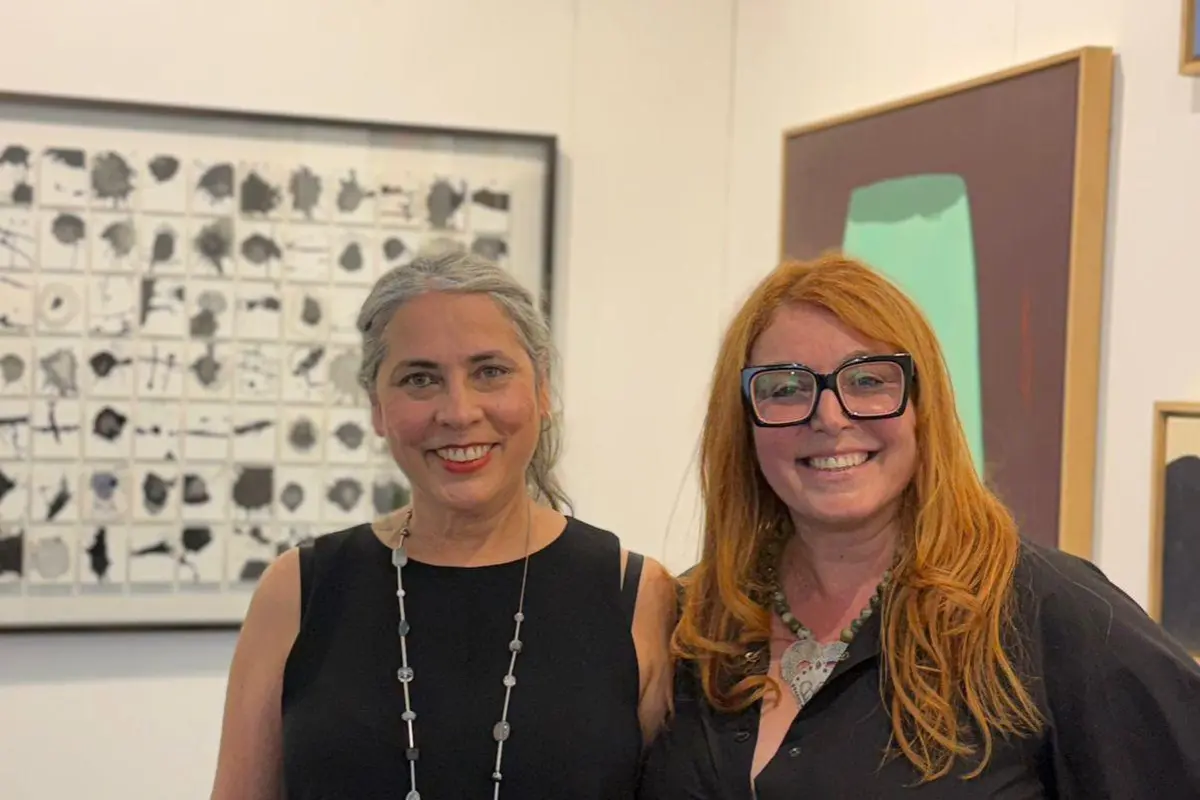
Marisa Caichiolo and Dermis León are the curators of “Inter-reality”, the artistic project of Chilean Norton Maza, which represents Chile at the 61st Venice Art Biennale, about to open this May 9. I know them both personally. Caichiolo, based in Los Angeles, is an artist and one of the most internationally renowned Argentine curators. With her I had the privilege of exhibiting my work a few years ago at PHotoEspaña, in Madrid. As for the wonderful Cuban writer and curator Dermis León, she lives between Berlin and Santiago de Chile. In the 1990s she worked at the Museum of Contemporary Art and Design of Costa Rica alongside its legendary director Virginia Pérez-Ratton, where she curated my first international exhibition.
Caichiolo and León, together with Maza, put together a multidisciplinary proposal for the Chilean pavilion at the Venice Biennale after having participated in the official call organized by the Chilean State. Call characterized by a solid track record of years of professionalism and transparency. “The Visitor” interviewed Caichiolo about the selection process and the participating work.
How was the call for the Chile Pavilion at the Venice Biennale handled?
The process was very transparent. I had already worked with Norton Maza on different projects and countries. In 2016, Norton participated in the Latin American pavilion of the Morocco Biennial, of which I was the curator and which I continue to support. I also curated a solo exhibition of his work at the MUSA in Guadalajara, Mexico, and was in charge of a curatorial project for “Pacific Standard Time, LA/LA”, promoted by the Getty Foundation. In other words, we worked very closely over the last decade.
With Norton I had already presented another proposal for the Chilean pavilion and we were preselected, but we did not make it to the end. For this second round we formed a work team that includes the co-curatorship of Dermis León, who is studying to obtain a doctorate in Santiago. I work from Los Angeles and traveled to Chile as many times as necessary.
We sent the proposal to the open call made by the Ministry of Culture, Arts and Heritage of Chile. We received the preselection letter prepared by the jury and later we managed to enter the final selection. It was a very diverse jury with a decidedly international outlook: the Brazilian Raphael Fonseca, curator of Modern and Contemporary Art at the Denver Art Museum; Victoria Noorthoon, director of the Museum of Modern Art of Buenos Aires; Jorge Macchi, the renowned Argentine artist; Eduardo Feuerhake, director of the Museum of Modern Art of Chiloé, in the city of Castro, Chile; Andrea Pacheco González, curator of the Chile Pavilion in the last edition of the Venice Biennale; Voluspa Jarpa, the Chilean visual artist who represented the country at the 58th Venice Biennale; and Sergio Pardo, director of the Public Art Program of the New York City Department of Cultural Affairs.
When we received the preselection letter, the entire team prepared under the coordination represented by the artist Norton Maza. Dermis and I as curatorial team, Matías Claus, as architect and Beatrice de Girolamo in the graphic design part. Throughout the process, more professionals were incorporated into the production area. Needless to say, I firmly believe in this rigorous selection process.
The final defense of the project had to be precise and forceful because the time we were given was only thirty-five minutes. Each member of the team prepared from their practice. In the case of the curators, we present a concept divided into two: in the first part we talk specifically about the work “Inter-Reality” and, in the second instance, we articulate the project from the curatorial concept conceived for this edition of the Venice Biennale, including the changes that the event underwent following the unexpected death of Koyo Kouoh, the general curator, in 2025.
We also discussed the feasibility of the project. Norton Maza emphasized the structural part, its dynamism, the viability of producing part of the work in Chile and the other in Italy, and how it could be articulated in the best possible way, not only in the structural aspect, but in pre-production, production and post-production before the opening.
The website of the Chile Pavilion call is a clear example of transparency. Includes the selection report of the winning project and the list of those preselected. It also includes the list of those who were not preselected and the minutes drawn up by the jury.
That’s how it is. It is of utmost importance that the calls are absolutely transparent. To do this, international judges must be included. Experts who provide their personal and professional perspective on the staging of the work; about how the project is defended, its viability and the conceptual and visual aspects around the ways in which a given country is represented on another continent and on the world stage.
In the Chilean case, it was undoubtedly a very transparent exercise. I would say impeccable. It gave me great satisfaction to be part of the process and its resolution. The entire jury, with whom we had to meet, asked us a lot of probing questions after our defense of the project. The second stage, already in the final stage of the contest, was more concrete in terms of production. There were things that changed and modified. New elements, new counterparts, more collaborators, more roles…
Tell us about the selected work.
“Inter-Reality” is an immersive and multisensory installation. Norton Maza offers us a diverse look that alludes to current conflicts in subtle ways that invite us to see many points of tension.
It is a monumental installation, where materiality plays between simulation and reality. Visitors will encounter different perspectives. It is a game through illusion, simulation and multiple looks. It relates directly to Norton’s practice, which is based on these juxtapositions.
The artist articulates his work in contradictions between contemporary art and classical, Western and baroque traditions, with different formats. His work is articulated in complex ideas that challenge us to understand different points of view. We are talking about a kind of monumentality from a total conceptualization of space; of a sculptural object within that immersive spatial totality. “Inter-Reality” also proposes a kind of fragmented perception of reality.
This project, of clear Latin American and South American origin, addresses in a subtle but profound way the most urgent problems of our time: current war and political conflicts, misinformation and fake news, the fragmentation of the media view, the role of artificial intelligence, the migration and refugee crisis, the ecological emergency and even the violence of drug trafficking and cartels.
In short, it is a fragmented view that was built from multiple perspectives, avoiding direct discourse to generate a more intricate and resonant experience.
From the curatorial level, Dermis and I accompanied the project from its initial stages, defining the conceptual axes for both the presentation and the work itself. Subsequently, we work on the necessary modifications, adjusting ideas and concepts in response to the constant changes in global reality.
The result is a project of great power, especially in the current context. It generates a critical, ethical and collective dialogue, and constitutes an outstanding example of Norton Maza’s practice: a fusion between hyperrealism and a space for deep reflection on the relationship between power, truth and freedom. Issues that take on particular urgency amid ongoing wars and the shadow of a possible third world conflict that appears to be brewing.
The author is a member of the International Association of Art Critics (AICA).
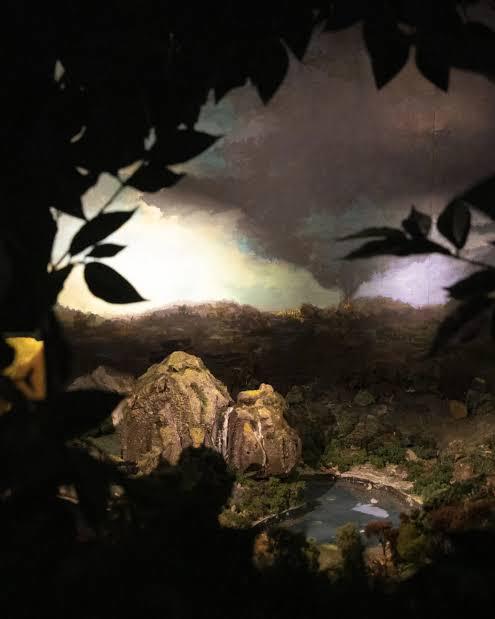
Inter-Reality, Norton Maza, immersive and multisensory installation, Chile Pavilion, Venice Biennale 2026.
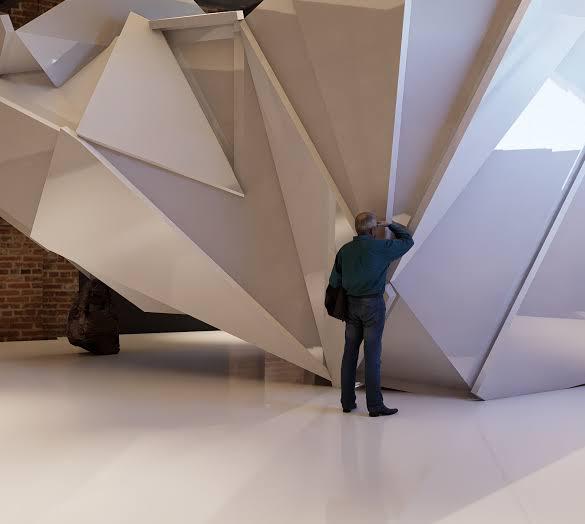
Inter-Reality, Norton Maza, immersive and multisensory installation, Chile Pavilion, Venice Biennale 2026.