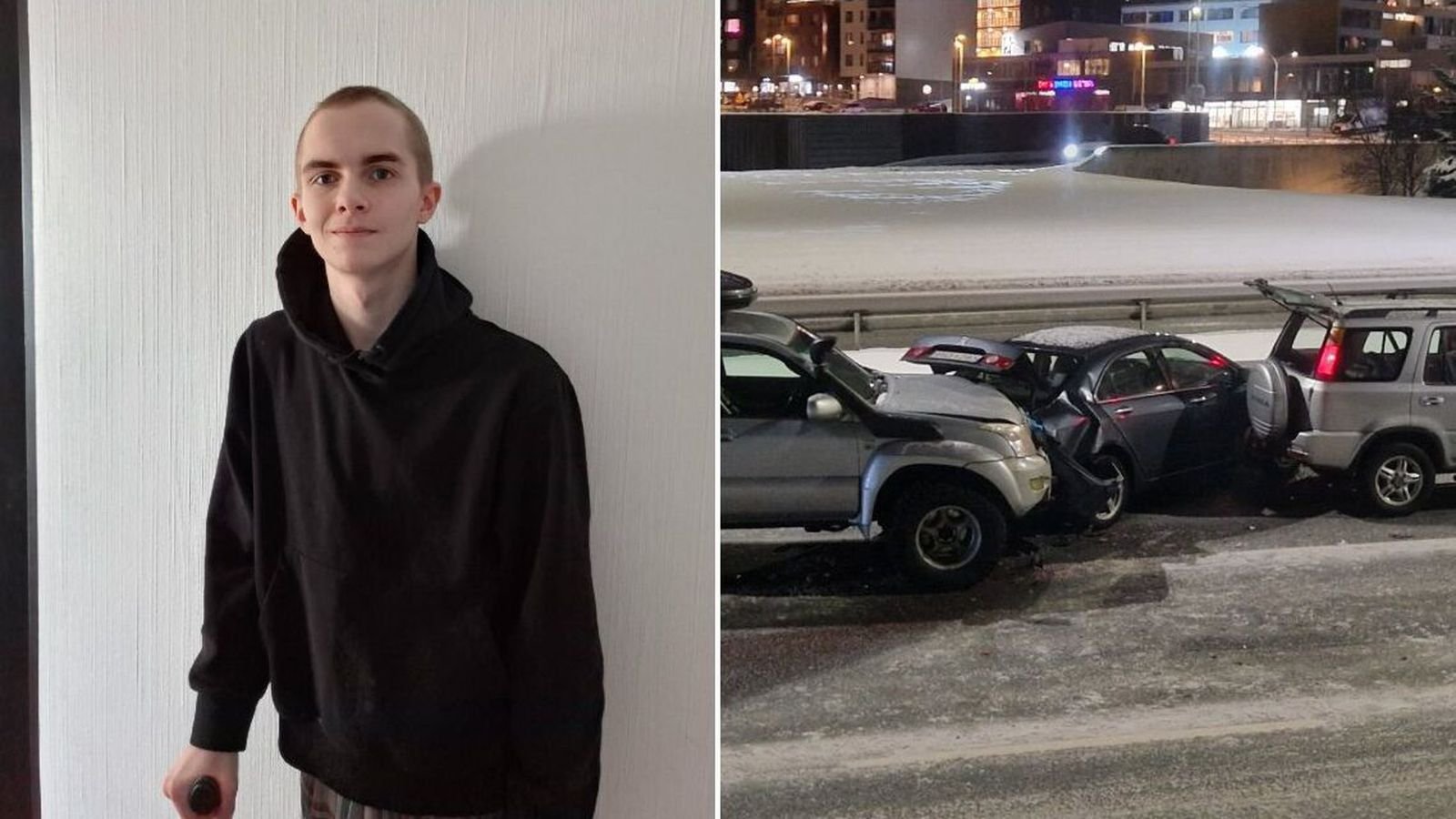
“I had just dropped my sister down in the center of Reykjavík and was on my way to Hafnarfjörður when I saw a car with its hazard lights out on the left side. Then I decided to stop my car and help the drivers who had blown a tire,” begins Finn’s story, but the sequence of events took a sharp U-turn when a collision occurred where a jeep ran into the back of the two cars.
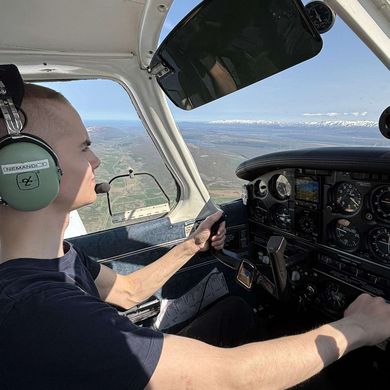
“I don’t think it’s a problem to help people and I’m used to repairing cars myself. So I immediately went to find a jack and when another kind stopped and offered to help, I said I could just take care of this,” says Finnur, but before the accident he was heading to the flight school.
Hit the car
Finn, who was standing outside the cars when the collision happened, was thrown a full six meters and then landed hard on the ground.
“When the car hit me, it drove into the right side of my body, which ended up breaking the right hip, thigh and tibia in five different places, the femur was completely broken in two and the fracture on the tibia was open,” says Finnur.
At this point, he has to take a break from the conversation with the reporter, too pained to continue for now. He says he always feels pain.
Was conscious the whole time
The injuries were serious, Finn broke his right leg multiple times when he landed on the hard asphalt, and among the injuries was an open fracture of the tibia. The right femur and pelvis were also broken, but the urethra was torn and Finn has had to wear a urinary catheter since the accident.
He was taken as soon as possible to the emergency department of Landspítal, but he was there for almost a month. Finn was completely bruised and bruised all over his back, but in reality it might have gone a little better than expected.
“I was awake the whole time, when I was lying there on the ground. When I tried to move the lower part of my body, nothing happened,” Finnur says, explaining that his left leg came out of the accident much better than he thought at that moment that he had been paralyzed.

“But it must be the case that when the hip breaks so badly, you can’t move your legs. I was still conscious and could say my social security number, my name and who the next of kin were,” Finnur says, but he is still in rehabilitation and will soon undergo his seventh operation since the accident.
Can no longer walk unsupported
He was transferred from the accident department to the rehabilitation department of Landspítal in Grensás.
For a while, Finn could only walk by leaning entirely on a walker.
“The urethra and the urethra meant that I couldn’t put any weight on my legs, or only about five kilos, so I had to use a walker to be able to walk around,” says Finnur, recalling that before the accident he went for walks almost every day with his dog, the schnauzer Svala.
Finn grew up in Sauðárkrók and graduated last year from an electrical engineering course at the Polytechnic School of Norðurland Vestra. Today Finn is not able to work like he used to.
The consequences of many kinds
He still cannot sit normally and has repeatedly had infections from the use of the catheter. Stones have formed in the urine that blocked the urethra. The open fracture also had repercussions, but he got an infection and ended up having to take antibiotics. Skin was taken from the thigh and used to close the fracture.
“I’m with a physical therapist now, but the amount of exercise I can do until the catheter is removed is limited. That should hopefully happen in May. But nails were put in the femur and the shin because a cast wouldn’t have been enough. Hopefully the nails will be removed next spring,” Finnur says, and says that he died significantly and today weighs 49 kilos.
He is on strong pain medication, which he says has caused him to have bad dreams, but every now and then he gets chills thinking about the trauma.
His mental health has been getting worse, but he has only recently started to sleep well and has started to exercise sensibly.
Should make a full recovery
“I should be able to move fully in about a year, but I’ve had six operations so far and have one more to go. Most of them were such that I was sedated,” says Finnur, but this young man’s medical history is quite unusual and he has been admitted to the intensive care unit a total of four times.
“A week before the accident, I was finally recovering from an infection in the larynx, and a year before, on my discharge day, I was admitted to the intensive care unit because I got sepsis, a life-threatening blood infection,” says Finnur. He has therefore had his share of mishaps and hopes that it will subside.
“I would like to get my story out there so that people realize that life can be taken away from them,” says Finnur and reiterates that the accidents do not stop him.