A retired couple from the countryside, from the extreme north of Romania, became known all over the world with an unusual passion: they recreate, with a lot of work and skill, the world of the traditional Romanian village, with the help of dolls made with a great sense of humor.

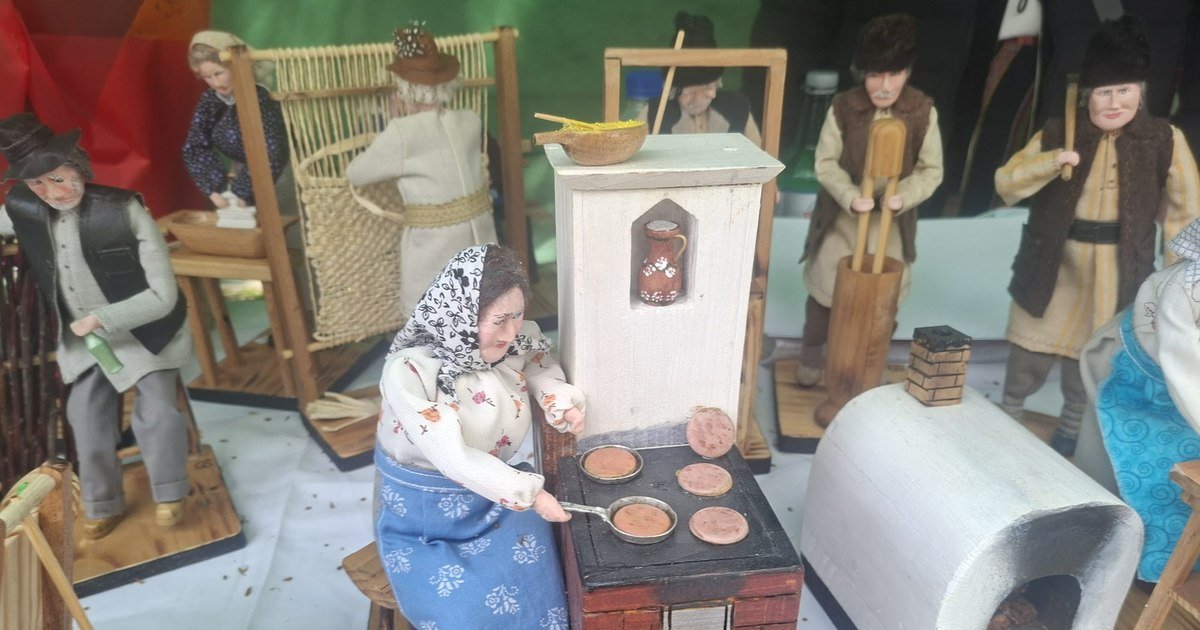
A part of the village world imagined by the Silion couple PHOTO Cosmin Zamfirache
The housewife baking pies in the oven, the peasant making baskets from reeds, the weaver making mats, a priest confessing a parishioner and even the village drunkard, holding on to the firewood. All these typical characters of the Romanian village inspired a retired couple from the north of Moldova to occupy their time in the cold winter evenings. More precisely, the two began to make all kinds of dolls, initially only from textile material, embodying different funny characters from the Moldovan countryside. It wasn’t long before the cure for boredom became a full-fledged passion. The half hour or, at most, the hour dedicated to making the dolls turned into hours, days, weeks of hard work. This is how the “Motherhood of the Puppets” was born, in Tocileniul Botoșanilor, a unique workshop where more interesting, funny characters are born and who have managed to conquer people from three continents. From distant Asia to North America. In short, the Moldovan rural world, transposed into masterfully crafted dolls, ended up conquering the world map.
“Doll motherhood”, a unique phenomenon born of passion
Dumitru and Georgeta Silion are two apparently ordinary pensioners from Tocileni village, Stăuceni commune, Botoșani county. Two householders, Dumitru, former foreman at a factory in Botoșani, and Georgeta, former textile worker at a local company. After retiring 13 years ago, the Silions thought about filling their spare time. Georgeta in particular decided to dedicate herself to a craft practiced especially by her mother: braiding, weaving and, in general, working with textiles. In order to bring joy to the children in the family, she started making dolls from textile materials, especially the traditional ones. Working almost every day, with more and more passion, Georgeta Silion perfected herself, and her dolls were noticed by the specialists from the County Center for Conservation and Valorization of Tradition and Popular Creation from Botoșani, an institution subordinate to the County Council, which deals with just such a thing, the promotion and preservation of traditional culture. The dolls of Botošanen particularly impressed by the mastery of the execution, the fascinating details, but also the dose of humor in certain creations.

The figurines made by the Silion couple PHOTO Cosmin Zamfirache
Last but not least, the dolls were reminiscent of the creations of entire generations of rural women who wanted to please their children or amuse their neighbors. “The idea came out of a joke, sort of. We started in 2012 or 2013. My wife made some baby dolls. And someone at the Creative Center saw them and thought they were interesting. And they asked me, ‘Who makes them?’ And I told them that my wife. They contacted her and told her that the papers were interesting, but she should focus on a specific theme. And I chose the village life, because it is a world so familiar to us and so dear. Especially the life of the traditional village in our area”says Dumitru Silion.
And so many jewels of traditional art began to be born. Practically, a room in the house was transformed into Georgeta’s workshop, a place called, also in the spirit of the Romanian peasant, “Maternity of the dolls”.

Georgeta and Dumitru Silion PHOTO Cosmin Zamfirache
The main source of inspiration was even the rural world and its typical characters: the priest, the farrier, the carpenter, the teacher, the housewives, the street gossips, but also the village drunkard. A village world in all its splendor. What the Silions make is called traditional miniatures. “Our characters are inspired by peasant life. They are traditional miniatures. We seek to be as authentic as possible, as port, as attitude, as posture”confesses Dumitru Silion.
Work in tandem on “Doll Maternity”
The two spouses work together on each figurine. Passion gripped both of them and they end up spending days in the workshop. Dumitru takes care of the skeleton of the character, made of wire and clothed, but also of the wooden accessories. Georgeta is the one who gives expression to the character and makes his clothes. “On a character, my wife works for about two days. I do about a day. In total, about three days for a figure. I make the wire skeleton part, clothed in fabric, and then when I present it to my wife in her workshop, that’s where the clothes are made. Afterwards, she comes back to my workshop and I make her the stand, the arranged position, the posture that has to represent the character”adds Dumitru. It is extremely painstaking work that requires special talent and patience.

Dumitru works on the structure of the doll PHOTO Cosmin Zamfirache
Georgeta creates clothes and expressions for her figurines with incredible precision, including tiny accessories planted on the tip of a needle. He says passion is the key. When she reaches the workshop, she forgets the notion of time and actually immerses herself in the world of her dolls. “It’s a joy! What I do fills my soul. I go to the workshop in the afternoon and forget to leave, I love making these dolls so much. Working, I’ve perfected myself, because I didn’t start like that all of a sudden”confesses Georgeta.
She inherited her talent and patience from her mother, also very skilled at making traditional objects from textile materials. “I’ve been talented at this kind of thing since I was little, but until now I didn’t get to dedicate myself to this passion, because it was work, family, responsibilities. I inherit the talent from my mother, but no one in my family has done something like this before, and I didn’t think I would do something like this either.”adds the Botošaneanca.
From Tocileni all over the world
At the “Motherhood of the Dolls” in Tocileni, figurines were born that represent, with fantastic accuracy, priests who confess, craftsmen who make barrels, peasants who beat the piua, housewives who make pies in the oven, country mothers, fishermen, blacksmiths, weavers, basket makers, carpenters, the country teacher, but also the inevitable drunk on the street. Some characters are made with a great sense of humor, especially those haunted by vices and passions. For example, the fallen drunkard is picked up by the wife with a rolling pin in her hand.
All figurines are unique. “We don’t work serially, I don’t do this for money, I do it for passion. I’m not making a fortune at my age”adds Georgeta Silion. However, Silion’s traditional figurines or dolls are a sensation at craft fairs or traditional art exhibitions from all over the country.
Exhibition of traditional Transylvanian crafts, internationally awarded with the Oscar of design

The dolls exhibited by the Silion couple PHOTO Cosmin Zamfirache
“They are absolutely fabulous. I sit and admire them for minutes. I don’t know which one I want, but I definitely want one. I’m amazed at the details”says a woman from Botošan who saw them on display at the last fair of folk craftsmen at the end of this month. Many want them for personal collections. Most figurines, however, take the path of foreignness. They are famous all over the globe. They reached the United States, Korea, Japan, Canada or South American countries. We are not talking about the European states.

Part of the figurines of the Silion couple PHOTO Cosmin Zamfirache
“They are also sought after in the country, but especially abroad. Most of our works go abroad. All those who buy from us tell me that they end up in China, in Korea, in North America, in Japan. They have reached almost all continents. They are very appreciated. There are Romanians who go abroad and take figurines there”confesses Dumitru Silion. Unfortunately, the two spouses lack education. Although they organized all kinds of workshops for children, precisely to have someone to pass on the craft, the two villagers say that the new generation no longer has the necessary patience. “They don’t have patience anymore. I had sitters with the kids, but they don’t have patience anymore. If 1% of them like it… It’s hard, it’s very hard, I tell myself”also specifies Georgeta Silion.