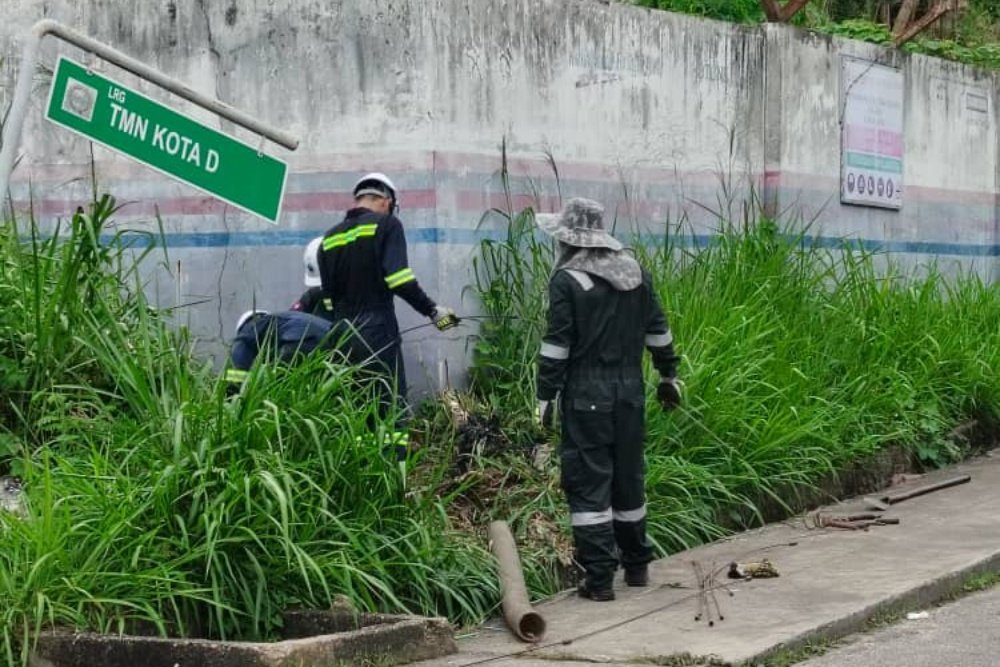

File photo of JPPS Keningau workers carry out repairs to fix the clogged sewerage system in Taman Kota.

EVERY year, speeches are delivered in recognition of workers’ dignity in their work on Labour Day. Nevertheless, there is still something else to consider, yet it seems to go unnoticed by everyone: What is going to happen tomorrow?
What makes the current work? It is planned for tomorrow.
In logistics, planning is a must. It does not matter whether it is about governance at the Port Authority, crane operators from Sepanggar, cargo handlers from Sandakan, or any drivers and ship planners from the rest of the world; all logistics processes consist of one system operating effectively if each part performs its job properly.
Nevertheless, while those port workers are so badly needed, what preparations were made for the future?
Certainly, taking care of labourers does not mean only providing wages, benefits, and bonuses. Even though money is important, proper care of labourers should include offering an opportunity. A company should provide a chance for learning some new skills, getting exposure to advanced technologies, preparing labourers for increased workload and responsibilities, and preventing the loss of the accumulated knowledge with the retirement of experienced staff members.
This is the reason why the technique of succession planning is of crucial importance. Succession planning is the way to transfer experience, develop capabilities, and achieve continuity. Otherwise, an organisation risks becoming excessively dependent on several people and faces critical gaps with their departure.
Succession planning provides for a transfer of knowledge and prevents its isolation within senior-level positions. Succession planning creates a path for development and provides for early identification and preparation of second liners, exposing them to opportunities and testing their skills and capabilities.
Moreover, succession planning increases an organisation’s capacity. Any organisation with an adequate succession plan is able not only to respond to changes but also to be proactive and prepared for them. Successions of leadership become occasions for renewal, while business operations remain uninterrupted due to the involvement of successors ready to take responsibility.
Overall, succession planning is more than just substitution. It is a demonstration of leadership, vision, and long-term orientation. This approach creates a positive workplace environment that is dynamic, forward-looking, and inclusive, where experience is shared, potential is developed, and readiness of the future leaders is ensured.
Succession planning requires some effort. It should be driven. The following statement might appear somewhat discouraging, but……
Unfortunately, not so many organisations do follow the principles of development of their labourers. Training sessions are organised only once; a person appointed as the second in command has not been adequately prepared for the job; exposure and mentoring are lacking, and potential is not discovered.
Such neglect of workers’ development rests squarely with leadership—including the Board of Directors and the General Manager or CEO and the latter carry the heaviest blame.
For example, a port’s General Manager should not confine himself merely to governance (kawal selia), or to overseeing vessel berthing and cargo operations. He also bears the responsibility of preparing capable successors to assume his role in the future. Did he do it on purpose? Any neglect of this duty is not a minor oversight, but a failure of leadership—and a clear shortfall against his key performance indicators (KPIs).
Therefore, addressing the following question: Why is there no successor in the organisation? Is it a result of the insufficient potential of labourers or negligence of leadership?
The conclusion could be reached equally: regardless of the reason for this problem, its effect will be the same – a lack of continuity and excessive dependence on labour will be created.
The situation in Sabah is even worse since the logistics network includes ports situated in Sepanggar Bay, Sandakan, Lahad Datu, Kudat and Tawau. It is necessary to understand that success is achieved not only due to the technical equipment of the facility; labourers’ knowledge and skills are also vital. However, while logistics networks rely on labourers’ efforts and devotion, their further development is neglected. Hence, not only are labourers ignored, but the very basis of the economy is weakened.
After all, the success of Sabah’s ports will not depend solely on cranes and vessels, but equally on the adoption of cutting-edge technology — and, crucially, on the preparation of the next generation of leaders. To neglect this would be a costly mistake. Gratitude to today’s workers, while important, is not enough; we must also invest in shaping the workforce of tomorrow. Workers sustain the present, but it is the duty of sound leadership to secure the future.
In Sabah, honoring the dignity of labor cannot only mean recognition but also safeguarding its history.
Logistically speaking, taking care of labor means ensuring its sustainability, safeguarding its dignity, and preparing its future.