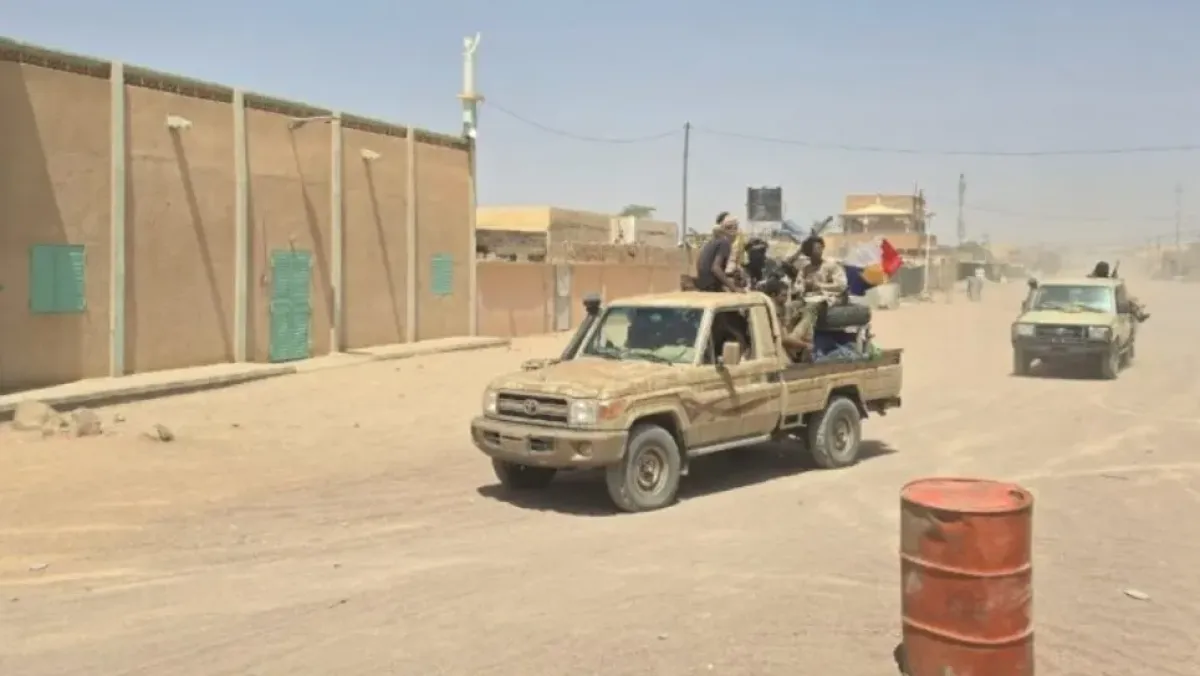
This vast country, which includes about 26 million people, already ranks high in the Fragility Index (FSI), as it is in the “red box” and among the 15 most failed countries in the world. Its development status is also very low, as it ranks 188 out of 193 on the HDI. Moreover, the country is located within the Sahel belt, where there are several countries facing the difficulties of geography (landlocked areas, the repercussions of climate change, etc.) and the common causes of coups, division, poverty, and external polarization.
With the recent intensification of coordinated strikes by groups opposed to the ruling military junta in Bamako, the country is facing the scenario of the center falling into the hands of these groups, especially the Azawad group, and thus it will turn into a version similar, to some extent, to Afghanistan. Perhaps Mali will be worse off, as its armed groups are different in ethnicity, ideology, and allegiance, unlike the Taliban, which is harmonious with – and largely accepted by – the Afghan people, and which over the past few years has shown signs of its ability to advance the country after the departure of the Americans.
The other outlook concerns the survival of the center, in the hands of the military, but isolated and weak, with armed groups controlling vast areas, and thus the country may be a copy similar to Somalia. In other words, Mali may turn into Afghanistan if the government falls, or into Somalia if it remains fragile as it is now.
In both cases, the ruling military junta will be the loser, along with the “Russian Legion” that replaced the “Wagner Group” and which is directly under Moscow’s direction. The Russians who came to the country after the expulsion of the French and international forces, under a deal stating “protection in exchange for money and wealth,” are now questioning and questioning their role.
Specialized reports say that the failure of the Russians in the north (Kidal) will make other “coastal” countries (Burkina Faso, Central Africa, etc.) wonder about the feasibility of also using the services of this “corps” in exchange for money and mineral wealth. For reference, Mali pays Russian mercenaries between 10 million and 20 million per month, and the total amount it has paid since 2021 has reached about 900 million dollars, according to international reports.
The logical choice for the rulers of Bamako, if they want to survive in the country, is to search for regional solutions instead of seeking help from distant powers that history has proven have neither defeated an opponent nor protected an ally.
Algeria stands out on the scene, capable of helping in several areas that go beyond the security and economic dimensions. Algeria, which has religious commonality and geographical attachment, is a moderate international power in the region. It can achieve what major international powers from outside it cannot achieve.
The global transformations themselves make the logic and effectiveness of the “Algerian solution” more likely, as the international trend now supports the efforts of the middle powers (through intervention and mediation to resolve conflicts, assistance in multilateral action, etc.) more than relying on the roles of the major powers.
Algeria, with its official rise to the ranks of middle international powers, has the desire, vision and ability to accompany its southern neighbor towards safety, unlike the countries that came to the region by surprise with strange and impractical plans and agendas. Perhaps the irony here lies in the fact that Mali and its “coastal” neighbors removed an old colonial power (France) and replaced it with a new, failed one (Russian mercenaries).
Conclusion: Mali is a weak country and has become even more weak after the military coup and the use of distant foreign protection. The logical solution, and perhaps the only one, is to return to civilian rule first and to its regional environment in search of cooperation, support and accompaniment second.