POSADAS. In anticipation of high political tension and strong economic impact, the governor of Misiones, Hugo Passalacquaannounced the end of the mechanism for advance collection of Gross Revenues known as “Parallel Customs.”
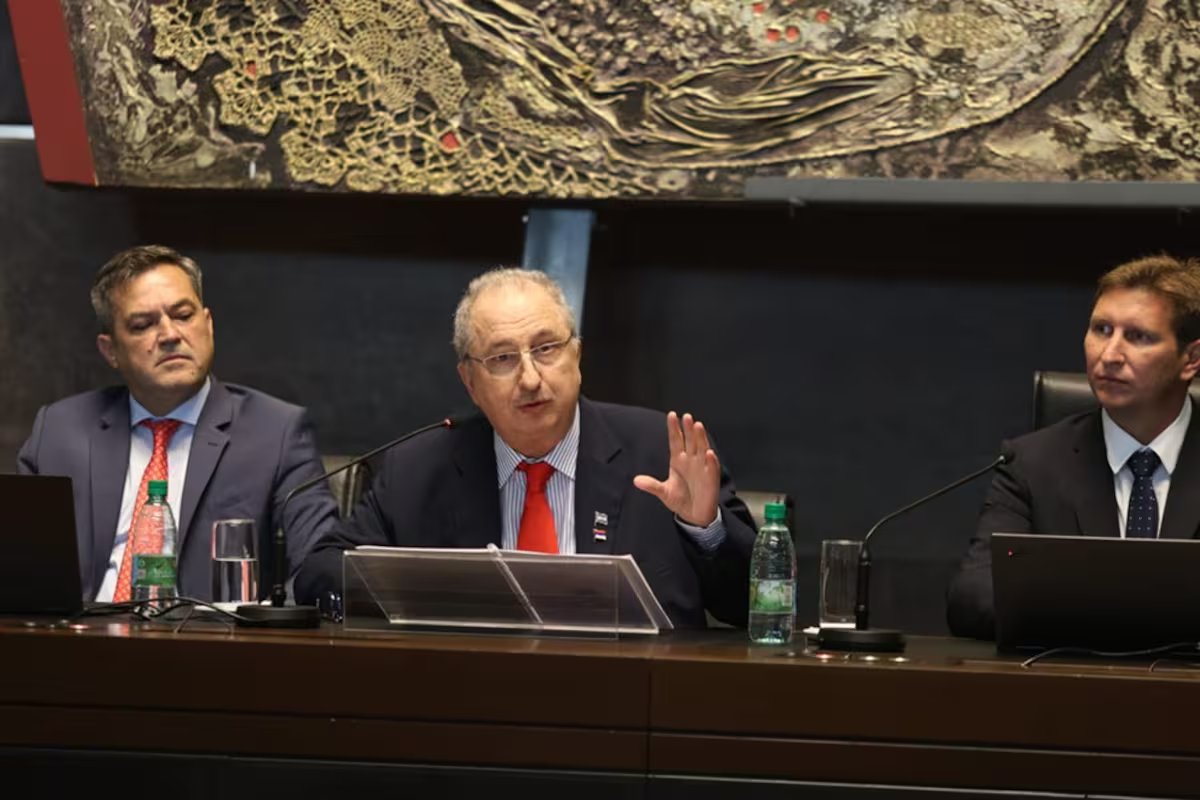
It was this morning, during the opening speech of the 54th regular session of the Legislature, when Passalacqua surprised everyone and everyone with the boldest measure in his two terms as governor.
“There will be no more charges of any kind at the access control posts to Misiones“, leaving them only for verification of documentation,” he stressed, under the watchful eye of legislators, the entire cabinet, mayors and the judges of the Superior Court.
Misiones is considered one of the most aggressive provinces in retaining Gross Income advances, and its control and collection system through enormous posts located on the border with Corrientes, on RN12, RN14 and RN2, They resemble a Customs between countries.
The elimination of these charges is a measure that has been long requested by business circles, firms outside the area and also by the political opposition for years. Lately, LLA-Misiones took it as one of its great flags.
But Passalacqua took the initiative and anticipated everyone, leaving the libertarians without a project that they intended to bring to the venue next Thursday, when the regular sessions begin.
“To confront with concrete facts the crisis caused by the economic contraction, I instructed the Minister of Finance to suspend the payment on account of the fiscal control in Ruta from July 1 and for a period of 12 months, in the first instance,” said Passalacqua.
As LA NACIÓN learned from official sources, The Government of Misiones will carry out a fiscal and political evaluation to decide in 2027 if the measure is forever. It could even contemplate the demolition of the enormous posts, in an act of high symbolic impact.
Automatically, starting July 1, some 16,500 SMEs will enter merchandise into Misiones without paying, while 873 large companies will pay the advance digitally, preparing shipments to the red land.
This controversial charging system started in 2011 and generated multiple lawsuits that reached the Supreme Court of Justice, with rulings against it. There were also large companies that stopped selling to Misiones, or threatened their clients in the province with stopping supplying them, given the succulent “balances in favor” accumulated, in part due to this aggressive collection system.
On the other hand, there were other provinces, such as Jujuy, that came to study it due to its effectiveness in collecting revenue.
No other province charges IIBB advances to trucks, But it is also true that Misiones has geographical advantages to practice this control, unique, since it has a small border with the rest of the country, and the rest is all borders with Paraguay and Brazil.
“95% of the taxpayer registry is excluded from this payment on account, the remaining 873 large companies that are included will make the payment on account in a global, digital, monthly and simplified manner, which will mean savings in administrative expenses, also streamlining entry traffic to the province,” Passalacqua explained.
Passalaqua’s announcement generated favorable reactions from the oppositionand left members of the ruling party rather perplexed, surprised by the impact of the measure. And because no one knew for sure what the political leader thought, Carlos Roviraabout it.
In Misiones, almost all figures in the ruling party have a reverential fear of publicly saying something that goes against the guidelines that Rovira sets out.
As LA NACIÓN learned, the initiative for the measure was taken by Passalacqua himself and he worked on it technically together with the Minister of Finance, Adolfo Safran.
However, Safrán publicly downplayed some of its importance by stating today that it would not have a very significant fiscal impact, but it will serve to demonstrate that the problem is not Customs (sic), “that is not the solution to the economic problems of Misiones.”
A month ago, the head of LLA-Misiones, Adrian Nunezwho is also vice president of the Legislature, proposed precisely eliminating this so-called “Parallel Customs” as one of the two strong bills with which he intends to take over the legislative agenda of the year that started today. The other is to repeal the Motto Law.
“Relief is necessary, but there is still much to do. That the governor has made that decision matters for the success of Javier Milei’s policy and his liberal policy and that is why Freedom Advances in Misiones,” Nuñez told LA NACIÓN.
Nuñez will promote a project to drastically reduce the “favorable balances” of Gross Income that Misiones accumulates with its taxpayers.
This province is, by far, the one that should return the most money to provincial tax payers for this concept.
According to a study by the Córdoba Revenue Directorate, two years ago Misiones accumulated the equivalent of 14 months of IIBB collection in “favorable balances”, while the rest of the provinces and CABA only had between 2 and 4 months.
“Now the libertarians are going to hang the medal on themselves,” he told LA NACIÓN, Héctor “Cacho” Bárbaroprovincial deputy and leader of PAYS, the party that most attacks libertarian policies in Misiones.
“I am in favor, it seems to me that it is one of the things that the Government had to review, very good timing by Passalacqua for the announcement,” said the former governor. Maurice Closswho has been asking for several fundamental changes to what he calls “sacred cows” of the Renewal.
But beyond the reactions of the opposition, what became evident on the day is that Rovira, the top leader of the ruling party, did not celebrate Passalacqua’s measure or publicly support it. As LA NACIÓN was able to find out, it was not a measure promoted by him.
Rovira has politically controlled Misiones for almost a quarter of a century, and during the mandates of Oscar Herrera Ahuad and Passalacqua (between 2015 and today), strong decisions like today’s were always made by him, in person, while the leaders were the executors and managers.
After the event, Rovira and Passalacqua did not appear together and both came out to greet separately the political groups of the renewal apparatus in Posadas, which were mobilized to gather at the door of the Legislature.
The Renewal was relaunched three weeks ago by Rovira, who changed its name after more than two decades to “Missionary Encounter”, in a new attempt to avoid the fatigue of an important part of the electorate.
In that conclave, Passalacqua nor figures close to him were invited, Rovira did not praise him even once and criticized him twice. Also, he ordered to reverse the dissolution of MisioPharma SE, a state firm created in the pandemic to produce Cannabis oil.
Passalacqua had announced days before that it would buy this input for public hospitals from third parties instead of producing them at a higher cost, saving money. But Rovira came out to tell his troops that it was necessary to “conserve the institutions of the State” in times of lean times, to relaunch them when the treasury had resources again.
Days later, the MisioPharma Shareholders’ Assembly, made up of officials, reversed the dissolution that the governor had ordered by Decree.
In political circles they take it for granted that Hugo Passalacqua, enabled by the Constitution, wants to be re-elected in 2027, something that does not convince Rovira.
Passalacqua, who is 68 years old, would thus become the only missionary to be governor three times, if he is successful at the polls.