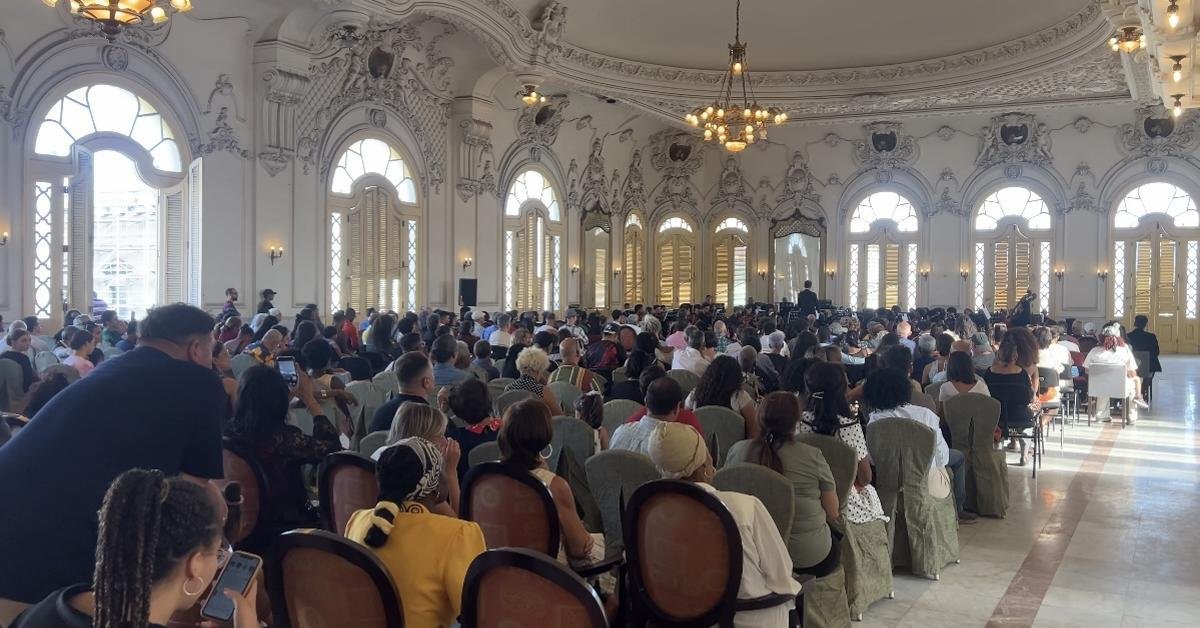
Havana/“The theater area is completely dismantled.” The phrase is said, almost in a low voice, by a veteran spectator who attended the concert for the 188th anniversary of the Gran Teatro de La Habana Alicia Alonso. He has returned to this building again and again for decades and now walks through it with a mixture of resignation and disenchantment. Together with him, this newspaper managed to enter the theater and see how one of the most beautiful buildings in the country turns, little by little, into ruins.
Piled up seats, scaffolding up to the ceiling, canvas covering delicate moldings, broken doors, boxes, construction materials and areas of the ceiling detached in the middle of a coliseum that was an emblem of the city and that today exhibits, without makeup, the wear and tear of a failed restoration.
The grand imperial staircase and the dome of the central lobby still preserve that dazzling effect that made the building one of the jewels of Havana architecture. Just enter and look up to understand why for decades this building was much more than a cultural headquarters. But the splendor is short-lived. As soon as you move towards other areas, the image changes. The eye encounters cracks, damp stains, broken carpentry, open false ceilings, damaged plasterwork and a general air of provisionality that seems to have established itself as the norm.

/ 14ymedio
“You can see that it takes and will take time to finish it,” says the man as he walks through various spaces. He has come to the anniversary concert, but he speaks as if he were also attending a wake. The show takes place in one of the enabled areas of the building, far from the Federico García Lorca Room, still occupied by the restoration. The function takes place in the area of the old Galician Center, the left wing of the complex, today used as a space for events and socialization, where some rooms still survive in better condition. “The building is commemorated while the building falls apart,” he confesses in a low voice.
The gala, designed to exalt the tradition of the coliseum, brings together the Grand Theater Symphony Orchestra, the National Lyric Theater and its choir, the Spanish Ballet of Cuba and Lizt Alfonso Dance Cuba. The program links fragments of Cecilia Valdes, Luisa Fernanda, The port tavern, Swan Lake, Nabucco, Maria the O and The mischief. On paper, everything refers to the musical and scenic lineage of the theater. In practice, this tribute takes place a few meters from a main room invaded by scaffolding, removed seats and signs of deterioration that are impossible to conceal.
/ 14ymedio
While music plays in one part of the building to celebrate its history, in the other a metallic jungle accumulates. Where once the boxes, the stage box and the mouth of the stage ruled, the tubular structures, the protective covers and the gloom of a restoration with no visible completion date now dominate.
The deterioration is not limited to the main premises. In another area, this newspaper found seats removed and stacked, as if the theater had been disassembled into parts. The same sensation is repeated in the corridors and halls. “I only see two people working. The rest are theater staff,” comments the companion of 14ymedio. Rather than an intensive intervention, what is perceived is a slow, fragmentary repair, without the pulse of a prioritized work.
/ 14ymedio
Before being the Gran Teatro de La Habana Alicia Alonso, this complex was part of the old Centro Gallego and, even further back, heir to the legendary Teatro Tacón, inaugurated in 1838 in that same urban enclave. The current social palace, designed by the Belgian architect Paul Belau and inaugurated in 1915, was built in a neo-baroque style, with a profusion of columns, balustrades, allegorical sculptures, arches, curved pediments, plasterwork and a monumental composition that dialogues with the Central Park and the Paseo del Prado. Throughout the 20th century, the building changed its name and functions until it became one of the great centers of the performing arts in Cuba.
The main room, today called Federico García Lorca, is the direct heir to the old Tacón and the most emblematic space of the complex. Over time, other rooms and rooms were added: the Ernesto Lecuona, the Lezama Lima, the Bola de Nieve, the Alejo Carpentier, as well as galleries, rehearsal areas, conference rooms and exhibition spaces. “It was a small show town,” says the veteran spectator. Since 1985, at the initiative of Alicia Alonso, the group was renamed Gran Teatro de La Habana, and in 2015 it officially added the name of the dancer, who died four years later.
/ 14ymedio
That’s why what we see today hurts more. Because the ruin does not affect just any building, but rather one of the few Havana buildings where Republican pomp, colonial memory and the cultural liturgy of Castroism came to coexist under the same decoration of stucco, marble and glass. A few meters from a still majestic dome on the ceremonial staircase, there are exterior doors defeated by the sun and the weather, deformed shutters, walls with detachments, fine cracks coming down from the ceiling and areas where the false ceiling has given way and exposes the insides of the building.
The last major intervention on the property concluded in 2015 and was presented in January 2016 as a major restoration. “That restoration was rubbish,” the viewer says with a crudeness that needs no embellishment. And he adds: “The theater boards were poisoned, and they received them in the same way.” Less than a decade after that triumphant reopening, the Grand Theater once again closed its main hall and began construction.
/ 14ymedio
“There is also the Alicia Alonso museum, which has not yet been inaugurated. It appears that it has been completed a long time ago, and is collecting the dust of the century,” adds the companion. In Cuba there are many works announced with great fanfare, but unfinished. The strange thing would be for a museum space to be ready and open in a timely manner. In the Grand Theater, that room of abandonment coexists with portraits of the diva, boxes of equipment and a feeling of postponed sanctuary.
The decay of the property is too similar to that of the country. As long as Alicia Alonso lived, her name functioned as leverage, protection, and budget argument. With the legend dead, the theater has retained its last name and its privileges have gone. “The restoration is going very slowly for a variety of reasons. Bad work, lack of resources, personnel, interest, the crisis, and a long etcetera,” summarizes the man.