According to the results of the first quarter of 2026, the real growth of total income of the population in Uzbekistan was 7.8 percent, and the real growth of per capita income was 5.8 percent. In terms of regions, the largest increase was recorded in the city of Tashkent – 10.3 percent. As a result, the difference in income between the capital and Namangan region, where the lowest indicator was observed, increased by 4 times.
According to the results of the first quarter of 2026, the total income of the population of Uzbekistan reached 263.2 trillion soums. About this in the report of the National Statistics Committee cited.
In January-March, the nominal growth of the population’s income was 15.5 percent, and the real growth rate was 7.8 percent. In the corresponding period of last year, this indicator is 20.9 and 9.8 percent, respectively was.
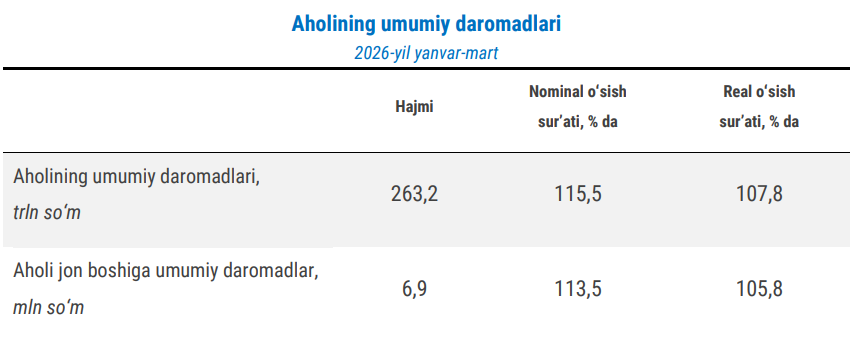
Total incomes per capita increased by 13.5% in nominal terms (18.5% in the corresponding period of 2025), and by 5.8% (7.6%) in real terms. As a result, the average income per capita during the reporting period was 6.9 million soums (5.9 million soums).
In terms of regions, the highest growth of incomes was recorded in the city of Tashkent (+10.3 percent), Navoi region (+8.9 percent) and the Republic of Karakalpakstan (+6.9 percent). In the capital and 3 regions (Navoi, Bukhara, Tashkent), the total income per capita was higher than the average indicator in the republic.
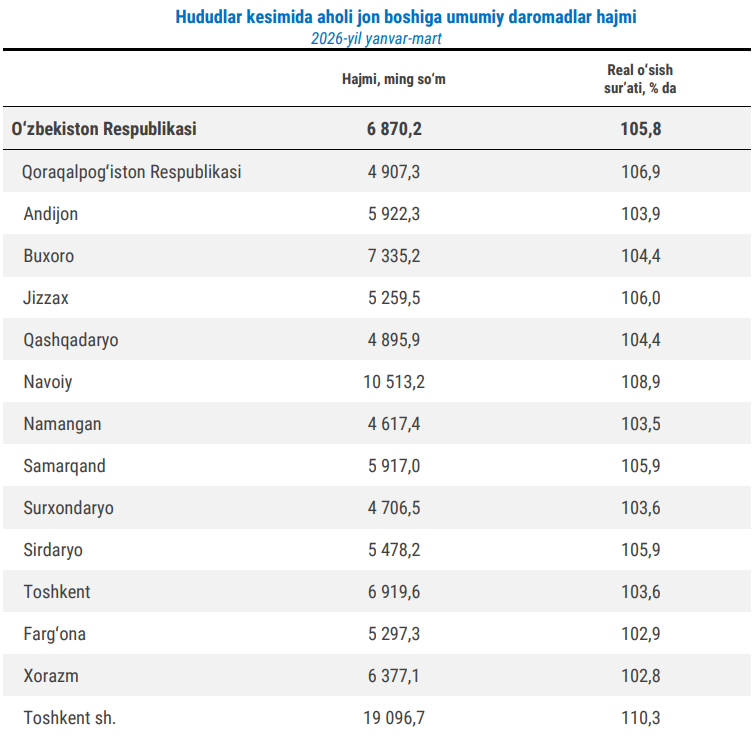
The lowest indicators in this regard were recorded in Namangan (4 million 617 thousand soums), Surkhandarya (4 million 706 thousand soums) and Kashkadarya (4 million 896 thousand soums) regions.
Revenue growth across regions
from 2018 Until 2025 – 7 years inside Total income per capita in Tashkent is nominal 4.5 times or increased from 16.2 million soums to 73.9 million soums. During this period, no other region of the republic saw a 4-fold increase. The best indicator after the capital was recorded in Fergana regions – 3.6 times. The smallest increase was observed in Jizzakh region – 2.9 times. According to the results of the first quarter of 2026, the difference in income in the capital and Namangan 4.13 times is organizing.
According to the calculations of economist Mirkomil Kholboyev according tocompared to the first quarter of 2021, the region with the highest relative impoverishment compared to the capital was Navoi region. In 2021, the total income of the average Navoi was 68.9% of the total income of the average Tashkent resident, and by 2026, this figure has decreased to 55.1% (13.6% reduction).
Also, in the regions of Tashkent (decrease in the share of income by 11.5 percent), Jizzakh (-8.9 percent), Syrdarya (-8.6 percent), and Bukhara (-8.5 percent), the relative decrease in income compared to the capital was the highest.
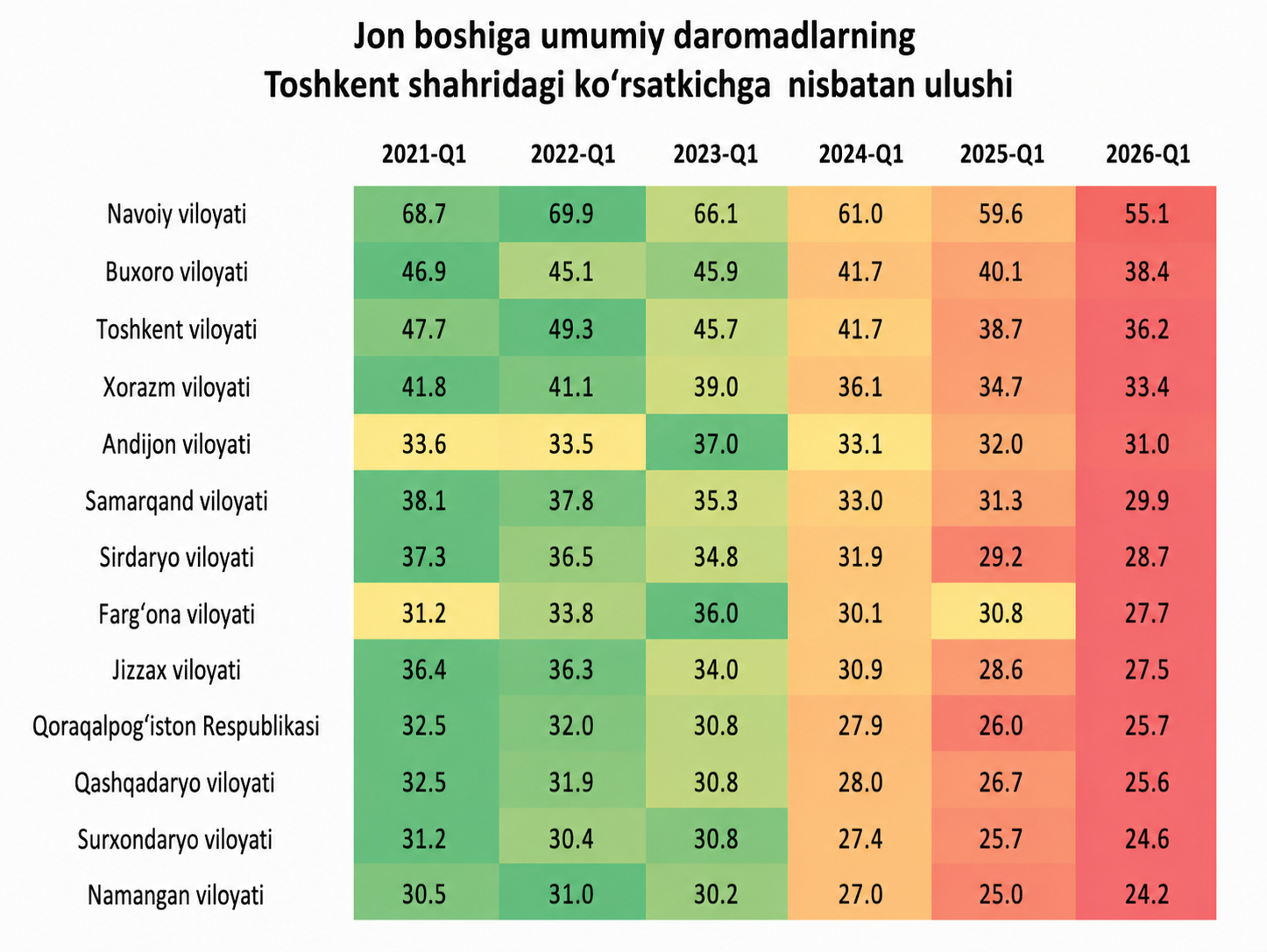
“Interestingly, during this period, none of the regions became relatively richer compared to Tashkent (that is, the share of income did not increase). That is, incomes in the capital are constantly growing higher than in other regions. This situation can be explained by the high growth in the service sector,” noted the economist.
The composition of the total income of the population
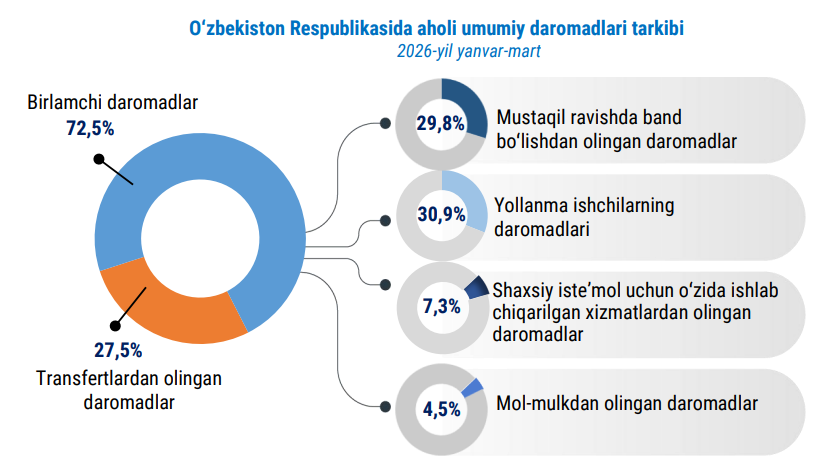
During the reporting period, a large part of the total income of the population was the income of hired workers – 30.9 percent. Also, incomes from self-employment (29.8 percent) and incomes from transfers (27.5 percent) occupy a significant share.
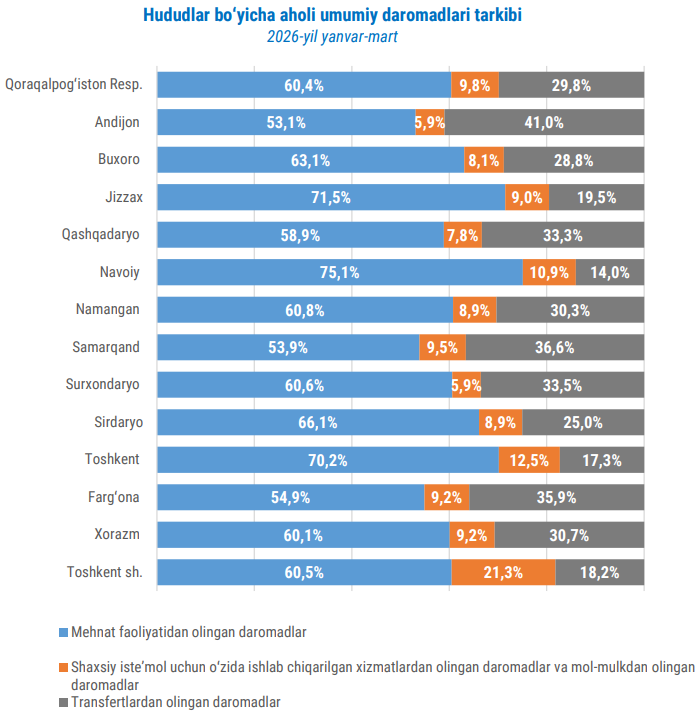
The share of income received from transfers in Fergana (35.9 percent), Samarkand (36.6 percent) and Andijan regions (41 percent) was higher than 35 percent of the total income of the population, while the share of this type of income was the lowest in Navoi region – 14 percent.
In particular, the share of remittances from abroad in the total income of the population was 17.5 percent.
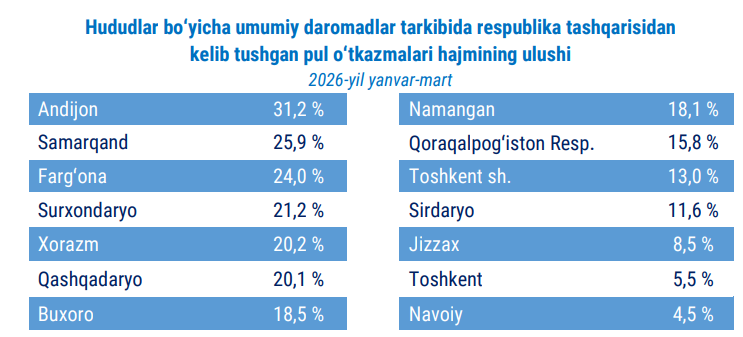
The greatest dependence on money transfers was observed in Andijan (31.2 percent), Samarkand (25.9 percent) and Fergana (24 percent) regions.