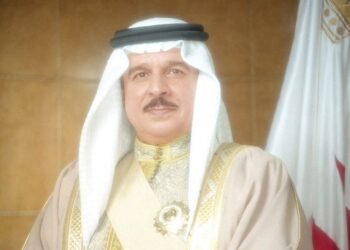
In moments of major crises, the strength of states is revealed, the resilience of peoples is tested, and positions are revealed with clarity that does not lend itself to interpretation. In this context, the speech of His Majesty King Hamad bin Isa Al Khalifa, King of the country, may God protect him, came to put the dots on the letters, and establish a stage whose title is firmness, whose content is the protection of the homeland, and whose ceiling is unbreakable: Bahrain first.
The sinful Iranian aggression that the Kingdom of Bahrain was subjected to was not a passing incident in the context of regional tensions. It constituted a real test of the cohesion of the internal front and the state’s ability to confront complex challenges, both security and political. More dangerous than any external threat remains what infiltrates from within, when positions become mixed and the compass is lost among a few who choose to place themselves in a position that contradicts the simplest standards of national loyalty.
His Majesty the King’s speech left no room for gray areas. He drew a dividing line between true affiliation and positions that can only be described as a departure from the national consensus. The homeland, as His Majesty emphasized, is a space, an identity, a covenant, and a charter, and belonging to it is a moral responsibility before it is a legal right. From this standpoint, any collusion with those targeting the country’s security and stability represents a clear betrayal that cannot be justified under any pretext.
Perhaps what distinguishes this royal speech is that it was frank and decisive, reflecting a deep awareness of the nature of the stage, and the necessity of dealing with it with clear tools that tolerate clarity of decision and solidity of position. The call to hold accountable everyone involved in cooperating with the aggression represents a national duty aimed at protecting society, preserving state institutions, and preventing the recurrence of such dangerous deviations.
At the level of the legislative institution, the message was clearer: Parliamentary representation is a national responsibility, and whoever deviates from this path loses the legitimacy of this role. Elected councils are supposed to be a shield for the nation and an arena for strengthening its principles and consolidating its positions.
Today, as Bahrain faces these challenges, it proves once again that its true strength lies in the unity of its ranks and the rallying of its people around its leadership. In light of this equation, maintaining security and stability becomes a collective responsibility, requiring clarity of position, decisiveness in decision-making, and firm loyalty.
In the end, the message conveyed by His Majesty the King’s speech is clear: No compromise on the nation, and no tolerance for those who tamper with its security. Bahrain, with its leadership and people, is able to overcome all challenges, simply because it knows well who it is, what it wants, and where it stands.