TELEMEDICINE is filling a critical gap in Papua New Guinea’s rural health system by giving isolated health workers access to specialist advice they would otherwise not have.
Dr Simon Ganal, founder of the Katim Tasol Foundation, said the absence of a second opinion during critical clinical decisions was a problem consistently raised by rural health workers across the country, and one telemedicine was uniquely placed to fix.
“When we are here in Angau Hospital, we can discuss cases and find the best solutions for the patient, we always have a second opinion,” Ganal said.
“We need to bring that on the ground.”
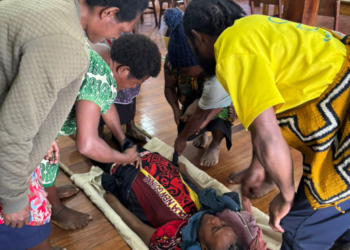
The foundation’s telemedicine network has already been used to guide emergency chest surgery at Indagen Health Centre in Kabwum, Morobe, where officer-in-charge Cathy Nasim performed a life-saving procedure on a patient with an open lung injury under remote guidance of Ganal, with no doctor on site and no evacuation available overnight.
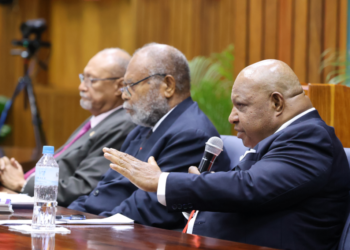
Ganal shared this during the Morobe health authority review this week in Lae.
He said in a separate case, a pregnant mother too unstable for air transfer was given a blood transfusion at the clinic following a remote risk assessment, before being safely evacuated to Angau Memorial Hospital for a Caesarean section. Ganal said telemedicine was one component of a broader infrastructure-first approach the foundation was piloting at Indagen.
He told the meeting that over half of Papua New Guinea’s rural health facilities at the primary-care level were not fully operational — a figure drawn from Health Department planning documents, and that continued training investment without fixing basic infrastructure was failing patients.
“If you don’t have infrastructure, it’s worthless, literally,” he said.
The foundation is installing solar power, ultrasound, sterilisers, and diagnostic equipment at Indagen, all chosen for durability in remote conditions, alongside on-site clinical training as the model’s third pillar.
Ganal said the breakdown of rural primary care was directly driving overcrowding at Angau Hospital, as patients who could not access local treatment travelled to the specialised facility at great cost.
“It starts with a patient in the rural areas and it goes all the way up to Angau. It’s all related,” Ganal said.