When observing the green grass, the cows eating, small houses on the slopes, mountains that cover a neighborhood and the sound of the river dragging its stones, time immediately moves to the countryside, in the middle of the urbanity of the capital.
“Welcome to the El Rosario municipal park“says a sign above a neighborhood house. Above, several houses face the ravine. Some blue, others tomato, several yellow or, those that are barely visible, white.
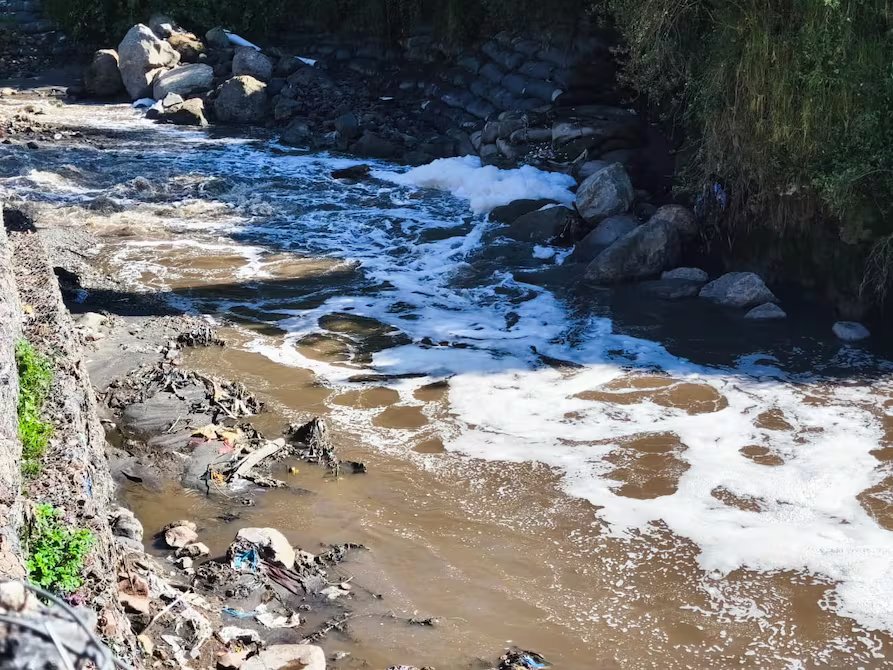
In each home, several people go out to work, study or shop under the same tone, that of the Machángara River. A different channel from the rest, since the pollution They have turned it into an open dump.
The same gesture is customary among the neighbors. They hold their noses, hold their breath, and run past, one faster than the other. It is that he nauseating smell of this traditional water reserve is impressive.

Two bridges have been built across the width of the river. It is a direct passage to the main streets that adorn the El Rosario neighborhoodin the south of Quito.
In one of the newest ones, which is made up of a kind of churo at one end, there is Melanie CorralesCommunication student at the San Francisco University of Quito (USFQ) and one of the pioneers who seek a better future for the river, raising the flag of the project Machángara Unites Us.
“What motivated us to start this project that united more careers was the concern for water. There is research that for the 2050 he 91% of the population will suffer water shortagenot because there are no rivers, but because they are so polluted that they cannot be used. We want to start with the Machángara River, because it is an emblematic river in Quito and try to find a viable solution that can be replicated in other cities,” he commented.
Minister of Health announces his objectives after the appointment of President Daniel Noboa
The 21-year-old from Guayaquil, who has lived in Quito for three years, found a character in Machángara. He raised it from the underground and gave it life in a documentary called The life of a river.
“We were inspired by the love for the Machángara River from the documentary made by Naia (Andrade) and Jorge (Anhalzer). They take the river as the main character and compare it to the life of a person who is born in perfect conditions, arrives in the city and corrupts it with alcohol, drugs, which simulate pollution. In the end they release it in the Pacific Oceanbut already old, without energy and totally consumed by society,” said Melanie.
The objective of this projection which premiered on April 25 was to raise awareness among citizens, the place where the cancer of the Machángara River originates and ends up affecting the same people who throw garbage into its waters.

Drug-resistant viruses in Machángara
“We did research from the area of ecology and we conclude that at least twenty-six families of drug-resistant viruses They exist in this river. That means that, if you have a virus in your body that is highly resistant to a drug, there is no medication that can save you, so you are more likely to die,” he said.
The reality of the inhabitants of El Rosario and the 55 neighborhoods More than sheltering the Machángara River, it is comparable to what the German explorer one day Alexander von Humboldt He said: “Ecuadorians are rare and unique beings: they sleep peacefully in the middle of crunching volcanoes, they live poor in the middle of incomparable riches and they rejoice with sad music.”
This is because, despite the multiple evidence of problems with a dying river, people walk with a smile on their faces, the cows eat the grass that irrigates that contaminated source and the children play among garbage and highly toxic waste.

The route of the Machángara and its regional impact
“The river flows into the beaches of the Pacific; that means that we not only contaminate Quito, but also the cities that are further down, such as Emeralds. That’s where the largest amount of seafood comes from, which is why we eat infected products“, he said.
The Machángara rises in the south of the capital, flows through the center, deviates in Nayón and joins the Monjas River, the Guayllabamba and more basins towards the north of the country. In Quito, the river has a length of 32 kilometersreaching 55 neighborhoods peripherals of the city.
Long-term solutions and industrial pollution
“Architects have mentioned that from here to 100 years the river could be clean; So, it is something that we can see in the long term and it does not mean that we should get discouragedbut from here to 50 years we will be the elderly people who we will be vulnerable to these viruses,” said Melanie Corrales.
The Machángara Nos Une project will have to travel a fairly long path in which they will articulate culture so that people go back to see the river and its present, then the architecture that it intends to install wetlands and encourage people to believe urban gardens that react like a sponge and purify the water that falls into the river.
Among the actions of this initiative, it promotes water reuse, neighborhood cleaning, increasing tree planting, using biodigesters, also requiring green buildings and filtering in gardens, that is, avoiding the use of cement in patios.
“We have validated with official documents that there are 157 industries identified as those causing river pollution. They do it in the early morning, because there is no regulation in that regard. They have been seen hospital wastesuch as syringes, gauze, foam that comes from chemical contaminants,” the student concluded.
Neighbors hope for improvements
Porfilio Guanoa resident of the sector who has seen the evolution and decline of the river, came out with a white cap. His slow walk spoke of his age, but also of the experience of having lived with the same problem for more than 50 years.
Marches and events activate special mobility plan in Quito during the holiday
He has a lot of optimism. He believes that the river will regain its identity, just as it did years ago when people bathed in its crystal clear waters and they could see themselves reflected in them. Today there is only one left dark brown streamplastics, paper and bottles on the edges and a large mass of foam, a product of the waste.
“I live here 56 years. I am one of the founders of this sector, one of the first who came to live here. Everything was thrown away; There were not the works that we have now. However, all of us who live bank of the Machángara River we know that it is the carrier of the residue of everything bad that exists in the city“explained the older adult.
He complained about the smell. He said that the summer drought and the humidity in the winter harm the environment and that, beyond having retaining walls and walls to prevent erosion, no one can combat the pestilence What does it mean to live there?
“I think I am also contaminated, but there is no other way of life to endure,” he emphasized.

The changing colors of the river
The color of the river is not always brown. Sometimes it is red, other days blue and sometimes multicolored. He presumes that its origin could come from different sources. “In the mornings, I don’t know what kind of chemical they throw into the river, but sometimes it comes half reddish… Sometimes the water comes half yellowish and changes colors type 6:00 to 6:30. Low sparkling and with a different color,” Porfilio added.
Operation in Quito detects shipment of cocaine hidden in hair products
They entrust themselves to God. They throw a prayer to the sky, hoping the stench won’t bother them. harm health to move forward. However, the problem is latent. Ecologists, architects, engineers and scientists have reviewed the conditions of the river and, in the best of cases, it will take ten to fifteen years more so that the torrent may be purified. (YO)