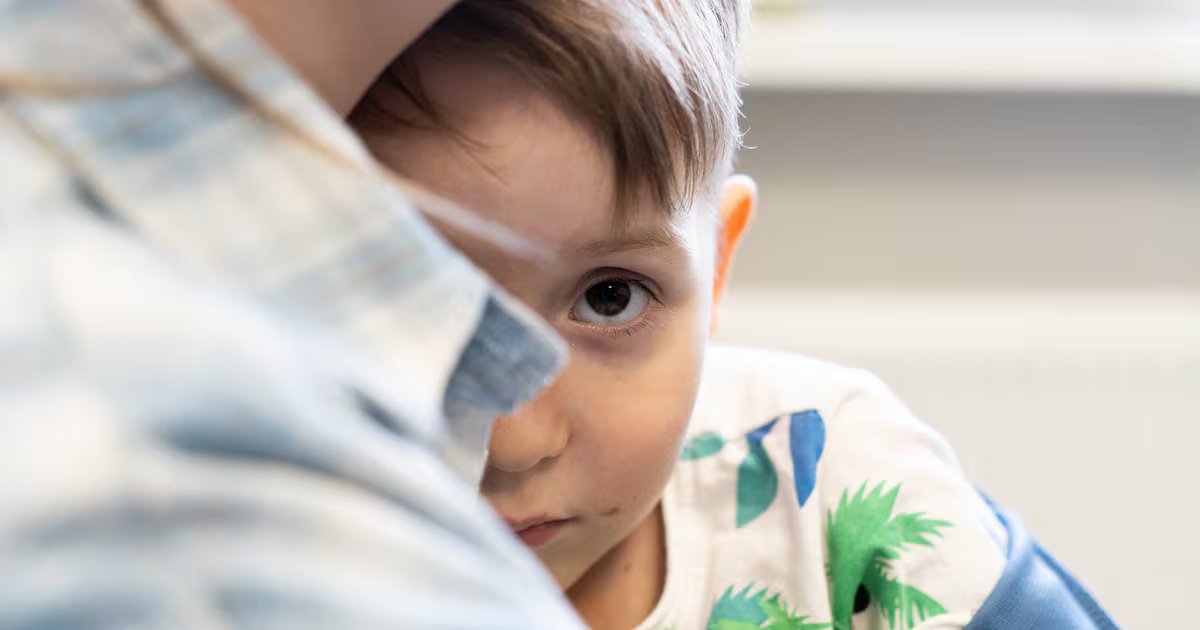
The tenderness between mother and child is more intense because she is terrified of losing him. The way he clings to her, then looks back for approval before grasping the teddy bear in the cardiologist’s consultation room. Her gaze is fixed on him as he shyly shakes a visitor’s hand. Bandages and incision marks are visible around the neckline of five-year-old Matviy Krutofist’s T-shirt, a few days after his fourth heart operation.
His mother, Yana, who is 27, runs a cafe. She takes antidepressants to calm her anxiety over Matviy’s heart trouble.
The first operation, when Matviy was a baby, was the most complicated. Three subsequent operations removed subaortic ridges or membranes that constrict the blood flow out of his heart. These ridges recur in more than 30 per cent of such cases, says Dr William Novick, the US paediatric heart surgeon who is leading a surgical mission for two weeks in Lviv to mark the 40th anniversary of the Chernobyl nuclear disaster, the worst in history. (Chernobyl is the Russian name for the town near Ukraine’s border with Belarus. Its Ukrainian name is Chornobyl).

Novick’s surgical mission is funded by Irish woman Adi Roche’s Chernobyl Children International.
Yana Krutofist was born in the town of Sarny, in the forested region near the Belarusian border that was contaminated by the world’s worst nuclear disaster 40 years ago on Sunday.
Krutofist was born 13 years after reactor No 4 at the Chernobyl nuclear power plant exploded, spewing radioactive iodine, caesium and strontium into the environment. She and her parents were issued Chernobyl certificates that entitled them to certain benefits. The certificates expired but the damage continues in Matviy’s heart.


Novick leads a team of paediatric heart surgeons called the Global Cardiac Alliance. In 1994 he received an appeal from a junior cardiac surgeon in Kyiv, Vasyl Lazoryshynets, who now heads Ukraine’s Amosov National Institute of Cardiovascular Surgery. “He told me they were noticing an uptick in Ebstein’s anomaly, and they wanted us to operate on several patients,” Novick recalls.
Ebstein’s anomaly is a rare congenital heart defect caused by a change in a parent’s DNA. A malformed tricuspid valve is displaced downward into the right ventricle. The Amosov Institute would normally see one such case in every 400-500 patients. That multiplied 15-fold after the nuclear disaster, and Amosov’s operations had a high mortality rate. Novick taught them a method invented by a French surgeon that dramatically improved the odds of survival.
Novick later encountered a similar increase in the Belarusian capital, Minsk. The malady came to be known as Chernobyl Heart.

[ The €500m hole in Chernobyl’s roof: A race to repair damage from a Russian droneOpens in new window ]
The radiation leak caused other forms of heart disease, including ventricular septal defects, a hole in the wall separating the heart’s lower chambers. Matviy Krutofist has neither Ebstein’s anomaly nor VSD, but his mother’s and grandparents’ proximity to Chernobyl is the probable cause of his illness.
“The liquidators [who fought fires at the Chernobyl power plant] had the highest incidence because they got the highest level of radiation,” Novick says. They are grandfathers now, no longer having children. They passed damaged chromosomes on to some children but not others. Penetrance – the genetic term for the likelihood that a gene mutation will express itself – is incomplete and decreases with successive generations.
“A lot of parents of children with Ebstein’s say, ‘I think my grandfather was involved in getting rid of dirty radiation, but I’m not sure,’” Novick says. “For me, that indicates the grandfather was probably a liquidator.”


Ukraine is approaching the end of the second generation of Chernobyl-related heart defects. It will eventually return to normal levels. “I’m not a geneticist but I have already noticed a decrease,” says Novick. “I suspect the Belarusians may carry increased incidence of Ebstein’s longer, because the radiation cloud really clobbered Belarus.”
Novick met Adi Roche at a screening of the Oscar-winning documentary Chernobyl Heart in Los Angeles in 2003. Both participated in the HBO programme but had not met during production.
Until then Roche concentrated on the neural tube defects caused by radiation but was unaware that it was also causing heart disease. The documentary contains heartbreaking scenes of her visiting children with spinal cords and brains in sacks outside their bodies, abandoned and consigned to grim orphanages.
The HBO producer found the footage powerful but wanted something to alleviate the tragedy of the malformed children. In the documentary, a Belarusian woman drops to her knees and feverishly kisses Novick’s hands to thank him for saving the life of her heart-diseased daughter. Novick is embarrassed by displays of emotion, which he calls “the warm and fuzzies”. In the film he turns away to hide tears.
“I have a real hard time with that level of gratitude,” Novick says. “I just look at this as what I’m supposed to be doing. I don’t see this as the miracle that a lot of parents seem to.”
Novick says Roche’s role in saving Chernobyl children has been “incalculable”. For several years after the documentary, her charity financed four trips a year to Belarus for Novick’s team. US ambassador to Belarus George Krol obtained a government donation of $500,000 for the same purpose. Novick called Roche and asked if she would be willing to transfer the funds to Ukraine. With her help, he established child cardiology departments in Odesa, Donetsk and Kharkiv.
Novick’s Global Cardiac Alliance has made about 600 trips to 36 countries, many of them conflict zones, and has performed heart surgery on nearly 12,000 children. Since 1994 they have made 81 trips and carried out 878 heart operations in Ukraine.
The child cardiology unit set up by Novick in Donetsk ceased to function when the Russians invaded the eastern province in 2014. The programme in Kharkiv has all but ended since Russia’s full-scale invasion of 2022. Children who would have been cared for in other centres now travel to Lviv.
One positive consequence of the collaboration between Novick and Roche has been the training of a new generation of paediatric cardiovascular surgeons in Belarus and Ukraine.
“It’s critical that when you are through with the programme, they can take care of their own children without our help,” Novick says. “To the point where children of the future with heart disease don’t have to ask: ‘When is the Novick team coming?’ Because now they have the Yachnik team.”
[ Depression and thyroid disease main health issues among Ukrainian refugeesOpens in new window ]
Novick refers to Dr Oleksandr Yachnik, the head of the paediatric cardiology department at St Nicolas hospital, who was born in 1986, the year of Chernobyl. “These guys have achieved a level of expertise where they can operate on just about anything that comes through the door, but I’ll get a call. ‘I’m seeing this that or the other; what do you think?’ Novick says. “Oleksandr has total access to me wherever I am in world. We have helped him with operations he’d never done before, that he now does very well without us.”
Congenital heart disease provoked by the nuclear disaster peaked in the late 1990s and early 2000s, but has not disappeared. The surgeons at St Nicolas hospital were to operate on a child afflicted with Ebstein’s anomaly grade D, the most severe, on Friday. “We can fix it,” says Novick.