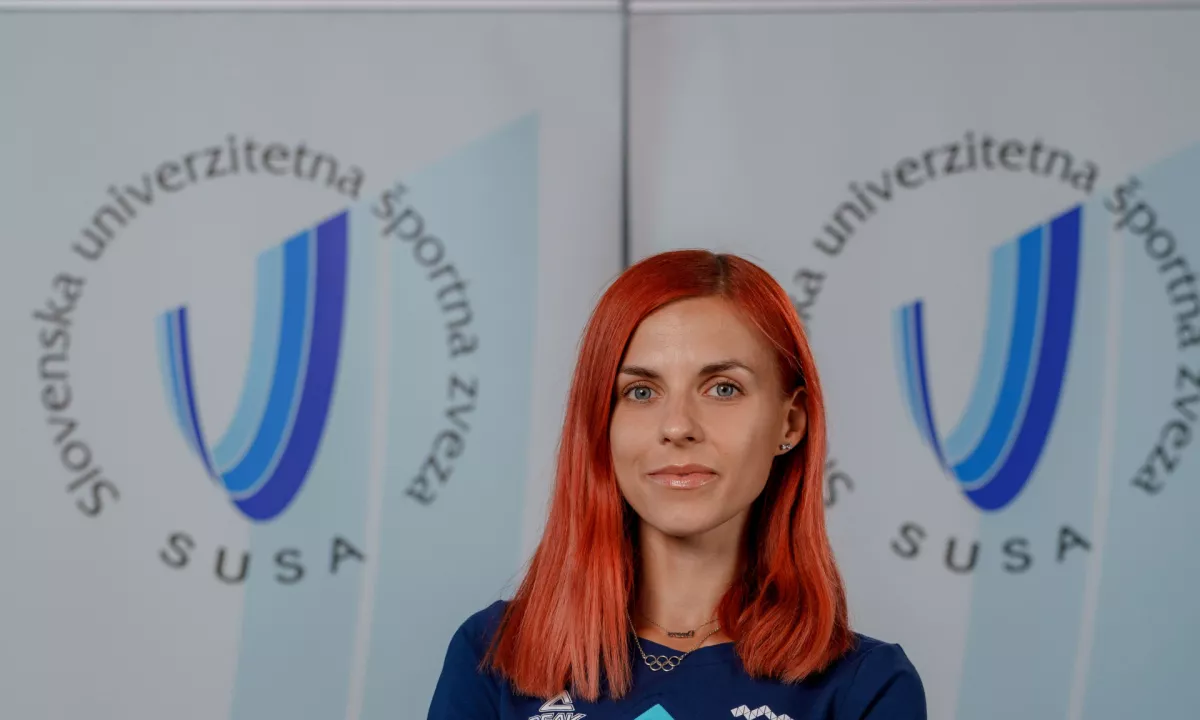
The twenty-five-year-old woman from Šentjernej staged a historic ten-kilometer road race in Laredo, Spain, and became the first European woman to sub the magical thirty-minute mark. The member of Slovan improves her results year after year, and also impresses outside the world of athletics, because in parallel with her professional sports career, she graduated from the Faculty of Biology and a Master’s in Economics, and now she also goes to work. Although 24 hours in a day seems insufficient for her, she also took the time for Dnevnik’s interview without any problems.
Congratulations on an outstanding record. Have you gathered your impressions after a few sleepless nights?
I haven’t quite grasped it all yet. Everything happened so quickly and the euphoria after the competition is still going on. I think that I will need at least a week or so to answer this question, so that I can completely calm down and process the matter.
Two different times of your run still appear. Which one is the right one?
The official time is 29:50, which is also recorded on the website www.worldathletics.org, which is considered the official website of world athletics. Somehow, recently, especially when European records were being set, an extra second is always added to the original time. I don’t know exactly why, but my official profile now says 29:50 and that’s the official result.
How did you approach a run in which you broke your personal record by more than half a minute with such confidence?
I like to discover unknown fields of life, which I don’t even realize in advance if I am capable of discovering them. Only after the competition itself will it become clear whether the self-confidence was justified or not. In my opinion, this is the only way that a person can push his own limits. If we do not dare to dream and reach for high goals, it is much less likely that they will come true. For the last race, I didn’t know if I could actually run half a minute faster than my previous record. But I set a rhythm and told myself that in the worst case scenario, I will only run the last kilometers much slower to the finish line. Nothing worse could happen.
What role does your coach Tevž Korent play in this?
I trust my coach 100% and he told me some time ago that I am capable of running under thirty minutes. I just nodded to him and we went into action. But I’m not always so confident. This changes from day to day. For example, the situation now and two months ago is completely different, because when I came home from Kenya, I was completely devastated. The body needed a lot of time to regenerate after the altitude preparations. If someone had asked me at the time if I was capable of such a run, I would probably have said something different. But then things started to come together, the coach kept telling me that I was making good progress, and I believed it. For me, every competition is a new challenge. It gives meaning to my running and then I give a little more of myself.
Did your experience also help you in your record run, as you also regularly break national records, or is the attack on the European record something else?
I prepare for every run with the same professionalism. It doesn’t matter to me whether I’m running on home soil or at the Olympics. The approach is always the same and I make no distinctions. I always try to do my best. There are races where you run for the ranking and not the time result, but even there I approach professionally and only in this way can something extraordinary be achieved.
You have started adding training in Kenya and Uganda to your training program. What can you learn as a European runner during that time in the mecca of long distance running?
It’s about altitude training. In March 2024, I went to specific altitude training for the first time, and this certainly contributed to the fact that my results are increasing. Otherwise the whole world would not practice it. However, height is very delicate and must be respected, as it can also be overtrained. There you have to have a good strategic plan, which my coach Tevž Korent definitely has. The thing with me is that I always have some problems when I return, and I’m not the type of runner who can immediately go to a competition. After my return, I myself may even be in the worst state in terms of my well-being, but an excellent foundation has been created, which must then settle down with me. After returning from Uganda, it took me about two weeks, and now, after the preparations in Kenya, as many as five. This surprised me a little, but it is also true that the training was more aggressive and the altitude was higher.
Where do you get the desire to run longer and longer?
I didn’t choose long-distance running by myself, but somehow I’ve always felt that it was the right one for me. I can’t explain it exactly, but I feel that I was sent to the world for a long run. The first coach in my childhood told me that I would be good at long distances, and at that time I competed in, for example, 800 meters, but even then it was possible to recognize that my potential lies in running longer distances. When the coach changed, when Tevž Korent took over, who is still my coach today, I started adding distances to my training really smartly. So gradually from season to season we add longer competitions to my program. This suits me very well, because I feel like my body is made for long distances. I’ve never really wondered where it comes from, but I kind of just follow myself and the whole team that guides me. I expect that in the coming years I will also try my hand at a marathon.
So this isn’t your childhood dream?
I have emphasized many times that I never really dreamed of being a professional runner. I never thought about, for example, competing in the Olympics or being part of the world’s elite. Somehow, I always did my best, in training I did what was necessary for a given day. I feel like it’s a part of me that lives for running. Because I persevered all these years and with all the support I have, the results have improved, and when the results are like this, of course, there is also motivation. But not everything is as rosy as it seems at first glance. For example, I had the 2022 season completely stopped. Due to the injury, I was not allowed to run for almost half a year. At that time, I was alone and could not train with my team, which could run. But I spent time alone in the pool and on the bike with my thoughts. That’s when you have to have a higher goal and constantly motivate yourself.
Is the fact that professional running was not your childhood dream also reflected in the fact that you were a full-time student all the time, but now you also work remotely at the same time?
To this day, my opinion is that a person does not have to deal with only one thing 24 hours a day to confirm that he is a professional. Of course, there are certain priorities, but I would not like to be successful only in the world of sports. I feel like I’m much more than just a runner. The education segment has always been important to me. This gives a person the latitude to live, but I am aware that one day my professional path will be over. You have to have a back-up plan for then, and I’m already trying to run that in parallel with my career. I’m the type of person that I can’t just do sports, because it would put a strain on me and I wouldn’t feel good mentally. At the moment, work is a wonderful distraction for me, but before that it was studying. If I only did sports, I would have too much time to think, and in my opinion, this is not good for real results.
But how can everything be coordinated?
When I have a long run scheduled for at least an hour in training, I have a lot of time to think. I play with my thoughts there. I usually think about what I have already done and what I still have to do, and thoughts about work also come into my head. I don’t mind that. I’m somehow of the opinion that a person has to face himself. Nowadays, we all run away from it and look for noise, but I find my peace in running and the opportunity to face myself. I find this helpful for inner peace and a healthy mental state.
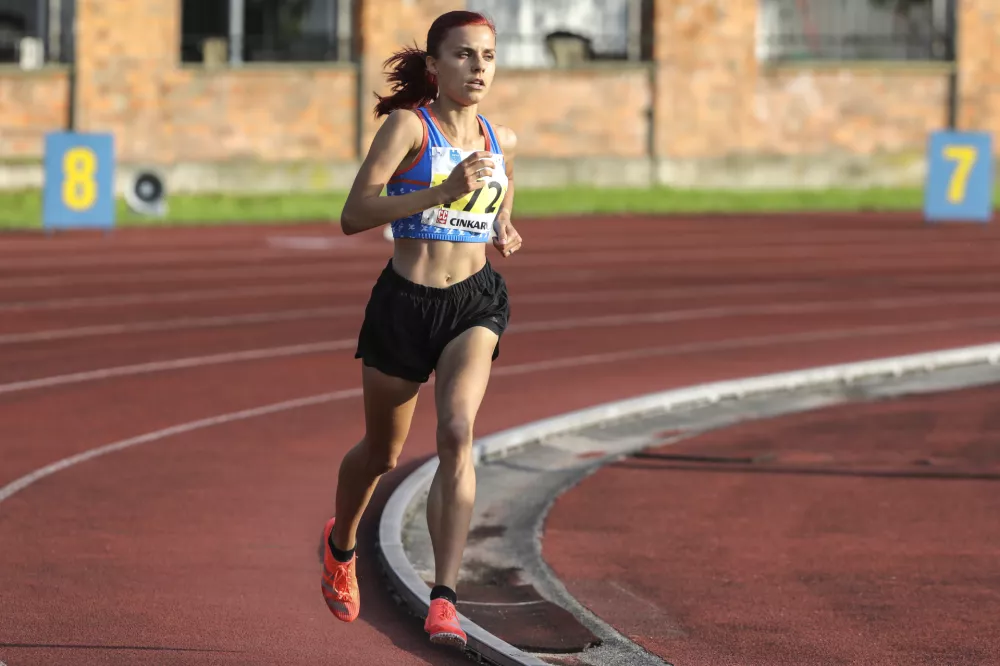
Why are you drawn more and more to road running and not so much to stadium running lately?
On the road, the dynamics suit me perfectly. When I go to a match, I don’t know what awaits me there, because the course is dynamic. The stadium circle is the same everywhere. There is much more dynamics on the road, and I enjoy running in mixed competition. Being able to run with men is a lot of fun for me and gives me energy to overcome the pain that occurs during the competition. Even the atmosphere itself is usually much better.
But what is it like to change the road and the stadium? For example, the footwear is also different.
I don’t bother with the footwear itself, but it is true that road shoes suit my running technique much better than sprinters. A very simple example is running ten kilometers on a track and 10,000 meters in a stadium. It’s much easier for me to run on the road because the sneakers themselves are made with a lot more cushioning. When you run 25 laps at the stadium in sprinters, I feel that the consequences are worse. I also need a bit more regeneration there. Otherwise, I don’t bother with the footwear itself, and the sneakers from my outfitter Puma fit me perfectly.
Do they make shoes made according to your foot?
I still have a completely standard shoe, according to completely standard measurements. But what happens is that when they develop a new model, I get a test shoe and then give my opinion. Their approach is that they like to listen to athletes. They actually develop models on their athletes, which I think is very smart, because probably the athletes can give the best opinion on what suits us and what doesn’t.
What are the main goals until the end of this season?
The main focus will be on the Road Running World Championships in September, where I will compete in the half marathon. In August, the stadium European championship awaits me, where I will compete in the 10,000 meters. These are the main goals, and in between I will compete in various rallies.
Another neutral question about athletics. Is athletics losing its value and popularity?
I think that athletics has not lost its importance in the world, but it has in Slovenia. When I talk to older people, they all explain to me that twenty years ago they were all sitting in front of the television watching athletics. Now I think that’s gone. There are simply no downloads either. I don’t know what the reason is. Athletics does not get the media attention it could. It is very interesting because there are so many different disciplines and there is a lot going on. That’s a shame, because if it doesn’t get written about a lot, it’s less attractive to sponsors and everything that comes with it.