The Government of Trinidad and Tobago has signed an agreement with the World Bank Group to establish a permanent office in Port of Spain, formalising a relationship that officials say will expand access to financing, technical expertise and private-sector investment.
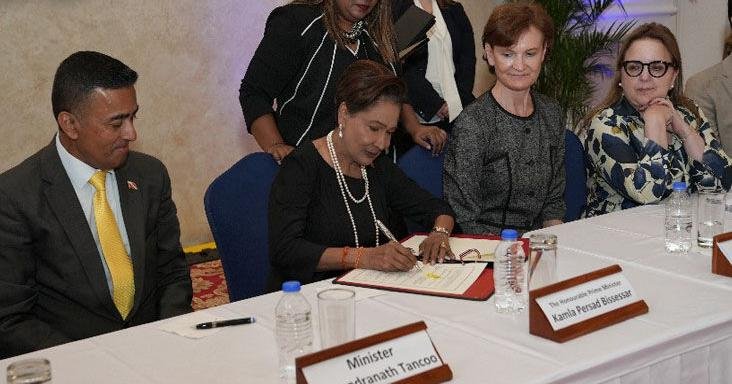
The establishment agreement, signed yesterday at the Diplomatic Centre, St Ann’s, brings together the International Bank for Reconstruction and Development (IBRD), International Development Association (IDA), International Finance Corporation (IFC) and Multilateral Investment Guarantee Agency (MIGA).
Prime Minister Kamla Persad-Bissessar signed on behalf of the Government alongside senior World Bank Group representatives.
According to a release issued last evening, the agreement sets out the legal and operational framework for the bank’s local presence, including internationally standard privileges and immunities covering office premises, assets, and official functions, as well as tax and Customs exemptions and unrestricted financial operations.
“These include the inviolability of offices and archives, immunity from legal process in respect of official acts subject to limited exceptions, protection of assets and property from search, seizure or expropriation, and autonomy in internal administrative and employment matters governed by the World Bank Group’s internal systems,” the release stated.
“In addition, the World Bank Group will benefit from exemptions from taxes, duties, and levies on its operations, property, and official transactions, including customs duties and indirect taxes. The Agreement guarantees freedom of financial operations, including the ability to hold and transfer funds in any currency without restriction, as well as the unrestricted import and export of goods necessary for office operations and secure communications using modern systems,” it stated.
The Government said the arrangement is intended to strengthen development cooperation and improve the delivery of national projects through closer coordination with World Bank teams on the ground.
Persad-Bissessar said the office would bring the bank’s expertise and financing capacity “directly” into Trinidad and Tobago, supporting efforts to diversify the economy, attract investment and create jobs. She also pointed to the expanded use of public-private partnerships as a central feature of the development strategy.
“These partnerships will support the development of infrastructure and national projects across key areas, including transportation, water management, education, and healthcare, improving efficiency, accelerating implementation, and expanding access to financing,” the release stated.
“They will also create greater opportunities for local businesses and entrepreneurs by improving access to capital, advisory services, and international markets, while signalling to global investors that Trinidad and Tobago offers a stable, credible, and structured environment for investment,” it stated.
Billon-dollar
investment pipeline
A key element of the agreement is the role of the IFC, the bank’s private-sector arm, in supporting investment mobilisation and project development.
Officials said this would help improve access to capital for local businesses and expand participation in infrastructure and services projects.
To date, the IFC has invested over US$670 million in T&T.
Since last October, Planning Minister Dr Kennedy Swaratsingh had signalled the Government’s intention to facilitate the establishment of the office, saying it would help unlock financing opportunities for the private sector.
The Government said it was also working with the World Bank Group on an investment pipeline for projects with projected financing between US$1 billion and US$3 billion for local businesses, and with broader financing initiatives projected to reach up to US$5 billion over the next three to five years.
T&T, a member of the World Bank since the 1960s, has previously benefited from IFC investments across financial services, manufacturing and business development.
Officials said the permanent presence marks a shift from episodic engagement to continuous in-country operations, aimed at speeding up project design and execution.
The agreement also positions Trinidad and Tobago as a potential regional hub for World Bank engagement in the Caribbean.