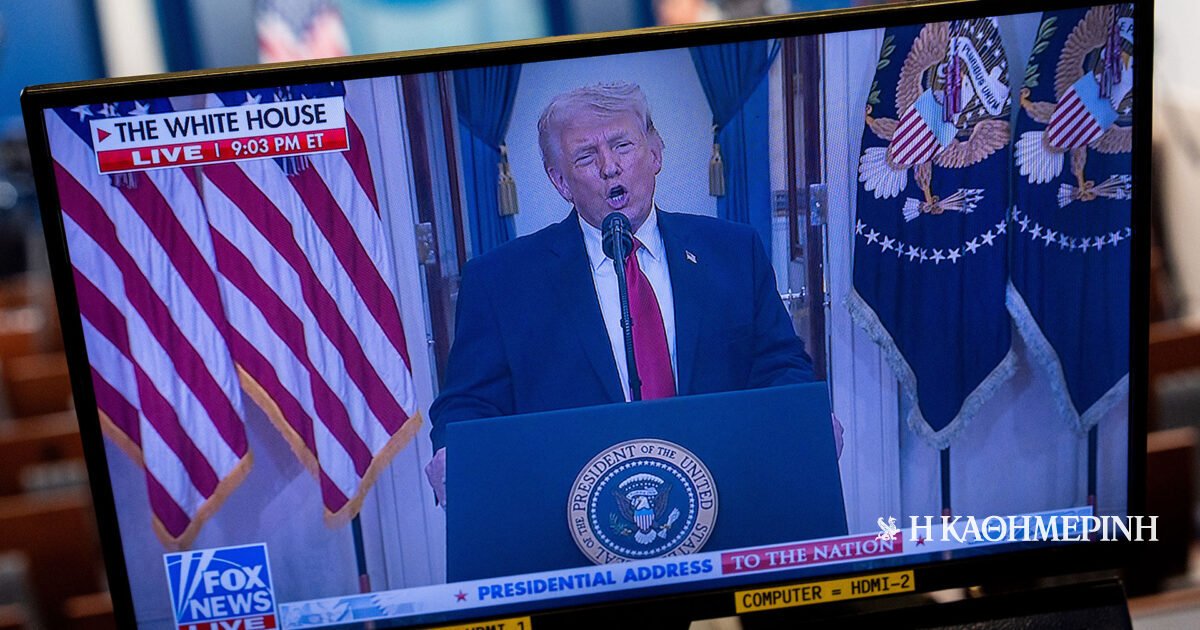
Move with unforeseeable consequences may prove for Donald Trump o naval blockade of Iranwith the American president testing in practice the theory that the supremacy of American power will succeed in bending his resistances Iran.
According to a CNN analysis, this strategy is based on on the assumption that suffocation of Iranian oil exports and imports that support daily life will lead to social collapsecreating unbearable pressure on the regime to accept American terms, including the definitive abandonment of its nuclear program.
For a number of reasons, this logic seems reasonable: every state, regardless of state, is weakened if it cannot secure basic goods such as food, energy and labor. In this light, rising inflation, job losses and shortages in Tehran are seen as signs that the blockade is working.
In fact, in this context, Trump is reported, according to the Wall Street Journal, to have given an order to his associates to prepare for an extension of the naval “blockade”.

It is, after all, a measure that allows pressure to be exerted without the risk of losses in ground operations or the repetition of air strikes with uncertain results. At the same time, he is seeking to restore American negotiating power, which was damaged when Tehran caused an international uproar by closing the Strait of Hormuz.
However, as CNN reports, there are two key factors that will determine effectiveness of Trump’s strategy:
The first concerns the ability of American political leadership and public opinion to bear the economic costs of the warsuch as the increase in fuel prices and inflation, even in view of the mid-term elections next November.
The second is related to whether the strategy is based on a realistic assessment of the situation in Iran and the behavior of its leadership. There is a perennial tendency in Washington to approach Middle Eastern societies based on Western logic, which does not necessarily reflect local dynamics.
The American side seems to bets that the Iranian leadership will react mainly with economic criteriadespite the fact that it is a theocratic system with a history of enduring high social costs.

The crisis in Iran is intensifying
At the same time, there are growing indications that the situation of the Iranian economy is becoming increasingly difficult. According to the WSJ, the unemployed are approaching one million, while the internet “block” has hit the digital economy hard. Inflation is running high, with basic goods such as red meat becoming unaffordable. At the same time, regional media are warning of shortages and risks to food security.
Oil Minister Mohsen Paknetjad called the citizens to limit energy consumptionwhile public services have been ordered to reduce the use of electricity by 70% after 13.00.
As reported by CNN, American intelligence agencies estimate that the Iranian economy can only last for a few weeks —or even days—in the present circumstances. Donald Trump has repeatedly argued that failure to export oil will force Iran to shut down production, risking serious and long-term damage to oil fields.

Analyst Alex Vatanka estimates that foreclosure can cause severe financial strainwhich may translate into political instability. However, he points out that such a development would take time: “We are in uncharted waters. The blockade has no precedent for Iran, not even during the war with Iraq.”
According to him, mass social reactions are not excludedwith millions of citizens clamoring for relief, testing the regime’s endurance. However, he emphasizes that turning economic pressure into political change requires a degree of opposition organization and defections within the system, elements that have so far not been apparent.
How could the blockade fail
But even if Donald Trump appears determined to extend his strategy, the possibility remains the naval blockade proved to be a wrong move.
Ifthe killing of Supreme Leader Ali Khamenei did not drive Iran into retreat and weeks of intense bombing did not bend its political will, the question arises whether a financial crisis can bring about a different result.

The resilience of the Islamic Republic has been taken for granted over time. The country has been subject to Western sanctions for decadeswhile enduring a devastating eight-year war with Iraq, counting around one million casualties. Whenever mass protests reached a tipping point, the regime responded with harsh repression.
At the core of his ideology, from the Iranian Islamic Revolution onwards, is the resistance to the United Stateswhich he characterizes as “Great Satan”. In this light, it is not out of the question that he will choose social collapse over retreating from Trump.
Trita Parsi, vice president of the Quincy Institute for Responsible Statecraft, believes that the current approach repeats a familiar pattern of American politics: the belief that intensifying pressure may force Tehran to back down.
“There is a constant search for a “magic bullet”, a pressure point that will lead to either Iran’s collapse or full compliance,” he notes, adding that such strategies often end in disappointment.
Trump’s confidence also reflects a long-standing tendency in Washington — particularly in conservative circles — to assume that the Iranian economy and regime are constantly on the verge of collapse.
“They just have to admit defeat“, said the American president, arguing that Iran could simply back down.
If that happens, it could mark the end of a nearly half-century long standoff between the two countries. Otherwise, it will be reconfirmed that the resilience of the Islamic Republic may neutralize even the power supremacy of the United States.