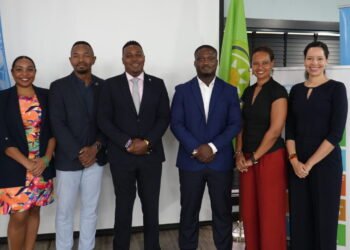

A cohort of sixteen law enforcement officers representing member countries of the Regional Security System (RSS) has completed the International Leadership and Management (Gold) Course.
The programme, delivered over three weeks at the RSS Training Institute in partnership with the Durham Constabulary, targeted high-ranking personnel such as Senior Superintendents, Division Commanders, and Assistant Commissioners, with the aim of enhancing leadership effectiveness across the region.
As outlined in an RSS release, the course concluded with a ceremony at RSS Headquarters on Thursday, April 2, where participants were awarded certificates and recognized for their achievements.
Among those addressing the graduates was Deputy Executive Director Atlee Rodney, who urged them to remain steadfast in their service to the region’s people.
Reportedly, he highlighted the importance of their leadership in helping both their individual agencies and the RSS as a whole respond to societal issues and improve citizens’ quality of life.

Rodney also reiterated the Training Institute’s dedication to offering relevant, forward-looking programmes and maintaining key collaborations, including its partnership with the Durham Constabulary, to strengthen policing capabilities.
In his keynote remarks, Commissioner of the Royal Grenada Police Force, Randy Connaught, spoke about the demanding strategic and political landscape senior officers must navigate in carrying out their responsibilities.
“My charge to you is to master what is perhaps the most delicate and critical skill of executive leadership – managing the expectations of the political directorate… This is not about being political. It is not about partisanship. It is about managing a relationship that is constitutionally vital, operationally impactful and perpetually challenging.
“As Gold leaders, you are no longer just guardians of public safety; you are also stewards of public trust and key advisors to the government of the day,” he asserted.
According to the release, Commissioner Connaught outlined what he described as three foundational elements of effective leadership, encouraging officers to act with strategy and integrity.
“I propose three pillars, grounded in the very principles you have studied here: Pillar One: Educate, Don’t Just Execute… Your role as a professional is to be the expert guide. When a new Minister calls for a visible, reactive crackdown on a complex social issue like gang violence, or youth offending, your job is to resist the urge to simply
salute and execute. Instead, you must channel the problem-solving ethos of the ‘Durham Difference’. You are there to explain the considerations of the threat assessment, the need for a Community Impact Assessment, and the importance of ethical decision-making in achieving a legitimate and durable outcome.
“You are not there to decide national policy that belongs to the government, but you are constitutionally bound to ensure that any such decision is made with the full understanding of the policing consequences. Your advice may be the difference between a politically expedient decision and a sustainable safe outcome,” Mr. Connaught advised.
He went on to stress the significance of preserving institutional strength and continuity, introducing his second pillar: maintaining organizational memory rather than acting on political interests.
“Integrity is your shield. Politicians come and go. Elections are cyclical. But the police service is an enduring institution. Your loyalty is not to the individual in the ministerial office, but to the office itself, to the law, and to the people you serve,” the Grenada Police Commissioner stated.
Turning to the issue of aligning public expectations with actual capacity, Connaught presented a third guiding principle focused on managing the gap between demands and resources.
“Perhaps the greatest source of tension lies in the mismatch between political expectation and operational capability. A political promise made during a campaign can create an expectation in the public that the police have a magic wand. Your job is to be an honest broker of capability… You must be able to demonstrate, with data and candor, the direct link between resources, funding, personnel, technology, wellbeing support and outcomes.”
He concluded by encouraging the newly trained leaders to adopt innovative thinking and a problem-solving mindset in their roles.
“Graduates, the “Durham Difference” is fundamentally about doing things differently, about applying a strong problem-solving ethos to drive meaningful change. I am asking you to apply that ethos to the relationship between your organisation and its political masters.”




![COMMENTARY: Once upon a time – Diplomacy in the image of our times [Shridath Ramphal Centre Trading Thoughts]](https://agentially.org/wp-content/uploads/2026/05/pexels-gabby-k-6289049-e1777829357976-350x250.jpg)