In the last eight years, Spain has become one of the favorites for Nicaraguans who have emigrated. This is shown by data from the National Institute of Statistics (INE) of Spain, which reflects a growth of 301% in the number of Nicaraguans residing in that country, between 2018 and 2026.
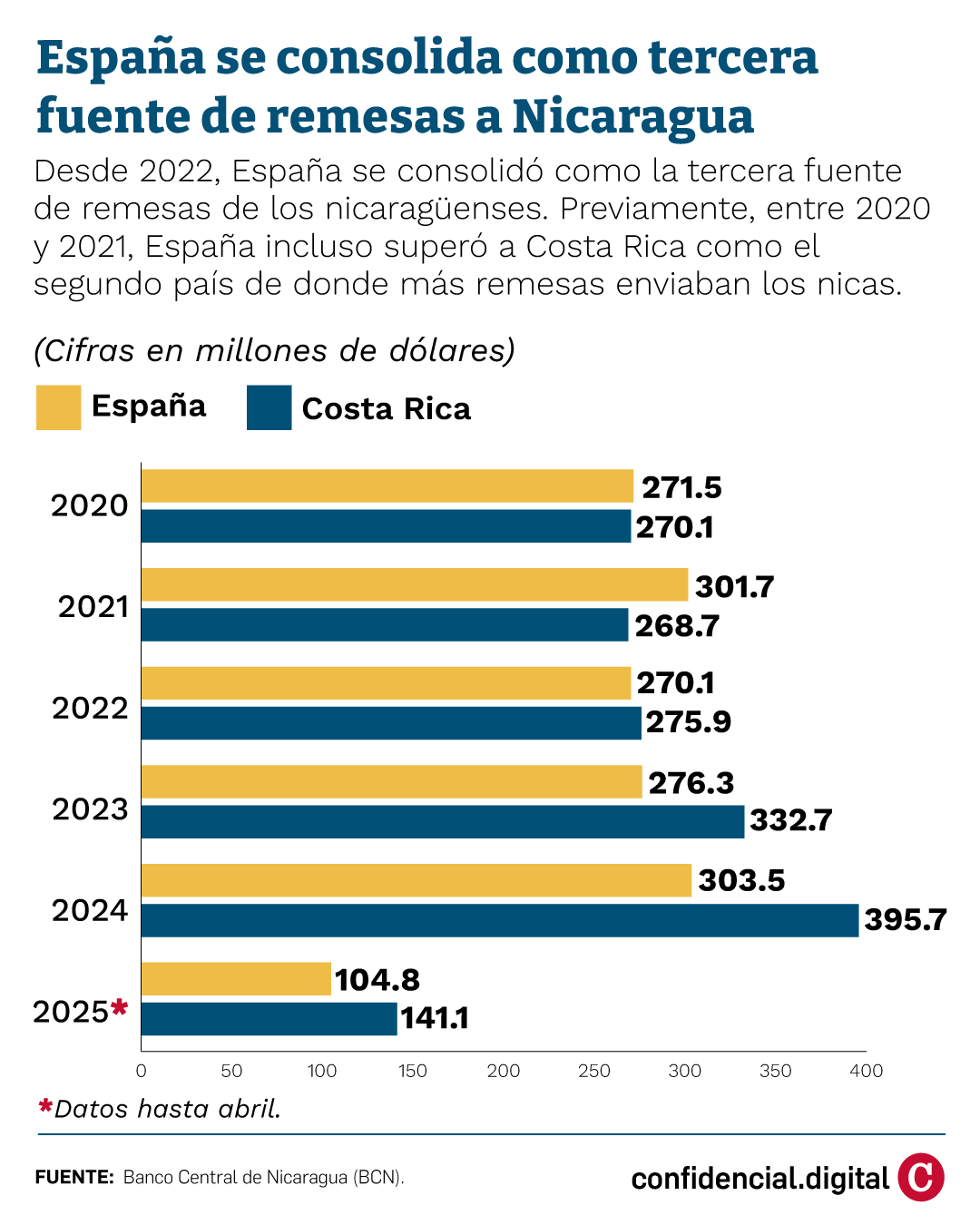
Statistics from the Central Bank of Nicaragua (BCN) also show an increase of 216.5% in the amount of remittances sent from Spain to Nicaragua, between 2018 and April 2025, which is when the Government canceled the publication of remittance figures.
According to the Spanish entity, as of January 1, 2018, there were about 31,180 Nicaraguans living in Spain. Seven years later, that number grew to 93,905. Mostly women.
In the case of remittancesthe information published by the BCN indicates that in 2017 (that is, the year before the start of the April Rebellion) 140.2 million dollars were received from that country. The figure reached 303.5 million at the end of 2024, the last year for which the Central Bank published complete data.
Gary Estrada and Xavier —a man from Leon who asked to be identified only by a pseudonym— are two of those migrants who arrived in Spain in recent years.
Nicaraguans migrate in the face of crisis
The crisis unleashed in April 2018, when the dictatorship quelled citizen protests with bullets, translated into an increase in migration, reaching around a million people, according to calculations by Manuel Orozcospecialist in immigration issues. As Nicaraguans left, the total remittances received in the country grew shortly after. Both those that originated in the United States, Costa Rica and Spain.
In fact, in 2020 and 2021, more remittances were sent to Nicaragua from Spain than from Costa Rica, according to BCN statistics. After that, Costa Rica regained second place as a source of these monetary transfers. Timidly at the beginning (275.9 million, versus 270.1 million in 2022), but the gap widened from then on, to the point that in 2024 it was just over USD 92 million.
“People have a desire to migrate due to despair in the face of the economic crisis. This desire to leave is high, and has remained since this crisis originated in 2018, with a rebound in 2021,” says Jesús Téfel, president of Hagamos Democracia.
Economist Enrique Sáenz complements this observation by pointing out that “massive migrations, and the persistent desire of the Nicaraguan population to emigrate, is evidence of the economic, social and political failure of the dictatorship. While they proclaim economic prosperity, the reality is that people are suffering,” and continue dreaming of leaving the country.
Nicaraguans in Spain do not forget their families
In the middle of the last decade, Gary Estrada went to Spain with his wife and daughter for academic reasons. He was supposed to return to Nicaragua after finishing his studies in 2018, but the April Rebellion showed that this was not a good idea, and the family decided to stay there waiting for things to improve in the country.
The next thing was to find a job, rent a place to live, and find a school for the girl. All of this, without leaving the family that remained in Nicaragua unprotected. To achieve this, every month he sends his mother between 150 to 200 euros (between 175 and 223 dollars, at the current exchange rate), although on some occasions the sending is biweekly. It all depends on the needs and possibilities.
Given the high number of migrants residing in Spain – more than 10 million of the 49.6 million who live in that country were born abroad – remitters have many options to send money back to their countries. One of them is an application called Remitly, which works with recharges, to send money when appropriate. The cost varies between three and five euros (between 3.50 and 6 dollars).
It is also possible to go to a call center (mainly a service center for migrants) where shipments can be made through traditional remittance companies. Another way is through bank transfers. “This is the best option so that they receive the exact amount that I sent, and do not have to go wait in line at a branch,” details Estrada.
Xavier He goes to the phone shops to send money to his family. In his case, he arrived on vacation in Spain at the beginning of 2020. His sister invited him to spend a few weeks with her, as a reward for having graduated as an agronomist, but the global shutdown in response to the covid-19 pandemic left him locked up in the Old Continent.
He had to stay and settle there. Now he works managing an agricultural farm, where he can put to use the knowledge acquired at a Nicaraguan university, although his university degree is not valid outside the country.
He doesn’t forget his family either. In particular, to his father and mother, to whom he sends around 500 euros ($585) per month to ensure that they can feed themselves and cover household expenses. In his case, he goes to a call center from where he sends the remittances directly to a Nicaraguan bank so that they can withdraw the money, with the certainty that they will deliver the amount remitted.
Immigrating to Spain also has its risks
The United States has always been the golden dream of most migrants or those who wish to migrate. That changed with the start of the second Donald Trump Administration, which disrupted many things. One of them is where to go to seek family support, or freedom.
People would prefer to go to the United States, but the restrictions introduced by the Trump Administration’s new immigration policies show that it is difficult to do so, explains Téfel. Hence, many see Spain as the second best destination, above Costa Rica. The former metropolis has an advantage: it can serve as a gateway to Europe. And there is no language barrier, like in the United States.
Sáenz observes that there are objective difficulties in fulfilling the dream of emigrating to Spain. One of them is the distance, and the existence of an ocean in the middle, which can be overcome, it is true, but it has a cost. The other thing is “the lack of tradition in migratory flows,” although that is something that is changing little by little, with the arrival of more and more Nicaraguans to that Iberian nation.
The problem is that these currents could change direction.
Estrada identifies himself as a social activist who works, among others, for the rights of migrants. From that perspective, it observes with concern the possibility that a change in the Spanish Government as a result of the next general elections will translate into a systematic rejection of migrants and the rights that have been granted to them. Even against those who have become Spanish nationals.
Sáenz also warns of this risk, especially if the conservatives come to power. “In any case, if the left were to lose, a change of government would open a more hostile position towards migration,” he concludes. The question is what would happen to the thousands of undocumented immigrants (among them, around 40,000 Nicaraguans) who are eligible to obtain immigration regularization in Spainif that forecast finally comes true.