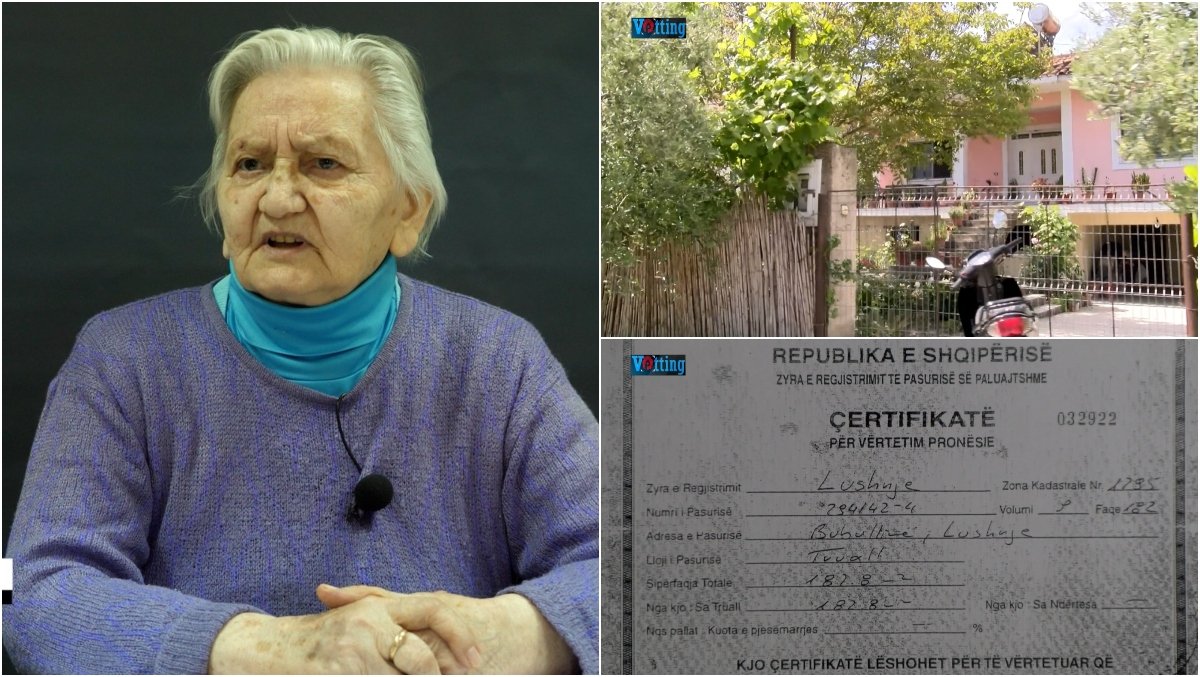
In July 2012, the Court of Lushnje would give the Boçi family the property with an area of 182 square meters at the entrance of Bubullimë village in Lushnje. The decision would not be contested by the person who had usurped Genci Gjoka’s private property by building a house without permission. This would give power to the court’s decision to be executed by the State Enforcement.
The information provided by “Vetting” and the interviews with Bukurie Boçin reveal that the former ALUIZNI and the former Lushnje Real Estate Registration Office legalized the property in violation of the law for the person who had built without permission on this land. What makes the violation more serious is that for the land there was a final court decision and ownership certificate from the Boçi family, as well as an execution order for the Enforcement to return the property to the owners.
“I want to make a clarification about today’s Cadastre. Within 3 months, Genci Gjoka received the certificate of ownership, a document that people have not received for who knows how many years. There is corruption here, and I say it with all my mouth that it is a big corruption that Genci Gjoka has committed”, says Bukuri Boçi for “Vetting”.
Former teacher, now retired, Bukuria came together with her husband Dhimo Boçi to the “Vetting” newsroom to appeal to public institutions and justice to get her property.
The adventures of the Boçi family began earlier in 1997 during the riots when illegal construction began on their property by the person they sued in the Prosecutor’s Office.
“I have an inheritance in Bubullimë (Lushnje). The Property Compensation Return Agency gave it to us then, we had 10,000 square meters, of these 10,000 they gave us only 7,000. But we will focus on the land they gave me with an area of 182.8 square meters.
We are heirs of Gena Boçi, my mother-in-law. My mother-in-law had this plot of land from her father and grandfather, that is, it has been passed down through the generations and is known as the heritage of the Papallars. The Papallars are known as great inheritors in Bubullimë, they also forgave a part of the surface. They forgave a part to the Church, which has done well and the school was built in Bubullimë, also in our heritage. I ask for my share now, that I want to take the share that three citizens from Bubullima took for me. Above all, I want to mention Genci Gjoka who took our part”, said Bukuri Boçi.
Beauty shows that after they won the first trial together with the other heirs they decided to make the proportion. Unfortunately, the person, Koli Papa, who had followed the trials as the representative of the heirs, would pass away and the Executive could not execute the decision as a new trial had to be opened in the name of Dhimo Boçi.
“We opened a trial with the judge of the case, Dritan Caka, who gave a final decision based on the inheritance we had and on the basis of the certificate we had received for the land of Bubullima as all the heirs and we on behalf of all the heirs”, declared Bukuria.
But the problems would come from the Lushnje State Enforcement since for many years it would not execute the decision, passing the responsibility to the Lushnje Territory Protection Inspectorate and the National Territory Protection Inspectorate. This is because these institutions had to support with heavy means the Enforcement together with the State Police to destroy the house, which was located on the land of the owners Dhimo and Bukuri Boçi.
In the decision given on July 11, 2012, the Court of Lushnje would order the defendant Genci Gjoka to return this property to the heirs of this land, removing at his own expense the construction and fencing he has carried out on this land surface. So, in the Court’s decision, it is clearly stated that it is the defendant who must return the property to its original state, by destroying the apartment itself.
Genci Gjoka would not appeal the decision to the Vlora Court of Appeal. But a few months later, Gjoka would appeal to the Supreme Court, under the pretext that he had not been there when the trial was held, but the Court refused him after the announcement was made in the municipality of Bubullimë at that time.
According to the lawyer Alban Duraj, if the debtor does not release the property voluntarily, then enforcement intervenes.
“In this particular case, with all the information we have, we are dealing with the non-execution of the court’s decision and the entanglement of institutions with actions contrary to the law”, lawyer Duraj told “Vetting”.
Although in 2012 the court’s decision was final, ordering the demolition of the building and vacating the land, this order collided with the institutional wall that appeared to be custom-built.
“We received the property certificate in 2011, in 2012 we received the final decision and all this was done by Genci Gjoka after the final decision, at the time when we had made the opening for the execution act, when we made the opening for the ac-execution, when we made the court order for the demolition of the building.
Genci Gjoka opened trials after trials to deceive, to get permission, he tried to torment us with lies, they took us even through the Enforcement”, says Bukuri Boçi.
From the official documents, Lushnje Enforcement claims that it was not possible to execute the decision because they did not have the means. From the documents of the Prosecution, it appears that the Lushnje Territory Protection Inspectorate did not have machinery available for the demolition of this building, while the court’s decision clearly states that the person who usurped the property and built illegally must do the demolition of the building and the fence at his own expense.
According to lawyer Duraj, the entire action is directed by the Bailiff, but there are cases when there are no means and in this case the IMT of the municipality should be directed to the National Inspectorate of Territory Protection.
“Supporting the Bailiff is done by IMT Lushnje with means together with law enforcement. Law enforcement is also needed because there may be objections and the execution of the decision may become more difficult since there are families inside,” said lawyer Duraj.
Seeing the circumstances, Dhimo and Bukuri Boçi applied to the Court of Lushnje for the execution of the court’s decision to take the property. In September 2012, the Court of Lushnje issued the execution order with decision no. 718, which charged the Enforcement for the release of the land for the legal owner Dhimo Boçi from the illegal construction of the debtor Genci Gjoka. At that time, the Lushnjë Enforcement Office registered this request in November of the same year and after the failure to release the land voluntarily, it ordered the mandatory execution. But the problems with the Boçi family would begin with delays in the execution.
“I saw the procrastination from 2012 to 2013, that’s when it started when I found the first means and I, so that things wouldn’t drag on, I found the private means myself and I always told the Bailiff Luiza Gjergjova”, says Bukuri Boçi.
The implementation of Lushnje would sink into a ten-year spiral of absurd postponements and the reason was always the same that Lushnje Municipality did not have the means. When the Boçi family found private means, the state was still not there. The workers left under the threat of weapons and violence, while the state police, represented on the ground by OPGJ Vasillaq Ziu, seemed to have other priorities.
The first documented presence of the Enforcement in the field, in the village of Bubullimë, was at the beginning of January 2013. On this date, the minutes of the enforcement actions were kept, in which the Boçi family and the debtor Genci Gjoka, law enforcement and local representatives participated, but the intervention was not carried out as the parties initially agreed on amicable solutions. Another field attempt was carried out in October 2013, but the action was postponed due to bad weather conditions.
“I came and told them, I found the tool, I showed it to Luiza Gergjova, let’s go to Bubullimë. The date was set for the execution, the first violation was this. We came there to demolish a two-story building with two policemen, I’m addressing you, Mr. journalist, can a two-story building be demolished with only two policemen and a policeman?”, says Bukuria indignantly. as it was difficult without support to get her property.
According to the lawyer Alban Duraj, high institutional support is needed in these cases.
“Police forces should be increased so that the bailiff is not harmed, but of course the forces of IMT Lushnje should be ready under the orders of the Judicial Bailiff”, said lawyer Duraj.
During 2014, the Enforcement has been in Bubullimë in several key cases, but the execution was postponed because the Boçi family had not provided the means to demolish the building. On April 24, 2014, the bailiffs were again in Bubullimë, but the work was stopped after the workers abandoned their duties under the pressure of people in the village.
The most tense intervention in the field took place on June 19, 2014. On this date, the Enforcement was present together with a military vehicle and police forces. The minutes record that the work started around 10:00, but was interrupted after the resistance of Genci Gjoka and his family members, who were then escorted to the police station according to the document from the Prosecutor’s Office.
“In conclusion, at the very end, with our insistence, 13 policemen came. Why didn’t these policemen come from the beginning? Vasillaq Ziu prevented these policemen, he was the Judicial Police officer for the village of Bubullima, and it was not useful for him to destroy the house of his friend, his friend, and he confirmed this to us with his own mouth. I am quoting the words of Vasillaq Ziu, “Make an agreement with Genci Gjoka, because I have krushk the hell”, I’m sorry for talking like this, but this is what he said.
We started to investigate ourselves and secretly saw that Vasillaq Ziu met Genci Gjoka behind a police building in Lushnje.
That’s when we started arguing with Vasillaq Ziu. On June 19, 2014, it was the blackest day for us because we were raped together with the fadromist”, says Bukuria in shock.
For this occasion, Dhimo and Bukurie Boçi recount in detail how they were violated in the presence of the Police. Mrs. Boçi even accuses the police officer Vasillaq Ziu of the failure of the work of the Enforcement itself, since she was forced to reimburse the bailiff for the damages suffered.
“We were beaten and the police took us in their van because our van had been driven away by the villagers of Bubullima. Genci Gjoka with the farmer, with his brother-in-law, who were present there, were driven away by the workers, whom we paid, they drove away the car that we were going to Bubullima”, said Bukuria.
According to lawyer Duraj, Enforcement must be supported by public institutions as only in this way it can be effective in carrying out actions.
“This is always done in a coordinated manner and the bailiff should not be left alone. There are many cases where the bailiff is left alone and we have a lot of sanctions from the European Union for non-execution of court decisions regarding the property,” said lawyer Duraj.