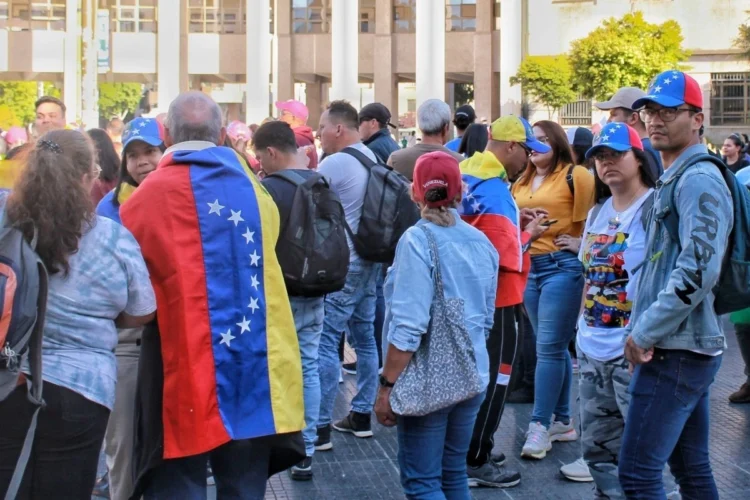
Fear and uncertainty. This is how Luis Urbaez, claims adjuster for an insurance company, of Venezuelan origin, and with six years in Chile, describes what many compatriots feel about the immigration policies that José Antonio Kast—who assumes the presidential mandate this March 11—promised to implement upon arriving at the La Moneda Palace.
The decisions of Kast, from the extreme right, not only concern the nearly 20 million Chileans, but also an estimated 2 million migrants, of which 42% are Venezuelans, according to figures from the Libertad y Desarrollo (LyD) study center. However, Venezuelans also make up 75% of the irregular immigrants who today live in the Andean nation.
Urbaez is of the idea that his host country should “put its house in order,” he said in conversation with Effect Cocuyo. Meanwhile, he believes that “the ‘Czechs’ (migrants seeking to regularize their status and have their papers up to date) should stay” and that “they be given the opportunity to obtain their documents.”
Procedures against the clock
During his third candidacy for the presidency, Kast’s message to migrants was forceful: 2026 will be “the most successful in expulsions” if he assumes power, an assumption that takes place this Wednesday.
“The invitation is that if someone wants to return to Chile one day and is in an irregular situation, take all their things, leave and then apply to enter again; but with all their documents in order, as appropriate,” stated the leader.
LyD details in its report that 336 thousand foreigners have entered Chile irregularly; 252 thousand, according to the researcher, from Venezuela. For Kast, these people “entered through the window and not through the door,” and he assured that those who remain in the country without valid documents, or are fugitives from justice, “will encounter authority.”
Wuinder Materán, a programmer who has chosen Chile as his second home for eight years, does not understand why the authorities refuse to regularize people who are free of criminal records.
“There are undoubtedly many good and hard-working people who came to do things well; they just entered Chile irregularly because they had no other option,” he added.
Migrants between little tolerance and respect
Chile is the fifth largest country for receiving Venezuelan migration, after Colombia, Peru, the United States and Brazil. The Center for Public Studies (CEP) of Chile revealed that, by the end of 2023, seven out of ten Chileans (without distinction between political ideologies) “strongly agreed” that the entry of foreigners increased crime rates.
Karem Alejandra, also from Venezuela, believes that there is little tolerance towards foreigners. “People no longer care if someone is treated badly or discriminated against because of their nationality.” However, she says that since she arrived she was welcomed “with great affection (…) always except in some cases.”
She settled eight years ago in Chile, where her brother already lived. She started as a waitress and ended up as an administrative receptionist. Materán agrees with her: the treatment of Chileans towards him and his family “has been very good”, but he emphasizes that sometimes “the media and (social) networks magnify what happens.”
However, she recounted a particular experience with the PDI (Investigative Police), where she received mistreatment when requesting information about a procedure for her daughter, who had just arrived in Santiago. “The treatment was hostile on the part of the officials. They had just murdered one, and they were Venezuelans. That brought a lot of hatred for us at that time,” he explained to Effect Cocuyo.
If there is something that Luis, Wuinder and Karem agree on, it is that those who have some type of record should leave Chile. Other interviewees agree.
Alejandro is from Caracas and arrived in the southern country in 2016, due to the stability it promised and the ease at that time in obtaining the relevant documents. It seems to him that Kast’s approach “is the right thing to do,” because he believes that uncontrolled migration has skyrocketed crime rates. Ricardo, his brother, agrees. For him, uncontrolled migration creates problems “because in the end you don’t know who is entering your house.”
And like Alejandro, he stated that the majority of Venezuelans he knows preferred Kast, from the extreme right, than his rival in the last elections, Jeannette Jara, a member of the Communist Party of Chile and Minister of Labor and Social Welfare in Gabriel Boric’s cabinet.
Migration that makes contributions
The United Nations Migration Agency (IOM) has highlighted the positive impact of the Venezuelan community in Chile, especially in the economic sphere.
In a study endorsed by the Organization in November 2023, “important contributions in fiscal matters, business investment and job creation” were evident and a fiscal impact of 410 million dollars was highlighted during 2022, which could have risen to 510 “if those who participated in the registration process were regularized.”
“Another relevant fact is that, according to the estimates made in the study, 51.2% of Venezuelan people have educational levels higher than the Chilean average education (…) Although these figures are positive, only 36.9% practice their profession,” the group detailed in a press release.
MCM meeting with Venezuelan community
José Antonio Kast takes office at noon on March 11 as the new tenant of the La Moneda Palace.
Among the 1,150 guests at the ceremony is María Corina Machado, leader of the Venezuelan opposition and 2025 Nobel Peace Prize winner. Kast has referred to it as “the beginning of a new path or the end of the tunnel for the purposes of freedom.”
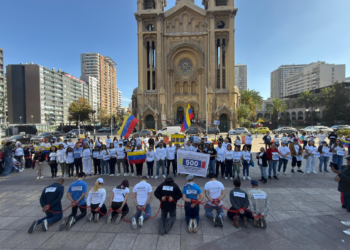
Machado called for a mobilization for the next day with the Venezuelans in Chile, scheduled for 5:00 in the afternoon on Paseo Bulnes with Parque Almagro, in the Santiago Centro sector.
Collaboration text by María Eugenia Lorenzo