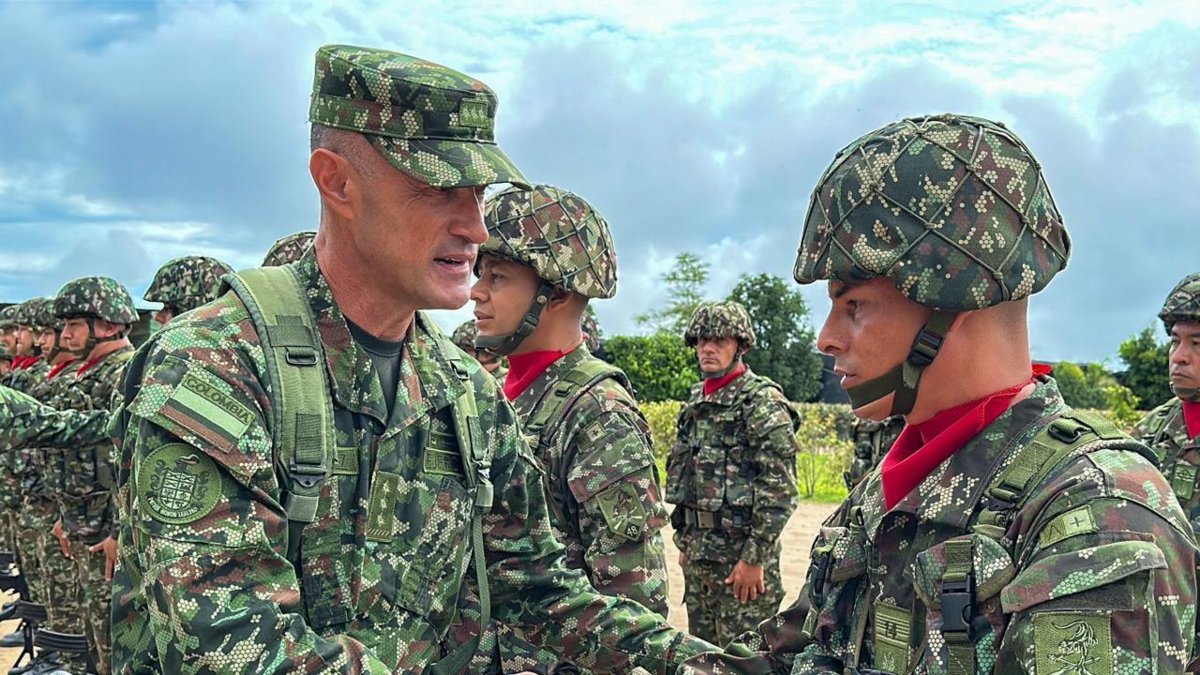
In the midst of the capture of Alex Vitonco Andela, known as alias Mi Pez or ‘David’, leader of the Dagoberto Ramos structure of the dissidents of ‘Iván Mordisco’, and after the recent wave of violence registered in the southwest of the country, the commander of the National Army, General Royer Gómez, He moved to Cali to provide details of the operation and the security panorama in the region.
In dialogue with EL TIEMPO, the officer explained how the structures of the Central General Staff commit crimes in Cauca, Valle del Cauca and Nariño, spoke about the challenges in the Micay Canyon, revealed information about the attack on the Pan-American highway and referred to the security plan for the next elections.
General Royer Gómez Herrera, commander of the Army. Photo:Courtesy
General, who was alias ‘My Fish’, what structure did he run and why was he a priority target?
All structures that commit crimes in Cauca, Valle del Cauca and Nariño belong to the Central General Staff. The main leader is alias Iván Mordisco, known for his criminal record. In this region they formed the so-called Jacobo Arenas western bloc, which is a second line within that organization. That block first had alias Mayimbú, who was neutralized by the Public Force, and then went under alias Marlon. Within that block there are several substructures. One of them is Dagoberto Ramos Ortiz, whose leader was alias Mi Pez. His capture was an operation carried out by the National Police and deserves recognition because this terrorist had been causing harm to the civilian population, police officers and soldiers.
20 dead, 35 injured left the Cajibío attack. Photo:JUAN PABLO RUEDA BUSTAMANTE
What other structures are in that area of the country?
There is also the Jaime Martínez structure, which commits crimes in sectors such as Jamundí, Suárez, Buenos Aires and to the south in areas such as Morales. That organization controls drug trafficking corridors to the Pacific. Further south is the Carlos Patiño, then the Franco Benavides and recently they created another called Andrés Patiño. Each has sources of criminal financing. Dagoberto Ramos moves with extortion, control of crops and marijuana trafficking. Jaime Martínez is focused on illegal mining and drug trafficking. ‘Carlos Patiño’ focuses on illicit crops and cocaine base paste laboratories. All of this financially feeds the bloc and the Central General Staff.
What are they using these illegal resources for?
In strengthening its structures. We see it in the recruitment of new members, especially boys and girls. Also in the purchase of drones, war material, explosives, rifles, ammunition and other elements to sustain their criminal capacity.
Central park of the town of El Plateado. Photo:Carolina Bohórquez Ramírez / EL TIEMPO
You are close to celebrating two years with ‘Operation Perseus’ in the Micay Canyon. Why has it not been possible to ‘turn off the violence’ in that area?
In September we marked two years since we entered the El Plateado sector and the Micay Canyon with operation Perseo. It has been a sustained military and police effort. The community recognizes that there has been progress in security and that riots to expel the Public Force have not been repeated recently. But the population also demands something from us that is recurring in many regions of the country: the comprehensive presence of the State. They ask for roads, hospitals, infrastructure and solutions to unmet basic needs for many years. There is also the weight of the illegal economy. There are communities that got used to it and depend on it. When a soldier or a police officer destroys a cocaine laboratory, it impacts that illegal economy. There social confrontation is generated. Structural, social and economic change is required. As long as drug trafficking persists, it will be very difficult for the Public Force alone to stabilize the territory.
About the attack on the Pan-American Highway. How was this action planned and what information do you have?
A terrorist action of this type does not need a robust structure. It can be executed by two or three terrorists. We have already seen the explosive charge used in other attacks and it is aimed at destroying armored vehicles, which are the ones that protect our soldiers. That day they conceived an attraction maneuver. They were present on the road to generate a reaction from the troops. The information reached our units and the movement began to clear the road and avoid armed presence. In that reaction we entered into combat with individuals who had been left near the site. It was not an intense combat, but in the middle of that development the explosive charge was activated. The result was the impact on the civilian population, because there were several vehicles concentrated at that point. The method of activation and the exact type of explosive are part of a scientific and technical investigation with specialized personnel. The truth is that they made a serious mistake by detonating when there were several vehicles grouped together, which increased the number of victims.
Ivan Mordisco Photo:Ivan Mordisco
The president has insisted on the neutralization of alias Iván Mordisco. What happens with that operation?
There is intelligence working permanently. Intelligence feeds on information; The better the quality of that information, the better the operational result. Against all the aforementioned structures there are intelligence agents constantly focused. Of course, there is also a permanent operation on Iván Mordisco, as well as on second, third and fourth level ringleaders. It is not possible to give a date. This process depends on the pace at which quality information is obtained that allows it to be refined and launched a military operation. It must be taken into account that he is a subject who is in a jungle area, with a closed circle of trust. Furthermore, military and police operations have affected his immediate environment, which has made him more distrustful and careful. That makes work difficult, but the operations continue to give results. The capture of the main leader of a structure like Dagoberto Ramos shows that progress is being made.
Soldiers remove a fence in Cauca from the ‘Iván Mordisco’ dissidents. Photo:Courtesy
We are one month away from elections. Is there a risk of a criminal plan to destabilize them?
Our focus is on combating illegal structures. What I can say is that the Army, starting May 1, will not have troops on vacation, or on rest, or in training cycles. The entire device will be oriented to the Democracy Plan. On May 31, all our capabilities will be deployed so that Colombians can go to the voting stations and exercise the right to choose.
Justice Editorial
Justicia@eltiempo.com