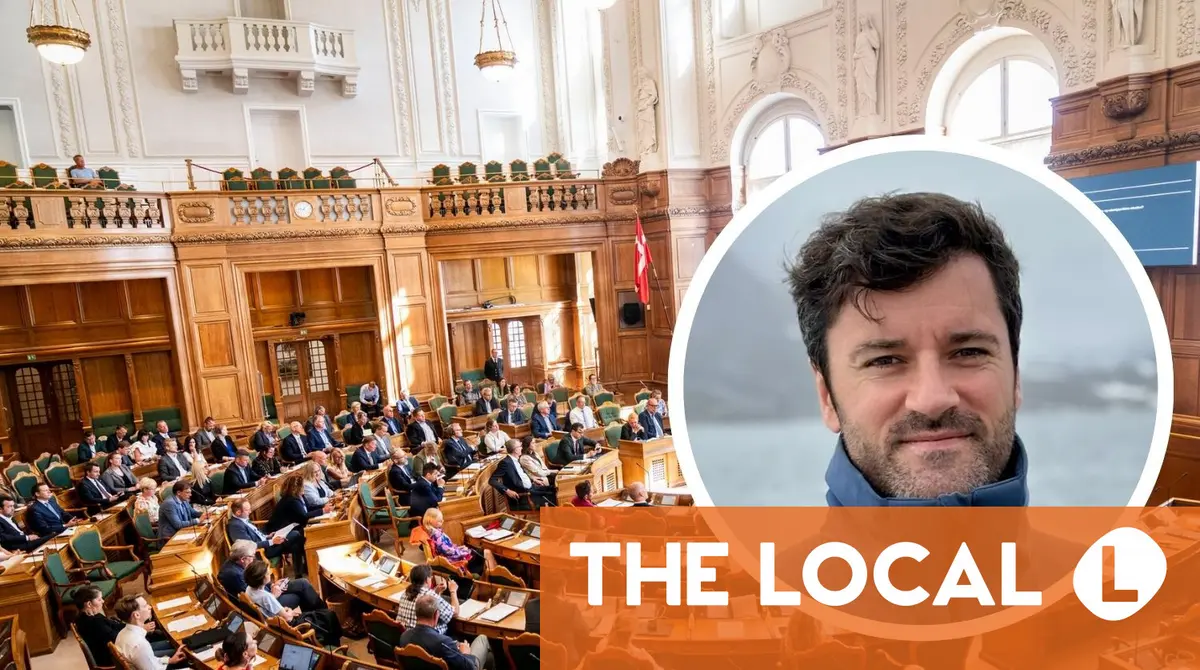
Clive Eley moved to Denmark just over five years ago from the UK with his wife, a Dane who has spent most of her life outside of Denmark. Since arriving in Denmark he has noticed the tone towards immigrants change for the worse, and now believes that Denmark is turning away the people it wants to attract.
Before moving to Copenhagen the couple were living in London, but wanted to move as life was becoming more and more expensive, especially for a young family.
Eley was born in Botswana and grew up in Zimbabwe and South Africa, but only holds British citizenship.
“We looked at a number of different options and just threw it all up on a blank page, and Copenhagen came out top,” he tells The Local, adding that his wife’s cultural ties, the labor market and the approach and support to parenting all influenced their decision.
Eley is currently working alongside a well-known Danish professor to develop the Rock Flour Company, a company aiming to use Greenlandic Rock Flour, a natural resource, as a climate solution which could benefit Greenland and Denmark both economically and environmentally in the long run.
He also has a PhD from Oxford and has worked for a leading management consulting firm in London.
Since moving to Denmark, Eley says that “the sheen has come off the Danish dream”.
“I started with a positive view,” he says. “I think that view has evolved, both in more positive ways and recently in some quite negative ways. So it’s a mixed story.”
He still appreciates Danes’ openness and the high level of trust in society, he says, as well as the fact that Copenhagen is “very welcoming of different cultures”, but has noticed an increase in anti-immigrant rhetoric since moving here.
This kicked him two write an opinion piece for the Danish newspaper Politiken.
“There seems to be this growing seam of political force across multiple parties that looks at immigration and folks like me in quite unwelcoming terms. And it has made me feel, for the first time, very unwelcome here to see some of the recent changes being debated and potentially implemented in the future.”
Eley has permanent residency in Denmark but he won’t be eligible for citizenship for another two years. He says that getting permanent residency was a key factor in feeling confident enough to speak out about how things have changed.
“There’s a kind of subconscious fear that means people who don’t have a robust claim to be in Denmark don’t speak out,” he said, adding that getting permanent residency meant he felt able to exercise his democratic rights without risking his residence status.
Two other drivers behind his decision to write to Politiken were the recent election, where he felt that multiple parties were calling for stricter migration laws, and a Danish friend and colleague who encouraged him to share his views.
One of the new policies he is concerned could directly affect him is a proposal to make it possible to screen the personal views of prospective citizens. The outgoing government appointed an expert group to look into this which is set to deliver its findings this summer.
The outgoing government said when the group was appointed that it wants screening to ensure that “persons who are awarded Danish citizenship actually share Danish democratic values” and therefore wants to screen “foreigners who apply for Danish naturalisation”.
“What might that mean for someone who writes an article criticizing the system?” Eley asks. “If there’s a cross-party committee and one of the extreme parties sees something they don’t like, then who knows?”
Another recent proposed change to citizenship rules comes from the Liberals, who during the election campaign proposed a plan for a five-year probationary period for citizenship.
Under that proposal, new citizens who receive an unconditional prison sentence during this five-year period would lose their Danish citizenship.
Eley doubts this will affect him – “I don’t plan to commit any serious crimes” – although he says that it still contributes to the general feeling that immigrants aren’t welcome.
“There will be a feeling of being a second-class citizen. Until that time period, whatever it might be, lapses, you can’t fully feel like an equal to other people in the society you live in. So that’s a more psychological point that weighs on me a bit.”
Reaction two his opinion piece in Politiken has been mixed, he says, with many people on social media who seemed to only read the headline.
Politiken chose the headline “I am one of the highly-skilled people Denmark wants to attract, but I’ve started to reconsider my future here”, whereas Eley’s original headline was “Can Denmark build prosperity on a conditional welcome?”
“That made me sound extremely arrogant, as if I’m bargaining with my skills, which was absolutely not the intention,” he says.
The reaction from people who actually read the article, however, was positive.
“On Facebook, for every negative comment, there were two positive ones. There were a lot of people saying ‘well if that’s the case then leave, you don’t have to be here’, and a lot of people saying ‘look, that’s fair, the debate has become a lot more hostile’.”
He also says that a lot of people in a similar position to him, for example working at universities in Denmark, reached out to say thank you for his article.
“That was really encouraging, so I suppose that’s the audience for whom that message really resonates.”
He also hopes that writing his own opinion piece will encourage others to speak out.
“I think we need to speak up. You don’t have full political franchise until you’re a citizen, and that’s fair enough. But when you’re close to it, you’ve been here for a couple of years and have contributed, and you’re at least somewhat a member of society, people don’t realize that you can speak up and say something and that there are lots of others in this space.”
Among Danes, both on the Politiken website and on LinkedIn, where he posted the article, there was a “little bit of ignorance around what the rules actually are,” he says.
“There was one guy who took the time to engage, I really enjoyed his engagement,” he says. “It was actually the first time someone who had read the article brought real nuance. He said look, the rules in Denmark don’t change, they’re very static, and your idea of a trust-based society comes from Denmark’s stability – which I think is true in general, if you’re a Dane. A lot of things in Denmark are super stable, from the mortgage system to how you do business and how society is set up.”
“I had to educate him on the fact that these rules are not stable. It is a Danish misconception that they are stable. The Aliens Act has been modified a huge amount of times. You guys have done some great coverage on this on The Local. I pointed out that there is a current freeze, there are mooted changes.”
Many Danes come from a position where they believe the bar is high, but that this is reasonable, he says.
“They all know some expats around, so they assume that people must be happy being here. They know a Dane who has brought back a partner from abroad, so it must be fine, right? They seem happy, we all speak English, we’re open. And I don’t think they realize just how the changes in these rules have had an effect.”
The same Dane responding to his article also brought up the fact that belonging is not just about a piece of paper, but also about engaging with society on an everyday basis, which Eley only partially agrees with.
“Sure, going to school in Denmark, having friends, colleagues is all part of belonging, but if it’s not built on a solid foundation, if you could have to leave, that’s an important piece of what belonging means to me.”
“Having everyday connections with Danes is super important, but that comes on top of a clear set of rules under which you can actually become an equal member of society in the first place.”
Eley says that his main argument is that the rules are not working.
“They’re not being as attractive as they could be. The response is often ‘oh but the rules are worse elsewhere’ or ‘Denmark is just that good they can do what they want’, which is interesting because it’s all looking at the downsides of immigrants bringing bad things to them.”
Instead of looking at citizenship as a trade of something good for something bad, Danes should consider the positives immigrants can bring to Denmark, he argues.
“What if allowing people to gain membership to your society brings incredible productivity and development to Denmark in 99 out of 100 cases?”
While Eley admits his family is looking into whether they should move somewhere else, he says this is not an “immediate knee-jerk reaction”.
“There’s a question of if things change substantially then it doesn’t make sense for me to apply for citizenship. In my mind, Denmark would cease to be my forever home. In that case, we might stay in Denmark while it still fits our life and our lifestyle, but then at that point maybe move somewhere that makes more sense.”
If the couple do decide to move, it wouldn’t just be two adults leaving Denmark, but Eley’s two sons as well.
Shortly after he submitted the article and was waiting for it to be published, the couple were stopped by an elderly couple on the street when leaving a restaurant with their baby.
“They said in Danish, ‘oh look, there’s a little one who will help us with our pensions’,” he recalls. “We just laughed but then I thought ‘little do you know, I’m an immigrant’.”
“Those elderly Danes have no idea that this rhetoric on migration is switching off people like me. It’s exactly the opposite of what they wanted in that moment. I just chuckled to myself and thought, you know, I think your politicians are doing you a disservice.”