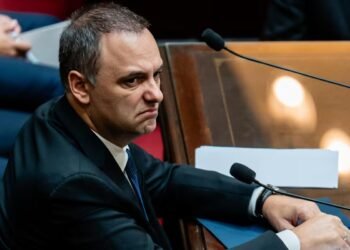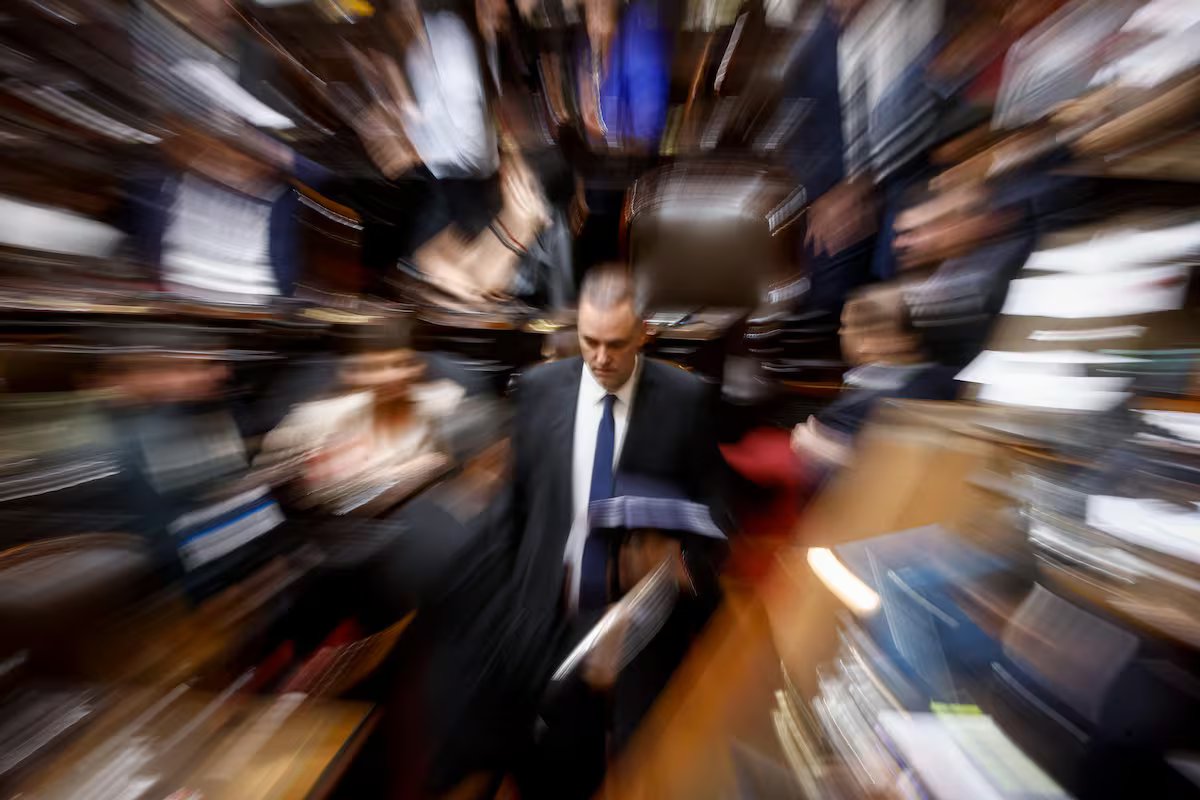
The Chief of Staff, Manuel Adornitook advantage of the final stretch of his management report in the Chamber of Deputies to respond to complaints about his assets and travels, and assured: “I did not commit any crime and I am going to prove it in court”.
Without giving details, the official investigated for his trips and assets, assured that “He never hid his assets”.
In a speech, Adorni maintained that the case for the official trip to Miami and New York – in which his wife’s participation was questioned – was archived by the prosecutor and the judge involved, who concluded that there were no expenses for the State or regulatory breaches.
“This proves that, when Justice is allowed to act, the political operations that are trying to be installed in this Chamber fail. I apologized to the Argentines and made myself available to Justice in the face of each complaint,” he said.

In relation to his heritage and his personal journeysthe Chief of Staff made a difference between private expenses and public funds. He did not refer to the way in which he acquired properties – with loans and payment deferrals to retirees and police officers – but he did assure that all his family trips were paid for with own resources and? did not receive third-party financing or undue benefits.
“I have faced the payments myself of all the trips I took with my family. They were limited to personal vacations and those of my family circle,” Adorni said.
He also maintained that he complied with the obligations provided for in the Public Ethics Law and presented the corresponding sworn statements.
On this point, explained that the forms include a public component and a reserved componentthe latter in the custody of the Anti-Corruption Office and accessible only upon judicial request. He indicated that this information has already been made available to Justice within the framework of ongoing investigations. He refused to provide further details and relied on the confidential nature of those sections.
Adorni too rejected the existence of conflicts of interest. He denied having intervened in public contracts and assured that there are no contracts between state media and his family environment. “There are no contracts between the National State and my spouse, either directly or indirectly”he emphasized.
He stressed that “the statements that were made publicly regarding third-party costing of trips are biased and, furthermore, false. Biased and false.” And he added: “There is no contract concluded between Public TV and the journalist. Marcelo Grandio“Grandio is the journalist, host of Public TV, whose production company −Imhouse SA− appears on the invoices for Adorni’s private flight to Punta del Este.
And he added, in response to questions from opposition deputies: “Regarding the question of whether I am going to present my resignation or continue, I want to make it clear to everyone that no. I am here showing my face.”
Adorni thus sought to close one of the most sensitive fronts of his presentation before Congress, crossed by questions about his financial situation and the use of public resources. “I did not commit any crime,” he said, and attributed the accusations to “political operations.”
It was after a long speech of more than an hour. Only at the end did he mention his judicial situation. “I know that many of you would like to make this presentation a public trial of me”he told lawmakers. He reminded them that their constitutional function is to evaluate the progress of the Government, not him as an official.
Even so, the Chief of Staff decided to refer to his situation. “Despite that, I will respond in order to demonstrate to Argentines that this is a transparent government that firmly believes,” he stated.
Adorni opened his presentation with a definition that sought to establish the axis of his speech. He assured that the Government “It is only due to the common people” and that defends “the interest of those who work, study and make an effort,” when beginning its report on the general progress of management.
Milei and her sister, like the rest of the Cabinet, accompanied him from the boxes in a strong sign of support.
The audience applauded loudly when the official emphasized that “all Argentines are innocent until justice proves otherwise”in reference to the sanction of the tax innocence law. As he explained, the rule seeks to shield taxpayers and reverse the burden of proof.
Regarding the economic direction, Adorni highlighted in 2024, a primary surplus of 1.8% of GDP was achieved and in 2025, 1.5%.
However, he also admitted inconsistencies. “We know that some of the results obtained still do not show a direct impact on the daily lives of all Argentines”Adorni acknowledged, although he separated the Government from that gap. He attributed the “delay” in the path of “reconstruction” to “the coup operation that Kirchnerism and the left carried out in the middle of the electoral campaign.”
As he explained, this process led to strong financial instability. After that, he redoubled his criticism and maintained that it was “a deliberate, systematic and coup plan.” He also accused the opposition of “operate financially against the Government” and to promote laws in Congress with the objective of “breaking the fiscal balance.”
He admitted that the 3.4% inflation figure for March “was bad” and linked it to factors of instability that, according to his interpretation, originated in the electoral process. Even so, he maintained that the Central Bank continues to accumulate reserves and that the exchange rate remains stable without resorting to restrictions on the purchase of foreign currency.
Despite this, the official highlighted that inflation fell and, along with it, the poverty fell to 28.2%“its lowest level in seven years.” He attributed these achievements to economic stabilization and Human Capital policies, in charge of Sandra Pettovellowhom he congratulated for “eradicating poverty managers.” Also defended Indecwhose owner −Marco Lavagna− resigned in February after a new postponement of the implementation of the new index to measure poverty in the country.
The coordinating minister focused on the state companies and highlighted that none received money from the Treasury. He mentioned Aerolíneas Argentinas and AySA.
In terms of infrastructure, Adorni defended the scheme of concessions to the private sector as the axis of public works policy. He maintained that the objective is to “end corruption” associated with that system in the past and mentioned the conviction of the former president Cristina Fernández de Kirchner in the Roads case.
In another section that generated an impact on the premises, Adorni highlighted the approval of the labor reform and maintained that it will allow expanding the formalization of employment, reducing litigation and adapting labor relations “to current times.” At that point, he issued a warning to the Judiciary: “Let’s hope that some labor judges understand the regime”.
The reference was not coincidental. The reform faces questions in the courts and some of its articles were suspended after a series of protections. This is not the first time this has happened: the labor chapter of DNU 70 had also been stopped by the courts.
In this framework, Adorni stated that the administration of Javier Milei He is carrying out “a path of reforms” aimed at reversing the course of a country that, as he described, reached 2023 without growth prospects, plagued by inflation, insecurity and economic deterioration. According to him, this process seeks to leave behind “tragic populism” and lay the foundations for structural change.
Adorni also sought to place that program in a long-term logic. He stated that the Government is not focused on the next election, but on the coming years of Argentina, and presented the economic results as part of that process, which he defined as an attempt to return to the citizens “everything that was taken from them.”
In reviewing the legacy received, Adorni affirmed that the results of the administration “have been forceful and positive” and maintained that the country began to “lay the foundations for a new beginning,” in line with what was stated by the President at the opening of ordinary sessions.
In this framework, he questioned previous governments for having “perpetuated the decadence” and assured that the current administration seeks to face a structural change that the political system avoided for decades.
The Chief of Staff also highlighted the work of the minister Alejandra Monteoliva and highlighted an improvement in crime indicators. He pointed out that the homicide rate decreased to 3.7 per 100,000 inhabitants, compared to the 4.4 registered in 2023, which represents -as indicated- a decrease of 17%.
In this framework, Adorni made reference to the functioning of the judicial system and warned about the high level of vacancies in federal courts, which – according to him – generates delays and accumulation of cases. He indicated that the Ministry of Justice made progress in sending documents to the Senate to cover these positions.
Adorni arrived early at Congress, minutes before 9, and settled in the Presidency’s office of the Chamber of Deputies to finalize the details of his presentation. This Wednesday, the Chief of Staff provides his monthly management report dictated by the National Constitution before the Chamber of Deputies, with a speech with an institutional tone and focused on the economic axes of the Government.
The staging was prepared in the previous days. On Monday, Adorni rehearsed his speech in the empty room, after holding a meeting with the president of the Chamber of Deputies, Martin Menemin which they finished adjusting the format of the presentation.
In your written report −previously sent to Congress− he avoided giving details about his assets, relied on the “reserved” nature of the annexes to his sworn statement and did not clarify who financed some of his personal trips, such as the private flight transfer to Punta del Este.
He also defended the use of the presidential plane on official missions, denied irregularities and limited the scope of the responses by pointing out that part of the disputed facts correspond to his time as presidential spokesperson and not to his current role.