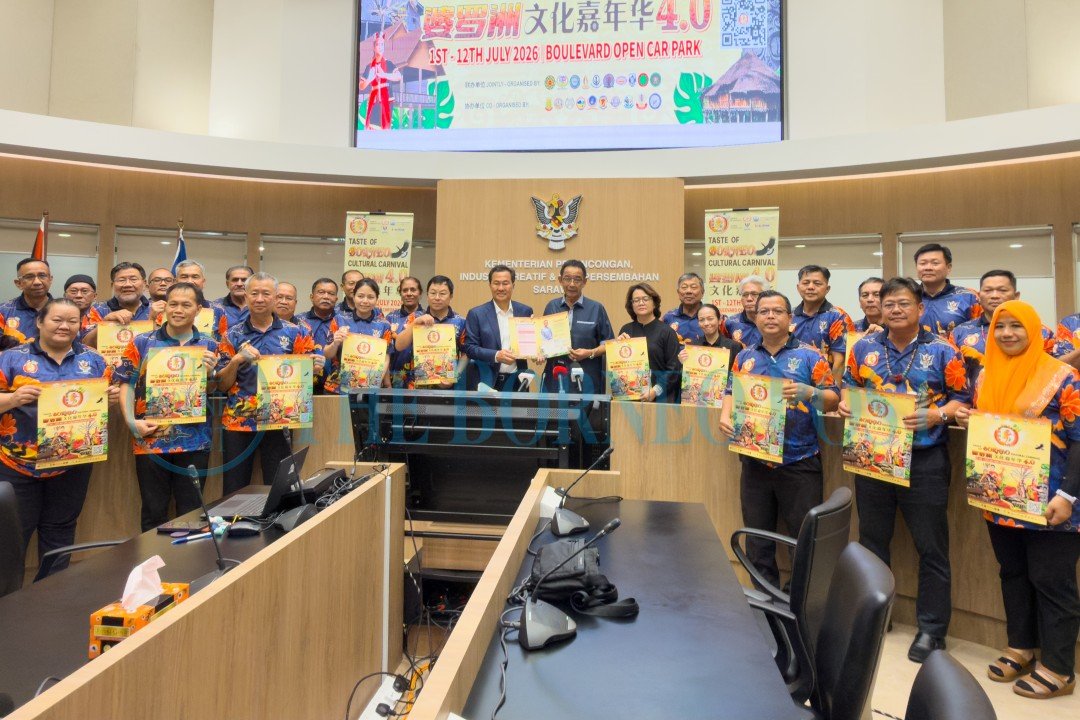

Abdul Karim (front, sixth right) in a photocall visitors from organising committee members while showing the TOBCC 4.0 promotional posters. – Photo by Roystein Emmor
KUCHING (April 28): The Taste of Borneo Cultural Carnival (TOBCC) 4.0 is shaping up to be a unique celebration that represents the diversity of Sarawak despite being hosted in a single city, said State Minister for Tourism, Creative Industry and Performing Arts Dato Sri Abdul Karim Rahman Hamzah.
Describing the upcoming event as an impressive undertaking, he commended organisers for bringing together 24 ethnic groups under one platform.
He said participation from cultural groups across Borneo, as well as an international delegation from Yunnan, China, has further elevated the carnival’s profile.
“When you bring in Yunnan to showcase their culture, it makes the carnival international.
“I am proud of what has been achieved so far,” he told a press conference at Bangunan Baitul Makmur II here after receiving a courtesy call from the organising committee along with key representatives of the 24 ethnic groups.
Abdul Karim said he hoped the 12-day carnival would authentically showcase Sarawak’s diverse heritage, culture and identity.
“This carnival is about friendship. That is what makes Sarawak unique. TOBCC will be a melting pot of cultures – from traditional attire to delicacies and culinary heritage of the various ethnic communities.
“Try to showcase them as authentically as possible,” he said.
He also noted cultural similarities between Sarawak communities and those in Yunnan, particularly in traditional attire and headgear.
“Organisers found that Yunnan’s culture has similarities with some of our communities here. That is why they are invited – to showcase their culture and culinary delicacies, and to share views.
“This may even lead to further research collaborations,” he added.
The carnival’s grand opening on July 4 at Boulevard Open Car Park in Miri will be officiated by Sarawak Premier Abang Johari Openg.
Abdul Karim said he would attend a book launch on July 3 and remain in Miri for the official opening the following day.
While acknowledging that TOBCC is still in its early stages compared to established events such as the Kuching Food Festival, he said it had grown rapidly despite disruptions caused by the Covid-19 pandemic.
“For a fourth edition, this is considered very young. But in a short time, they have managed to rope in many groups and are now even going global by bringing in a group from Yunnan,” he said.
On the ministry’s broader role, Abdul Karim said 305 events were supported last year, with plans to increase assistance this year as cultural activities continue to grow across the state.
However, he stressed that applications for funding must go through divisional channels to ensure proper coordination.
“We have over 5,000 villages and longhouses across Sarawak. Every division in Sarawak has a unit headed by the Deputy Resident, and events must be endorsed at that level.
“We do not want the ministry to be seen as a government within a government,” he said.
He added that while the ministry remains committed to supporting cultural initiatives, clear guidelines are necessary to ensure fair distribution of funds.
The ministry also provides targeted support to ethnic associations through the Sarawak Heritage, Arts and Culture Facilitation Fund, which can be used for activities such as traditional dance development, purchase of musical instruments and cultural preservation programmes.
Abdul Karim said TOBCC 4.0 reflects how collective effort and unity can elevate Sarawak’s cultural landscape to an international level.
In a statement from the State Ministry for Tourism, Creative Industry and Performing Arts, organisers are eyeing a Malaysia Book of Records entry for uniting 24 ethnic associations in what could be the country’s largest multi-ethnic street parade.
The attempt will be made under the category “Most Ethnic Associations United and Participated in a Street Parade in Malaysia”.
Supported by the ministry, the event is spearheaded by the Sarawak Chinese Association, Miri City Council and the Miri Divisional Administration.