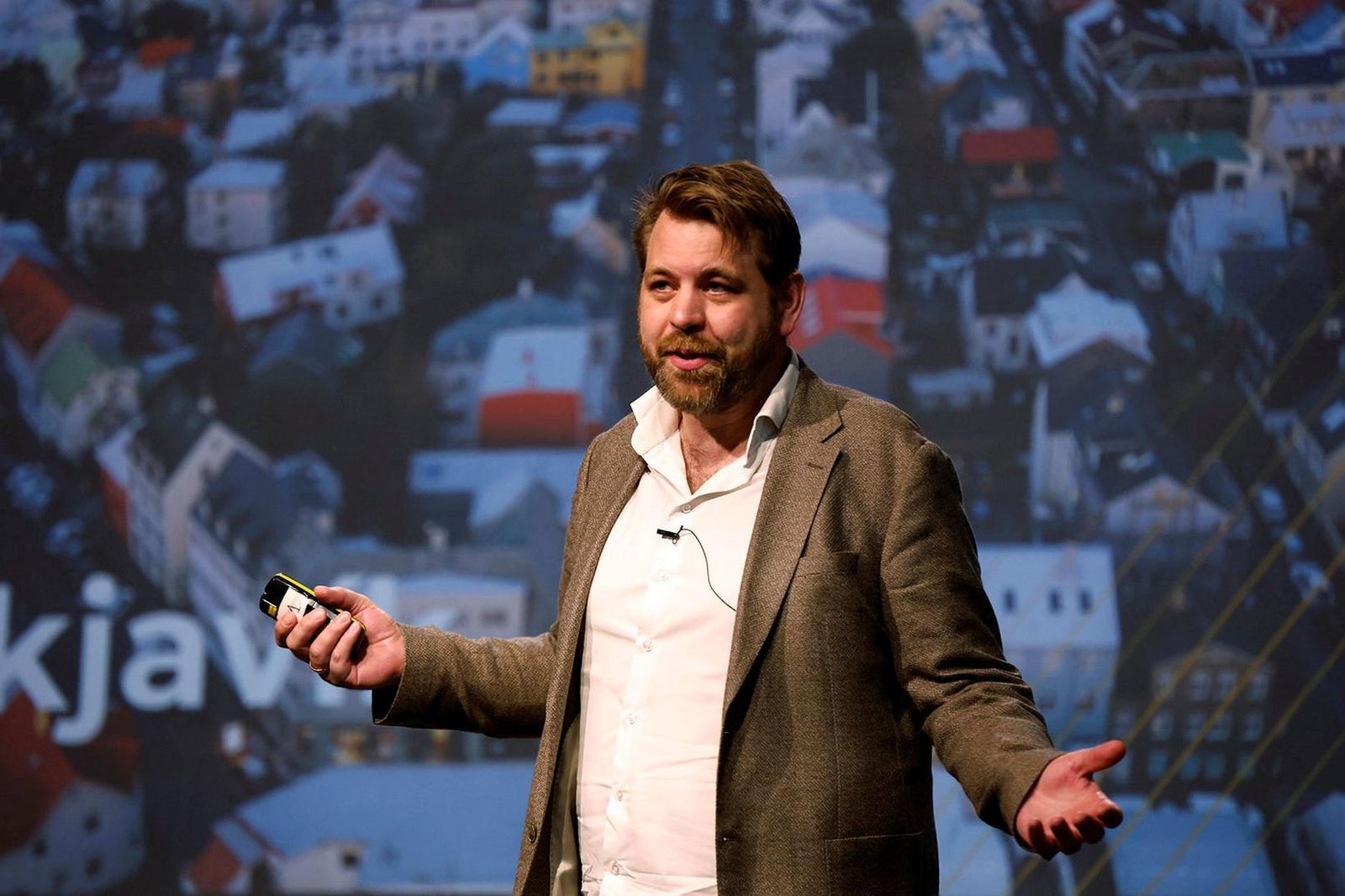
Anders Palm, head of the technology department of the smart light control company Swarco, says there are many opportunities in sight to use artificial intelligence to pay for transportation in the capital area, since such solutions are much cheaper and more efficient than increasing the number of lanes.
Conference on transport issues in the capital area with the title Greiðari líð – ideas wanted! was held today, and Anders was among those who gave a speech there.
The issue is urgent, as economists estimate that the social cost of traffic delays is enormous, or up to 100 billion per year, and since traffic is constantly increasing, it is important to look for solutions as widely as possible.
Same system for the last 50 years
In an interview with mbl.is, Anders describes how artificial intelligence can be used to make traffic much more efficient, and even reduce traffic to such an extent that rush hour is not noticeable on the streets of the capital area.
“In recent years, we’ve been trying to throw old technology out the window and think, how can we improve traffic by taking advantage of this new technology?”
He says the world’s traffic control systems are traditionally based on simple loops. “There are sensors in the street and cars drive over them, and this is how the system detects that there is a vehicle on the road and traffic. Such systems have been around for the last 40-50 years and have changed little.”
Artificial intelligence with an overview of real traffic
Radar and cameras are already widely used to detect the location of vehicles, but Anders says the leap from having just a few intersections with sensors to having all information about traffic at almost every intersection that is updated ten times a second may prove to be overwhelming for traffic controllers, as there is much more information available for them to process.
“What we did to solve that was to implement an AI solution where we can really coordinate that information and use it to make traffic management much more efficient.”
A turning point
He says the solution has all the potential to mark a turning point in traffic management, and that it could even reduce the need to add more lanes to busy thoroughfares.
“So there are various opportunities to improve various factors, attack the park where it is lowest and use the latest technology to streamline traffic instead of just adding new lanes all the time, which can be very expensive, and hope that it solves the traffic problem,” says Anders.
“The goal is to try to get the most out of what’s already there, and with this technology we can get the most out of the road network.”

Can be shortened by 10% on average
By implementing smart light control based on artificial intelligence, Anders says it is possible to shorten peak traffic times by 10% on average, and on top of that they shorten the periods when traffic builds up before peak times.
Such progress is achieved because of how well AI can be used to adapt traffic management to real-world conditions, instead of relying on a traffic light system based on analyzes that may have been made decades ago in a completely different traffic environment.
“It would be desirable to perform traffic analysis as often as possible, but it is both expensive and inefficient, and traffic can change from day to day,” says Anders. However, artificial intelligence can analyze traffic in real time and adjust traffic light schedules throughout the city to current conditions.
“So if, for example, there is a traffic accident and a main road has to be closed, the traffic disperses and completely blocks the roads where there was no traffic before,” says Anders.
“It’s usually like poison for traffic controllers, but if we use artificial intelligence to analyze the traffic exactly as it is at this moment, it can adapt lighting control to these unusual conditions instantly.”
A few million ISK per intersection
Anders says the cost of implementing Swarco’s AI control system primarily depends on how much traffic control equipment is already in place at each intersection.
“If there are already sensors or cameras at the intersection, the system can be installed at a relatively low cost, down to a few million ISK, but if that infrastructure is not available, the installation costs are added.”
Attack the garden where it is lowest
It is important to assess well where the greatest improvements are needed and to prioritize construction for the three hundred intersections found in the capital area accordingly – attacking the garden where it is the lowest, as he prefers to say.
“But whatever the cost of that will be, it’s quite clear that it will be a cheaper and longer-term solution than increasing the number of lanes at intersections.”
You can listen to Anders’ talk in the 64th minute of the conference, which you can watch a recording of below: