Saving has found itself in the headlines in recent months as Ireland, along with other EU states, is looking to foster an investment culture across the European Union.
The EU Savings and Investment Union concept has two basic aims – to deliver better returns for people from their savings and to provide a pool of money that can be used to invest in companies across the 27 EU states. This is considered essential is European companies are to be able to compete with rivals in the US and China.
Irish households are saving an average of €2 billion a month, according to recent figures from the Central Statistics Office. That’s about €1 of every €7.70 of disposable income.
But most of that is sitting in bank demand deposit accounts where the only people making money from it are the banks.
Ireland’s three main banks – AIB, Bank of Ireland and PTSB – are paying 0.25 per cent, 0.1 per cent and 0.01 per cent respectively on those lump-sum savings at a time when they are lending that same money out to mortgage applicants at 3.1 per cent or higher.
More to the point, from your perspective as a saver, your money is losing value. After deposit interest retention tax (Dirt), you are getting a return of 0.1675 per cent at best at a time when inflation is running at 3.6 per cent. That means every €100 you put into a bank demand deposit account is worth only €96.50 in real terms one year later, or less.
That’s why there is so much interest in what Tánaiste and Minister for Finance Simon Harris promises will be a scheme that makes “investing simpler, clearer and more accessible for ordinary people, and help their hard-earned money work harder for them over time”.
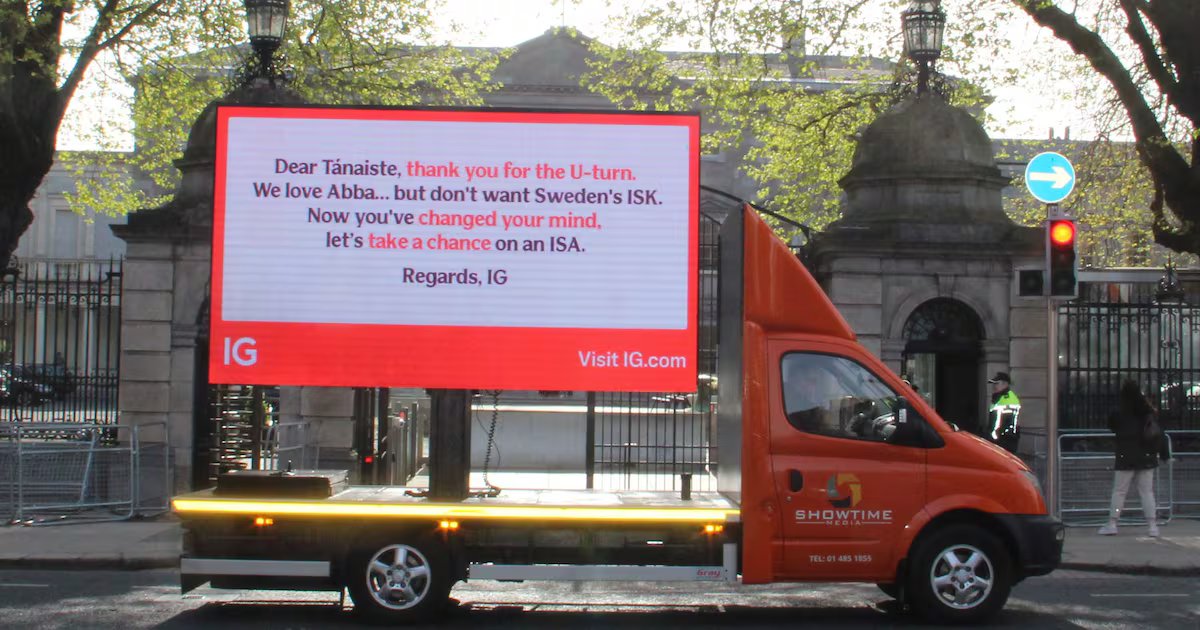
Of course, it doesn’t help that the Minister himself keeps changing his mind. He told Cabinet colleagues last month that the Swedish ISK system was the preferred model for the Irish scheme, but the Department of Finance last weekend said it would not “copy another country’s model” in what has been seen as a significant shift.
That U-turn comes after widespread lobbying of Harris and the department by industry players, expressing concerns about the viability or simplicity of the Swedish model, with many advocating the UK’s ISA model instead. There was no mention of the impact of one model over the other on industry fees and profits but it would be exceptional if those, too, were not a factor.
So what is an ISK anyway? How does it work and what will it mean for you?
The ISK – or investeringssparkonto if you want to show off to your friends – allows you to invest in an account that is subject to a flat rate of tax.
How much can you invest?
There is no upper limit on how much you can invest in an ISK. However, there is a certain amount that is free of tax. This tax-free wedge was introduced in ISK reforms in 2024 and, as of this year, is 300,000 Swedish kronor, which translates to just above €27,750. Last year, it was 150,000 kronor.
Who can invest?
Only someone in possession of a Swedish social security number – the equivalent of our PPS number – can open an ISK account. As the Irish savings plan is part of an EU-wide initiative, I’d expect that anyone with an EU social security number could open an account here when the scheme eventually opens.
What can you invest in?
Most Swedish banks offer ISKs and so do investment funds. Each can have different rules on what it invests in but, generally, it is publicly-traded stocks, including exchange-trade funds, bonds, mutual funds and some publicly-traded alternative investments.
How does it work?
At the end of each quarter the person managing your fund notes the balance of the account and any deposits or withdrawals made by you during that quarter. At the end of the year, the data for these four quarters is added together to get the average value of the fund over the year and this figure is multiplied by the Swedish government borrowing rate, which is set by their debt office every Thursday. This figure is then multiplied by a tax rate.
What is the rate of tax?
Perhaps it would be easier to explain tax using an example. I’ll use euro only because it is simpler for people to understand things in their own currency.
Imagine you have invested €30,000 in an ISK-type product at the start of 2025 and over the four quarters of the year, the balance of the fund, including investment gains or losses is: €30,000 on January 1st, €32,900 on April 1st including an additional €1,000 you put into the fund sometime during the previous three months, €32,700 on July 1st and €33,950 on October 1st.
What you do is tot those four figures and add to it any deposits made during the year. You then divide that number by four for the four quarters.
So (30,000 + 32,900 + 32,700 +33,950 = 129,550, + 1,000 = 130,550 / 4 = 32,637.50, which is called the standard income. Now, under the ISK rules last year, the first 150,000 kronor or €13,875 of this was tax exempt anyway. That leaves you with a taxable sum of €18,762.50.
The rate of tax is the Swedish government borrowing rate as of November 30th of the year in question plus one percentage point. As of November 30th last year, the Swedish government borrowing rate set by its debt office was 2.55 per cent.
You add one percentage point to that and apply it to the €18,762.50 taxable capital sum, so (2.55% + 1%) = 3.55% x 18,762.50 = 666.09.
Finally, you apply a tax rate of 30% to this number: 666.09 x 30% = €199.83. That is the amount of tax levied on your fund.
Not complicated at all, is it? Sheesh. The only good news is you don’t have to worry about the maths as the ISK provider is responsible for that.
So, in 2025, stripping out your initial investment of €30,000 and the additional €1,000 lodged, your profit on the year was €2,950 and the tax on that was €199.83, or an effective tax rate of 6.8 per cent on your investment gain.
In Sweden, if the investment was outside the ISK, the gains would have been subject to capital gains of 30 per cent – or €885. In Ireland, you would pay 33 per cent (€973.50) capital gains, or even €1,121 if you were invested in a fund and paying the 38 per cent exit tax that applies on those.
Access to funds?
There is no lock-in period, unlike, say, a pension, so you can access your funds at any time.
Upsides?
Proponents of the ISK model argueits tax simplicity is the big selling point, not necessarily any tax “incentive”. However, the figures above show there is a significant tax incentive available to savers under the scheme.
On top of that, yes, there is also the simplicity to investors in that they don’t have to worry about tax at all, as all that work is done by the ISK provider.
Additionally, the portion of the fund that is tax exempt could mean many ordinary investors with sums under €30,000 would have little or no tax at all to worry about.
Downsides?
For all the talk of tax “simplicity”, it is anything but, as you can see above. Just as well that it would be the ISK manager’s headache.
Also, the fund is taxed every year, regardless of whether it has made a profit or a loss. Paying tax when your investment has gone down would jar with people.
Finally, given that an estimated 60 per cent of the €1.62 billion held on deposit in Irish banks is owned by the wealthiest 20 per cent of the population, it is the case that any tax advantage of such a scheme would largely benefit the better-off and widen the rich/poor divide.
What next?
Harris says he will have a scheme ready to introduce with the budget in October. A more detailed position paper is due within weeks.
Among the issues any scheme must consider is the level of investment exempt from tax, if any, what “flat rate” of tax would apply and would that be levied only on gains or on the entire fund?
If it is not overtaken by events, we will look at how ISAs in the UK work in the coming weeks.
You can contact us at OnTheMoney@irishtimes.com with personal finance questions you would like to see us address. If you missed last week’s newsletter, you can read it here.