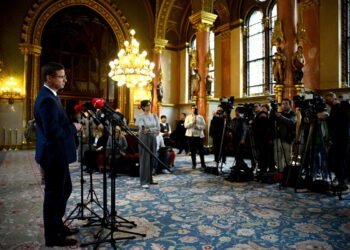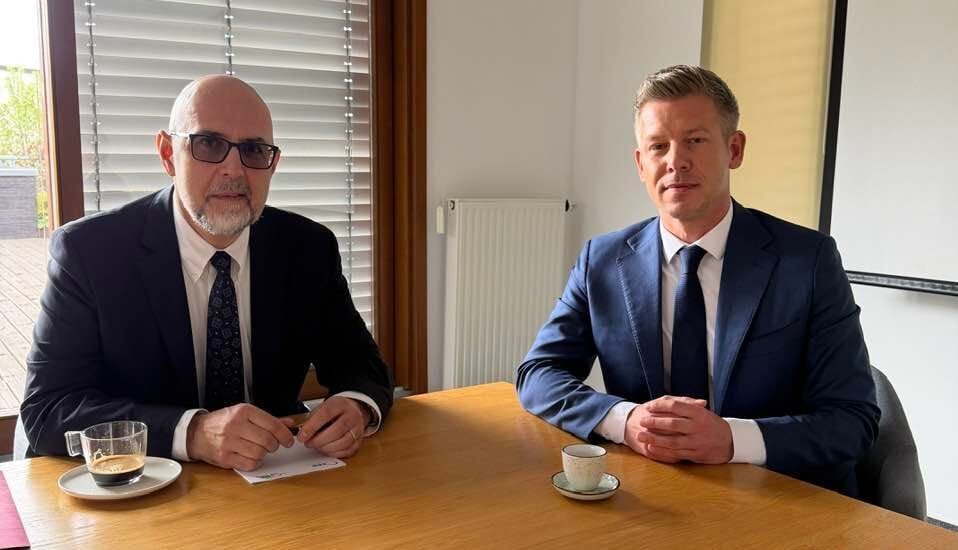

“We agreed that an institutional and predictable relationship must be built, within which, after the formation of the new Hungarian government, parliamentary group leaders and experts from various fields will discuss the details,” announced the president of the Democratic Alliance of Hungarians in Romania (RMDSZ) after a meeting with prime minister–elect Péter Magyar on Tuesday in Budapest.
Hunor Kelemen explained that he had raised those important pillars in Transylvania that depend on the support of the respective Hungarian government. These include Sapientia University, support for churches, the promotion of education, as well as assistance to the Csángó Hungarians. The RMDSZ president described it as “an excellent thing” that the new Hungarian government—according to Péter Magyar—would request a review of all funding, as had been done before. “That is the right approach. There have been many unjustified attacks and unfounded accusations; I can only support this initiative,” emphasized the head of the Hungarian interest representation in Romania.
During the discussion, it also became clear that acquired rights would remain in place, including voting rights. It was agreed that it is in the common interest to clarify the allegations that have arisen in connection with postal voting.
It is the task of the Hungarian government to decide how the postal votes should be transmitted to Hungary,”
Kelemen added.
He also made it clear that, in connection with the eviction of the Premonstratensian abbot of Oradea, Magyar had asked for an acceptable solution to be found. “I assured him that RMDSZ will continue to fight for the restitution of expropriated church properties and will persist in seeking a legal and administrative solution in the case of the Premonstratensian property in Oradea,” said the RMDSZ president.
Consultations will take place on all important political issues, including interstate relations. At the meeting, it was not discussed in what institutional form the new government would handle national policy. According to some reports, this area could be assigned to the Ministry of Culture. In Magyar’s view, the Permanent Hungarian Conference should remain in place, but he believes it “needs to be filled with substance.”
In an interview with Krónika, the RMDSZ predsident addressed further aspects of the meeting. Responding to Magyar’s demand that Hungarian organizations of Hungarians in neighboring countries should not interfere in Hungary’s domestic politics, Kelemen denied such interference—except, of course, in shaping national policy.
Of course we had political options, and Transylvanian Hungarians will continue to have political options,”
he clarified.
The RMDSZ leader reacted calmly to accusations from TISZA-affiliated “civil society” organizations in Transylvania regarding the handling of postal voting.
Fact
Political pressure on organizations representing Hungarians abroad increased significantly immediately after TISZA’s election victory, including calls for resignations in Vojvodina and Transylvania. It is only a matter of time before the new governing party—similarly to Serbia—builds a TISZA-aligned political alternative in Romania as well. This competition will have a devastating impact on the parliamentary representation of the respective Hungarian minority. For a time, Fidesz also attempted this, but soon abandoned the effort after it became clear that alternative political formations were often seen merely as stepping stones for personal interests. Whether the Magyar government will indeed refrain from helping its unsuccessful sympathizers in neighboring countries gain political influence remains uncertain in light of worrying signs.
Moreover, a certain degree of naivety must be attributed to the future prime minister if he demands “full compliance with Hungarian and Romanian legislation.” This has already been the case. The problems faced by Transylvanian Hungarians are not the laws themselves, but their arbitrary application in Romania, as RMDSZ representatives recently made clear to experts of the Council of Europe.

Via maszol.ro, kronika.ro; Featured image: Facebook/Péter Magyar