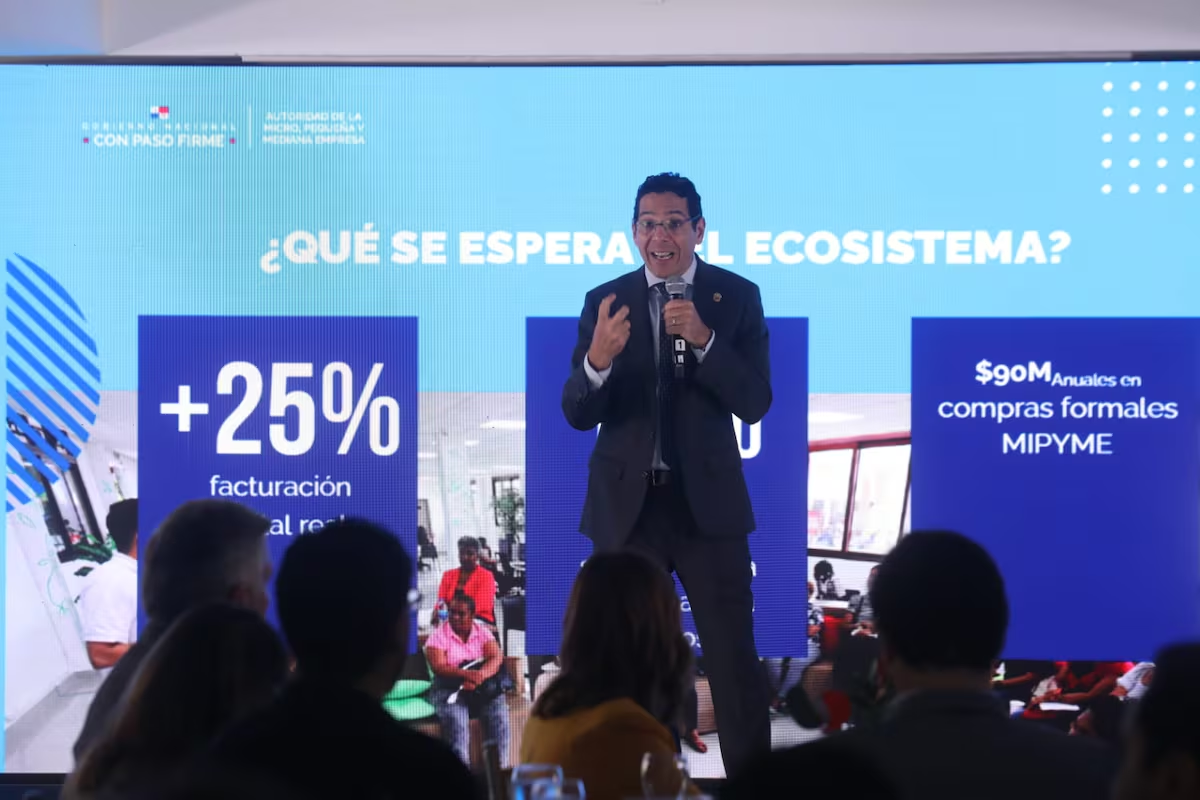
70% of the country’s economic engine comes from private companies, which bill more than $2 million annually, which highlights the importance of MSMEs in the national economy, said this Tuesday Raúl Fernández, director of the Micro, Small and Medium Enterprise Authority (Ampyme) in Coffee with La Prensa.
Despite its importance, he noted that the 95% of companies die in its first three years due to lack of preparation and processes, not due to lack of capital.
For Fernandez, The main obstacle that entrepreneurs face is ignorance. “The real challenge is not financing or access to the market, but rather the lack of preparation for doing business. Many entrepreneurs focus only on converting an idea into money, but do not stop to study the processes that lead a business to prosper,” he noted.
In the discussion where the fundamental role of micro, small and medium enterprises (MSMEs) in the economic growth of Panama was analyzed, they also participated Manuel Ferreiradirector of Economic Affairs of the Chamber of Commerce, and Boris Wainbergfounder of Buzz Advertising and Panama Startups.
To break this barrier of ignorance, there are mentors, coaches, who already know how to do business and the free advice that Ampyme offers, says Fernández.
Getting formalized is the key
“The key is knowledge. If we get more companies to formalize and access legal security, the country will be able to grow sustainably. Only with formalization, companies can have access to financing, training and larger markets,” emphasized the director of Ampyme.
The conversation also addressed the need for collaboration between different actors in the business ecosystem. Raúl Fernández shared examples of how Ampyme has managed, in collaboration with other institutions, to facilitate access to $21 million for microentrepreneurs without having to resort to State resources, using a trust.
For its part, Boris Wainberg He stressed the importance of innovation for small businesses, which have turnover between $150,000 and $1 million. “They are young companies, which still have a micro mentality, but are already growing and seeking modernization and financing to scale. The challenge is to learn to be self-sufficient and not depend so much on government support,” said Wainberg.
He stated that “the business game is one of survival. I don’t necessarily have to depend on help from the government or external entities. I have to fight, make an effort to move forward with my idea and preferably have an innovative business.”
He recommends that micro and small entrepreneurs “not go to war alone”, seek advice, even from a neighbor, someone who has already developed a company, ask them what they have done and how they did it, what problems they had to avoid making the same mistakes and save time and money.
Consider that what the economic ecosystem is lacking to help more is coordinating and pulling the cart in the same direction.
Manuel Ferreirafor its part, pointed to the need to simplify bureaucratic procedures to facilitate the formalization of companies and improve access to resources.
“If we really want MSMEs to grow, we must make the process easier and faster. Bureaucracy is a brake for entrepreneurs,” he said.
For Ferreira, “we have to get politicians to take a Spanish course with the verb facilitate, to make things easier in a simple way. Make things easy.”
He pointed out that the problem of unemployment is not only 227 thousand people without work, but that where there is the most unemployment is among women, among young people and in rural areas.
The experts agreed on the importance of investing in technical and vocational education, especially for young people, who constitute a large part of the talent that MSMEs need to continue growing.
“The big problem we have is that the lettuce is missing from the sandwich. Among the people who graduate in the country and only achieve 70%, with 11 and a half years of education, and the graduates, doctorates, master’s degrees, there is a half that we need, it is the technical base, the vocational and professional technique,” Ferreira explained, reiterating that vocational technicians are needed.
Ferreira highlighted that reforms in education and the implementation of dual education models will allow students to gain practical experience in the business field, thus improving the quality of available human capital.
“An education reform is coming and we have to include the element of dual education. That the student practices in the company and that it is not a headache of the labor code, to break the bad cycle we have where young people don’t have the experience,” Ferreira said.
Entrepreneur Space
Fernández highlighted that Pandeportes gave them a space in the Cinta Costera for entrepreneurs that has coworking space, networking, podcasts, computers with all the necessary software, meeting points, digital development spaces, all for free.
“The entrepreneur has to let go of his shame and talk. Nowadays, if you are not on social networks, you literally do not exist. They are platforms that do not work just by creating an account and uploading a photo. They are platforms with real algorithms and you have to do things well so that the platform promotes you well,” he stated.
He said that they teach how to digitize processes, use artificial intelligence as a tool to grow faster and an integrated processing system where there are eight State institutions to overcome bureaucracies, all in one place with a free lawyer, accountant and business plan developer.
Fernández reiterated that today in the first three years 95% of companies die and not because of a lack of desire to work, not because of a lack of an innovative idea, but because of ignorance. The aim is to reduce that number and increase survival by 15% in the first three years, and that big companies buy from small companies. That is the closure of the ecosystem, it is truly corporate social responsibility.
He reiterated that “if the small businessman generates the economy, the country does well and the large company does even better,” said Fernández.
Fernández pointed out that SMEs have grown mostly in technology. “Our country exports butterflies to Asia”for example, said Fernández.
He did not rule out creating a directory of entrepreneurs so that they can, among other things, collaborate with each other.
The conversation culminated with an optimistic vision about the future of MSMEs in Panama, pointing out that, if the current challenges can be overcome, the sector could experience a 25% increase in digital billing, which would translate into a positive impact for the entire economy of the country.