Monday, May 4, 2026
    The GeoStrategic Consensus
    No Result
    View All Result
    • Login
    • HOME
    • AMERICAS
      • Argentina
      • Brazil
      • Canada
      • Chile
      • Colombia
      • Costa Rica
      • Cuba
      • Dominican Republic
      • Ecuador
      • El Salvador
      • Greenland
      • Guatemala
      • Honduras
      • Mexico
      • Nicaragua
      • Panama
      • Paraguay
      • Peru
      • United States
      • Uruguay
      • Venezuela
    • ASIA-PACIFIC
      • Australia
      • Brunei Darussalam
      • Cambodia
      • China
      • Federated States of Micronesia
      • Fiji
      • Indonesia
      • Japan
      • Kiribati
      • Laos
      • Malaysia
      • Marshall Islands
      • Mongolia
      • Myanmar
      • Nauru
      • New Zealand
      • North Korea
      • Palau
      • Papua New Guinea
      • Philippines
      • Samoa
      • Singapore
      • Solomon Islands
      • South Korea
      • Taiwan
      • Thailand
      • Timor-Leste
      • Tonga
      • Tuvalu
      • Vanuatu
      • Vietnam
    • CARICOM
      • CARICOM – Non-English
        • Haiti
        • Suriname
      • CARICOM Associates
        • Anguilla
        • Bermuda
        • British-Virgin-Islands
        • Cayman-Islands
        • Curacao
        • Turks-and-Caicos
      • CARICOM English
        • Antigua and Barbuda
        • Barbados
        • Belize
        • Dominica
        • Grenada
        • Guyana
        • Jamaica
        • Montserrat
        • Saint Kitts and Nevis
        • Saint Lucia
        • Saint Vincent and the Grenadines
        • The Bahamas
        • Trinidad and Tobago
    • EURASIA
      • Armenia
      • Azerbaijan
      • Balarus
      • Georgia
      • Kazakhstan
      • Kyrgyzstan
      • Moldova
      • Russia
      • Tajikistan
      • Turkmenistan
      • Ukraine
      • Uzbekistan
    • EUROPE
      • Albania
      • Andorra
      • Austria
      • Bosnia and Herzegovina
      • Bulgaria
      • Croatia
      • Cyprus
      • Czech Republic
      • Denmark
      • Estonia
      • Finland
      • France
      • Germany
      • Greece
      • Holy See
      • Hungary
      • Iceland
      • Ireland
      • Italy
      • Kosovo
      • Latvia
      • Liechtenstein
      • Lithuania
      • Luxembourg
      • Malta
      • Monaco
      • Montenegro
      • Netherlands
      • North Macedonia
      • Norway
      • Poland
      • Portugal
      • Romania
      • San Marino
      • Serbia
      • Slovakia
      • Slovenia
      • Spain
      • Sweden
      • Switzerland
      • United Kingdom
    • MIDDLE EAST AND NORTH AFRICA
      • Algeria
      • Bahrain
      • Egypt
      • Iran
      • Iraq
      • Israel
      • Jordan
      • Kuwait
      • Lebanon
      • Lybia
      • Morocco
      • Oman
      • Palestinian Territories
      • Qatar
      • Saudi Arabia
      • Syria
      • Tunisia
      • Turkey
      • United Arab Emirates
      • Western Sahara
      • Yemen
    • SOUTH ASIA
      • Afghanistan
      • Bangladesh
      • Bhutan
      • India
      • Maldives
      • Nepal
      • Pakistan
      • Sri Lanka
    • SUB-SAHARAN AFRICA
      • Angola
      • Benin
      • Botswana
      • Burkina Faso
      • Burundi
      • Cabo Verde
      • Cameroon
      • Central African Republic
      • Chad
      • Comoros
      • Cote d’Ivoire
      • Democratic Republic of the Congo
      • Djibouti
      • Equatorial Guinea
      • Eritrea
      • Eswatini
      • Ethiopia
      • Gabon
      • Gambia
      • Ghana
      • Guinea
      • Guinea Bissau
      • Kenya
      • Lesotho
      • Liberia
      • Madagascar
      • Malawi
      • Mali
      • Mauritania
      • Mauritius
      • Mozambique
      • Namibia
      • Niger
      • Nigeria
      • Republic of the Congo
      • Rwanda
      • Sao Tome and Principe
      • Senegal
      • Seychelles
      • Sierra Leone
      • Somalia
      • South Africa
      • South Sudan
      • Sudan
      • Tanzania
      • Togo
      • Uganda
      • Zambia
      • Zimbabwe
    • HOME
    • AMERICAS
      • Argentina
      • Brazil
      • Canada
      • Chile
      • Colombia
      • Costa Rica
      • Cuba
      • Dominican Republic
      • Ecuador
      • El Salvador
      • Greenland
      • Guatemala
      • Honduras
      • Mexico
      • Nicaragua
      • Panama
      • Paraguay
      • Peru
      • United States
      • Uruguay
      • Venezuela
    • ASIA-PACIFIC
      • Australia
      • Brunei Darussalam
      • Cambodia
      • China
      • Federated States of Micronesia
      • Fiji
      • Indonesia
      • Japan
      • Kiribati
      • Laos
      • Malaysia
      • Marshall Islands
      • Mongolia
      • Myanmar
      • Nauru
      • New Zealand
      • North Korea
      • Palau
      • Papua New Guinea
      • Philippines
      • Samoa
      • Singapore
      • Solomon Islands
      • South Korea
      • Taiwan
      • Thailand
      • Timor-Leste
      • Tonga
      • Tuvalu
      • Vanuatu
      • Vietnam
    • CARICOM
      • CARICOM – Non-English
        • Haiti
        • Suriname
      • CARICOM Associates
        • Anguilla
        • Bermuda
        • British-Virgin-Islands
        • Cayman-Islands
        • Curacao
        • Turks-and-Caicos
      • CARICOM English
        • Antigua and Barbuda
        • Barbados
        • Belize
        • Dominica
        • Grenada
        • Guyana
        • Jamaica
        • Montserrat
        • Saint Kitts and Nevis
        • Saint Lucia
        • Saint Vincent and the Grenadines
        • The Bahamas
        • Trinidad and Tobago
    • EURASIA
      • Armenia
      • Azerbaijan
      • Balarus
      • Georgia
      • Kazakhstan
      • Kyrgyzstan
      • Moldova
      • Russia
      • Tajikistan
      • Turkmenistan
      • Ukraine
      • Uzbekistan
    • EUROPE
      • Albania
      • Andorra
      • Austria
      • Bosnia and Herzegovina
      • Bulgaria
      • Croatia
      • Cyprus
      • Czech Republic
      • Denmark
      • Estonia
      • Finland
      • France
      • Germany
      • Greece
      • Holy See
      • Hungary
      • Iceland
      • Ireland
      • Italy
      • Kosovo
      • Latvia
      • Liechtenstein
      • Lithuania
      • Luxembourg
      • Malta
      • Monaco
      • Montenegro
      • Netherlands
      • North Macedonia
      • Norway
      • Poland
      • Portugal
      • Romania
      • San Marino
      • Serbia
      • Slovakia
      • Slovenia
      • Spain
      • Sweden
      • Switzerland
      • United Kingdom
    • MIDDLE EAST AND NORTH AFRICA
      • Algeria
      • Bahrain
      • Egypt
      • Iran
      • Iraq
      • Israel
      • Jordan
      • Kuwait
      • Lebanon
      • Lybia
      • Morocco
      • Oman
      • Palestinian Territories
      • Qatar
      • Saudi Arabia
      • Syria
      • Tunisia
      • Turkey
      • United Arab Emirates
      • Western Sahara
      • Yemen
    • SOUTH ASIA
      • Afghanistan
      • Bangladesh
      • Bhutan
      • India
      • Maldives
      • Nepal
      • Pakistan
      • Sri Lanka
    • SUB-SAHARAN AFRICA
      • Angola
      • Benin
      • Botswana
      • Burkina Faso
      • Burundi
      • Cabo Verde
      • Cameroon
      • Central African Republic
      • Chad
      • Comoros
      • Cote d’Ivoire
      • Democratic Republic of the Congo
      • Djibouti
      • Equatorial Guinea
      • Eritrea
      • Eswatini
      • Ethiopia
      • Gabon
      • Gambia
      • Ghana
      • Guinea
      • Guinea Bissau
      • Kenya
      • Lesotho
      • Liberia
      • Madagascar
      • Malawi
      • Mali
      • Mauritania
      • Mauritius
      • Mozambique
      • Namibia
      • Niger
      • Nigeria
      • Republic of the Congo
      • Rwanda
      • Sao Tome and Principe
      • Senegal
      • Seychelles
      • Sierra Leone
      • Somalia
      • South Africa
      • South Sudan
      • Sudan
      • Tanzania
      • Togo
      • Uganda
      • Zambia
      • Zimbabwe
    No Result
    View All Result
    Agentially
    No Result
    View All Result
    Home EUROPE Hungary

    Telex: The nationality voting system has become absolutely unsustainable

    The Analyst by The Analyst
    April 28, 2026
    in Hungary
    Telex: The nationality voting system has become absolutely unsustainable


    Before the 2026 election, a critical mass of Hungarian voters with German identity unregistered from the German nationality register, so long before the election it was clearthat unlike 2018 and 2022, the German nationality will not have a full mandate this year. Business it seemed on the other hand, that everything is together in order for the Roma nationality to succeed in sending a representative to the parliament for the first time this year. It didn’t turn out that way. Although for very different reasons, the movements around both the German and the Roma nationality mandates reinforced the unsustainability of the status quo.

    READ ALSO

    Telex: Luis Enrique: It was the best game I ever experienced as a coach

    Katalin Karikó to Receive Honorary Doctorate from the University of Oxford

    A lot before we dealt with with the German nationality mandate, below we will talk about the Roma nationality list and mandate, as well as the inevitability of reforming the system.

    Signing up

    Political Capital daily from June 23, 2025 until Election Day monitored movements of nationality registers.
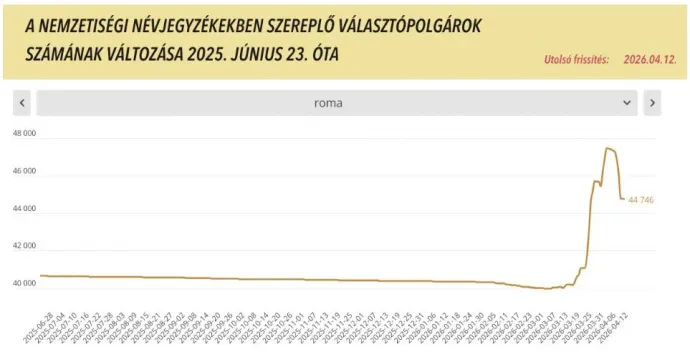
    The evolution of the number of people signing up for the Roma nationality list before the 2026 parliamentary election. Graphics: Political Capital

    The evolution of the number of people signing up for the Roma nationality list before the 2026 parliamentary election. Graphics: Political Capital

    For about half a year, only natural weight loss could be read from the slow decrease of those registered on the Roma nationality list: their number decreased from 40,653 to 39,968 from June 23, 2025 to March 5, 2026. This includes the fact that several hundred people unsubscribed after receiving the notices in February this year. However, on March 6, the curve began to rise, and from the 18th it shot straight out. It peaked at 47,453 people on April 3, and then corrected back to 44,746 on election day.

    Lakmusz asked for detailed data, which is another addition serves: “According to the information received from the NVI, between February 21, 2026 and April 2, 2026, 63 people submitted their applications to the Roma nationality register electronically (with the help of Customer Portal+ or DÁP), 35 in person, and 10,062 through a delivery representative. Therefore, 99 percent of the applications were made in the most likely way for abuse, came by proxy.”

    First of all, the question arises as to how more than 10,000 people could sign up if there was no day when there were so many more people than the base value of 40,000 in the contact list. This is possible because in the weeks leading up to the election, two opposing processes took place: thousands were simultaneously registered on the list and many people unsubscribed from the same list. Therefore, the daily data shows only the difference, but not the exact number of people who subscribed and unsubscribed that day.

    Second, it is quite clear from these data and field reports that registration / subscription took place. Even the temporal trend of the settlements producing the greatest growth is in line with this hatedand the fact that only a handful of people signed up in person or electronically, and more than 10,000 through a proxy, confirmed the well-founded suspicion that the registration took place as part of an organized action.

    In contrast to previous elections, the National Roma Self-Government and Fidesz therefore he was ambitious the acquisition of the Roma nationality mandate. All signs indicated that this would not cause any problems for the much-tried mobilization machine: if the political will is there, 25-30 thousand of the approximately 45 thousand registered people will definitely be able to validly vote. It didn’t happen that way.

    Election day

    No, despite the fact that more than 25,000 of the registered voters actually showed up at the polling stations. Just like Tamás Kovalcsik in Electoral Geography he wrote itfar fewer valid votes were cast than the number of people who signed the Roma nationality register:

    • There were 419 fewer nationality ballots in the ballot boxes; there were so many people who took the ballot home or destroyed it,
    • 5782 people cast invalid votes,
    • The stamp was missing from 39 ballot papers,

    so the remaining, only 19,203 votes were valid.

    Seeing the results of the national election and the crisis of Fidesz, today it is not so much surprising as it is symptomatic that the (former) government party campaign machinery was not able to solve such a well-defined task.

    The change in mood across the country has also become noticeable among the Roma, which is an important addition provided The price of a vote movie, and the vigilante movement partly based on it. As a result of the work of activists engaged in citizen awareness / fraud deterrence activities around the polling stations, estimates according to they could even prevent diverted votes from entering the ballot boxes by hundreds of thousands. There could certainly have been several thousand among them, which, if they had reached their destination, would have been included in the nationalities list.

    For a high number of invalid votes, several interpretations are possible. It may arise that many people protested in this way: although they could not resist the compulsion, they got into the minibus, went to the polling station, but in the privacy of the voting booth they voted invalidly – even by taking a photo of the ballot paper filled in according to expectations and then invalidating it. This behavior presupposes a rather strong civic awareness and self-awareness, so a more likely explanation is that many people did not understand how to vote validly, and it is not their fault at all: it is one of the darkest of the Hungarian electoral system shames himthat in the nationality election, the national nationality municipalities have a monopoly on the establishment of lists, as a result on the ballot paper, they must be placed in a single circle of a single list. The election offices do not announce the reason for the invalidity of the ballot, but it would not be at all incomprehensible if, for example, many people had intended to vote validly by circling the name of the leader of the list, or had thrown in the ballot blank, since they – correctly – did not see where this option was.
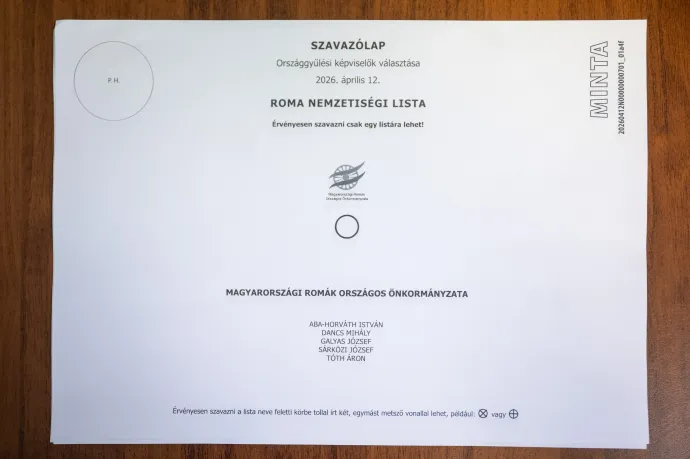
    Roma ethnicity ballot at the meeting of the National Election Commission in Budapest on March 10, 2026 - Photo: Zoltán Balogh / MTI

    Roma ethnicity ballot at the meeting of the National Election Commission in Budapest on March 10, 2026 – Photo: Zoltán Balogh / MTI

    Meanwhile, the preferential quota – partly due to high participation, partly by TISZA with a huge difference won individual districts, partly due to the low proportion of non-useful votes (DK and MKKP together did not even get 2 percent) – it was extremely high, 26,712 (for how the quota is calculated, see the Political Capital electoral system explanation his little one). Therefore, the Roma nationality list would not have reached the preferential quota necessary for obtaining a mandate, even if 100% of the Roma nationality voters who had reached the polling station had voted validly.

    The indispensable reform

    Although the parliamentary representation of nationalities is a noble goal, in 2011 Fidesz created a system that

    1. excludes electoral competition,
    2. 11 out of 13 nationalities do not even have a mathematical chance of actually obtaining a mandate,
    3. paves the way for the power to capture the nationality mandate.

    The previous three, and especially this year’s election, confirmed in practice that the system, which is spoiled in every way, needs radical reform. The European Court of Human Rights in 2022 he said this – so far without any consequences.

    According to all signs, the newly established government has the intention to conduct a comprehensive electoral reform. The question of what Hungary wants to do with the complex issue of national representation is only a small part of this.

    As with the entire electoral reform process, the creation of national representation as part of it must also start with a broad political, professional and social debate. There is a better choice in order to promote this, we published it last December our election leader.

    Once this discussion starts, it will be worth starting from there whether it is really justified to provide a full-fledged, preferential mandate for Hungarian nationalities, or whether it would not be enough to provide an advocate position. To do this, first of all, it is necessary to examine the results achieved since 2018 by the only national representative with a full mandate, as well as the 11-13 national advocates in different cycles. It is not only necessary to involve the representatives of the nationalities in the dialogue, since it is a matter affecting the entire political community.

    An example clearly shows why the method of electing national representatives is inseparable from thinking about the entire electoral system. Suppose, after a long consultation, the decision is made that it is indeed necessary to create the possibility for all 13 nationalities to have full parliamentary representation. As long as it was only about one or two mandates, the nationalities “interfered” only moderately in the competition of the parties, but if we reserved 13 mandates for them, the parties would also have a say or two. In a parliament of 199 people, the 13 representatives of nationalities can even decide the relationship between the government and the opposition, but nobody really wants that. If we accept this, the weight of the national mandates could be reduced by drastically increasing the number of parliamentarians. This in itself might not be a problem, but it is hard to imagine that this decision would be accepted by any party. And it has not even been discussed why a mandate of the same weight would go to a nationality of a few thousand people as to the Roma minority of hundreds of thousands. The alternative solution is if nationalities can only obtain advocate mandates, but the conditions for competition must still be created, and one can think about strengthening advocate credentials.

    It is therefore necessary to think about the creation of the actual representation of nationalities as part of the larger whole. The primary task of the new government is not to provide answers to all the detailed questions that arise (we have seen where this perception of roles leads), but rather to create a forum for the clash of different interests, values, and arguments, and after carefully considering them to make the necessary political decisions, to create the legislative environment for the new electoral system, including the representation of nationalities.




    Source link

    Related Posts

    Telex: Luis Enrique: It was the best game I ever experienced as a coach
    Hungary

    Telex: Luis Enrique: It was the best game I ever experienced as a coach

    May 4, 2026
    Katalin Karikó to Receive Honorary Doctorate from the University of Oxford
    Hungary

    Katalin Karikó to Receive Honorary Doctorate from the University of Oxford

    May 4, 2026
    G7: György Matolcsy’s name comes up as soon as they start investigating the spontaneous privatization – but not like that
    Hungary

    G7: György Matolcsy’s name comes up as soon as they start investigating the spontaneous privatization – but not like that

    May 4, 2026
    Old Hungarian Friend Sends Support to Donald Trump after Assassination Attempt
    Hungary

    Old Hungarian Friend Sends Support to Donald Trump after Assassination Attempt

    May 4, 2026
    Telex: The billion-dollar state support of the cultural holding in Pécs is delayed, the clues lead to Péter Hoppál
    Hungary

    Telex: The billion-dollar state support of the cultural holding in Pécs is delayed, the clues lead to Péter Hoppál

    May 4, 2026
    No Room for Exhausted Politicians in the New Fidesz Parliamentary Group
    Hungary

    No Room for Exhausted Politicians in the New Fidesz Parliamentary Group

    May 4, 2026
    Next Post

    Donald Trump calls for moderator Jimmy Kimmel's expulsion - again

    POPULAR NEWS

    Justin Bieber fans flood Coachella festival for headlining show – Entertainment

    Justin Bieber fans flood Coachella festival for headlining show – Entertainment

    April 20, 2026

    Over 600 flee homes as Army, NPA clash in Negros Occidental

    April 21, 2026

    Ex-DPWH exec recalls P800-M ‘delivery’ to Zaldy Co 

    April 20, 2026

    Former PM Paluckas suspends party membership, to waive immunity over criminal probe

    April 24, 2026
    Pres. Ali challenges CARICOM to transform into health research powerhouse

    Pres. Ali challenges CARICOM to transform into health research powerhouse

    April 23, 2026

    EDITOR'S PICK

    All of them

    All of them

    April 28, 2026

    Luxury problems, phone scams and long-awaited evening drinks

    April 26, 2026
    Air pollution in São Paulo increases the risk of kidney disease – 04/12/2026 – Equilíbrio e Saúde

    Air pollution in São Paulo increases the risk of kidney disease – 04/12/2026 – Equilíbrio e Saúde

    April 12, 2026
    Trump continues the blockade of Hormuz: Iran can hold out for a few more days

    Trump continues the blockade of Hormuz: Iran can hold out for a few more days

    May 1, 2026

    Recent Posts

    • Drunk-driving crash at east-coast beach town kills teen passenger
    • China denounces Japan, EU over South China Sea
    • Rising number of young people engaged in gang violence reflects systemic failures, says expert
    • More than just PR problem – Editorial

      © 2026 Agentially - Navigating shifting sovereignties and global risk .

      Welcome Back!

      Login to your account below

      Forgotten Password?

      Retrieve your password

      Please enter your username or email address to reset your password.

      Log In
      No Result
      View All Result

        © 2026 Agentially - Navigating shifting sovereignties and global risk .

        This website uses cookies. By continuing to use this website you are giving consent to cookies being used. Visit our Privacy and Cookie Policy.