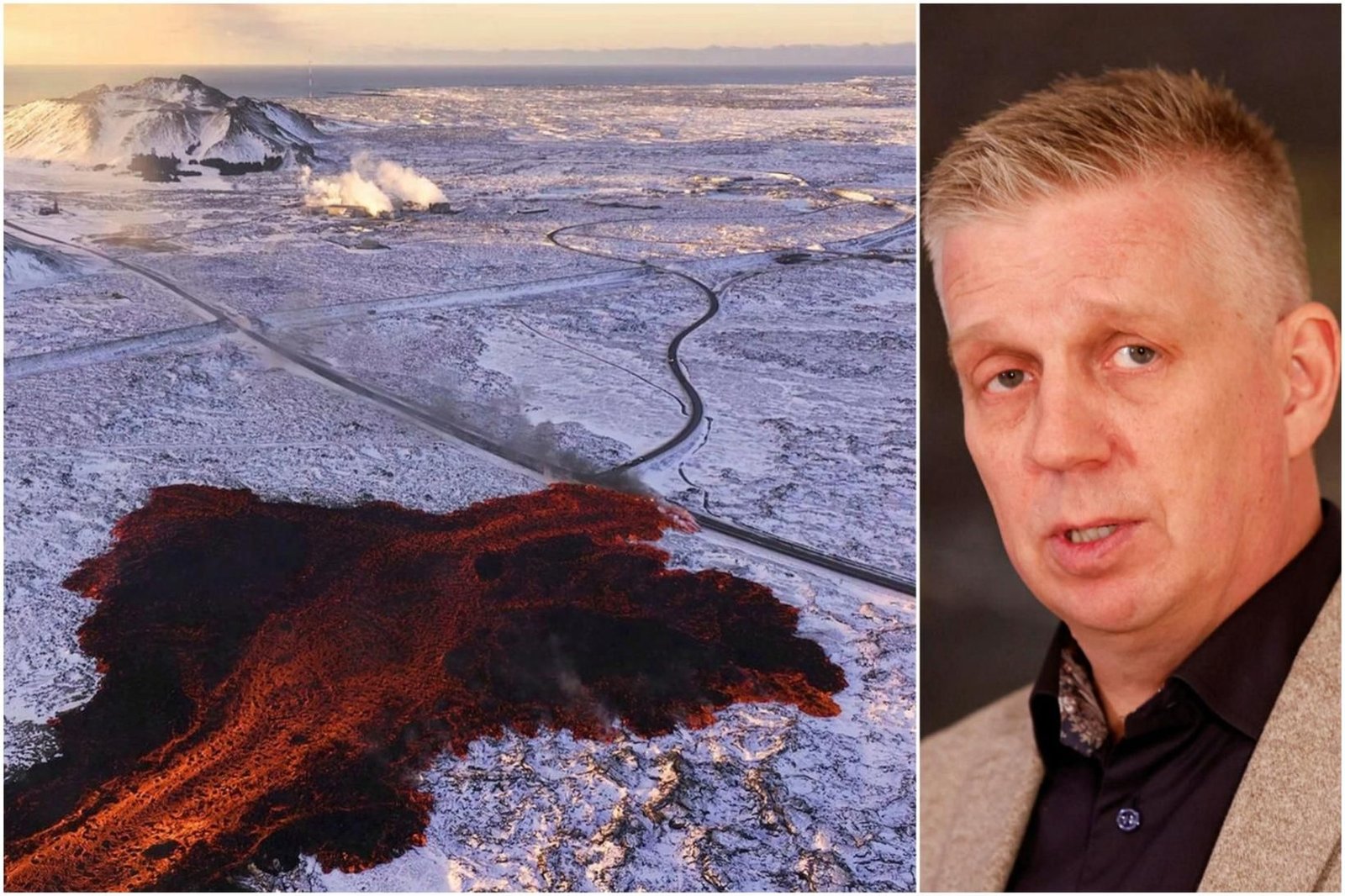
Víðir Reynisson, former head of public defense and current parliament member of the Swedish Confederation, does not recognize the criticism expressed in the report of the National Audit Office on the construction of the fortifications in Grindavík.
Víðir was in charge of operations in Grindavík. The essence of the National Audit Office’s criticism is that although the project was a technical success and the defenses worked, the administration, responsibility and control were insufficient and unclear.
It is also said that the project proved to be too much for the National Police Commissioner.
“Perhaps it would have been ideal for the National Audit Office to talk to those who were responsible for this. There was no discussion with me, my head of department or the deputy manager. Therefore, I doubt that what is presented is based on the correct data.”
“Those of us who worked on this know that I, as the director of public safety, was responsible and I thought the system was clear. I also felt that the people I worked with from Verkís and Vegagerðinn had their role clear,” says Víðir.
Prepared dozens of reports and memos
He says that he has not been given the opportunity to read the report that was published today, but that he can comment on the matter.
“When we started looking at how we could protect this infrastructure, we experimented with various types of defenses during the eruptions of 2020 and 2021. Dozens of reports and memos were prepared on the matter, although in many cases it was confidential,” says Víðir.
He says that later on, a project manager from Verkís was hired, who had the role of ensuring that the projects were carried out in a professional manner.
“I led the project and was responsible for it. If it is being claimed that I did not handle the project, then it is not true,” says Víðir.
He says that decisions were made based on the situation each time. The main goal was to defend Grindavík and Svartsengi, and it was successful.
“In that respect, it was a success. The cost estimates were also met, based on the estimates we presented to the Prime Minister.”
Were responding to an emergency
He says that the fortifications were built on the basis of lava models from the Icelandic Meteorological Office, the University of Iceland and Verkís.
“Plans came from these models, and defenses were subsequently built. But we repeatedly found that the lava went higher than expected. The lava reached the highest heights and in some cases, such as when it crossed the parking lot at Bláa lónin or when the hot water pipes at Svartsengi were affected, it was necessary to act quickly. Some decisions were therefore made in a state of absolute emergency,” says Víðir.
Recognize once
It has been pointed out that the criticism is not that the implementation failed, but that there are examples of costs that were poorly traceable and that administrative responsibility was not sufficiently clear. It is also mentioned that a defensive wall was raised without the involvement of the minister.
“The only time I can think of regarding the minister is when the eruption was overflowing the defenses and people reacted to it. I don’t know anything else,” says Víðir.