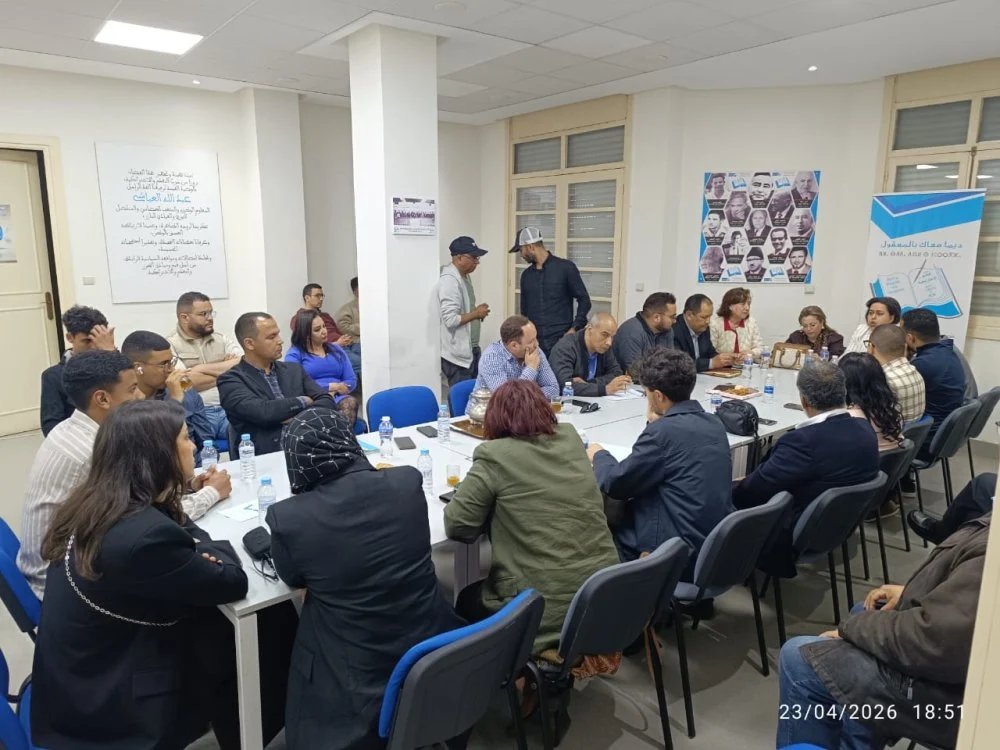
The deadlines of 2026 and 2027 are not only an electoral issue. They raise the question of the mandate, the quality of representation and the political link to be rebuilt between the elected official and the citizen. It is on this ground that the Espace des cadres of the PPS of Casablanca-Settat chose to launch the debate and deploy its vision. From the joint interventions of party officials, elected officials and academics, the same requirement emerged: forming credible profiles, reestablishing links with citizens, cleaning up public practice are the sine qua non conditions for returning elected officials to their primary function, that of carrying trust, defending causes and fully inhabiting institutions.
Before addressing upcoming deadlines, Dalila Loudiyimember of the political bureau of P.P.S.wanted to recall the meaning of this initiative. L’Frame spaceshe emphasizes, is not thought of as a framework reserved for activists alone, but as “a common space, open to all energies”, including those who are interested in political action without being part of a partisan organization. This openness gives its scope to the meeting. It is not only a question of preparing for the legislative elections of 2026, but of highlighting the responsibilities of elected officials, in Parliament as well as in local authorities.
Rehabilitate the figure of the elected official
But for Karim Taj, this national mission never erases territorial roots. A parliamentarian remains linked to the territory which supported him. From this articulation arises a profile requirement: seriousness, competence, probity, proximity to citizens and capacity for advocacy. It is this vision that the PPS aims to embody through its investitures. It is about presenting women and men capable of presenting credible alternatives, mastering issues and establishing a relationship of trust with citizens. In other words, qualify the human offer as much as the programmatic offer.
Train before competing
This requirement is consistent with the analysis of Karima Ragoubaprofessor at the Faculty of Legal, Economic and Social Sciences of Aïn Sebaâ. In its legal and constitutional reading, democracy depends neither on the mere existence of institutions nor on the regularity of elections. It depends on their effectiveness, the competence of elected officials and the link between responsibility and accountability. The debate thus moves towards the essential: not only who will be elected, but how the mandate will be exercised.
The mandate as background work
In this same logic, Touria Skallimember of the PPS political bureau and former parliamentary deputy, brings the debate back to what, according to her, constitutes the substance of the mandate. “The role of the elected representative is not limited to the plenary session,” she recalls, emphasizing that parliamentary work is also carried out far from the cameras: in the commissions, the examination of texts, amendments, legislative proposals, control of the governmentthe evaluation of public policies and the parliamentary diplomacy.
Parliament is therefore not just a place for speech. It is also a space for intervention on social policiesthere mental healththe cost of living, rights, freedoms and national causes, including Moroccan Sahara through parliamentary diplomacy. Touria Skalli, however, regrets that certain parliamentary reports, despite their findings and recommendations, do not always find a concrete translation, citing in particular the case of mental health.
Proximity and limits of local power
In this context, the “advisor’s weapon” is often reduced to questioning, correspondence and advocacy. The observation shifts the debate: the crisis of confidence is not only due to elected officials themselves, but also to the institutional framework in which they operate. This reading is in line with the recommendations of the meeting, which call for reviewing the legal framework, strengthening control mechanisms and broadening the opposition’s margins of action.
Moralize political action to restore confidence
Karima Ragoubaprofessor at the Faculty of Legal, Economic and Social Sciences of Aïn Sebaâ, places this requirement in a broader reading of democratic functioning. For her, the effectiveness of institutions, transparency and the fight against forms of rent-seeking are inseparable from real democracy. But this democracy does not rely on elected officials alone: it also presupposes an active citizen, capable of voting, following public action, engaging in community life and using participatory democracy mechanisms.
Karim Taj, member of the PPS political bureau, brings this requirement back to the direct relationship with citizens. An elected official can only convince in the long term if he is recognized for his credibility, his integrity, his seriousness and his presence on the ground. In this reading, moralization does not relate to an abstract register: it becomes a condition of electoral credibility as much as a source of democratic strengthening.
Making proximity a political project again
Mostapha Mandour recalls that the link with citizens cannot be limited to electoral meetings: the mandate supposes a continuous presence, listening to grievances and monitoring the realities of the territory. Karim Taj, for his part, insists on the contract of trust between elected officials and citizens, based on credibility, competence and the ability to propose concrete responses. Touria Skalli and Karima Ragouba further broaden this reading: citizen participation does not stop at voting. It presupposes the monitoring of public action, associative commitment and the use of participatory democracy mechanisms. This explains the approach taken by the PPS: “Making proximity not a campaign reflex, but a sustainable political method, capable of restoring meaning to the mandate and consistency to the representative link”.
A political line more than an electoral prelude
At the end of the meeting, the threads are tied together coherently. Train executives, choose credible profiles, restore weight to the mandate, review certain institutional frameworks, moralize public practice, reconnect with the citizens : these sites do not form a simple inventory. They draw a deeper direction. THE P.P.S. seems to want to approach the 2026 deadlines through what gives the electoral act its true significance: the quality of the women and men called to represent, the solidity of their roots, the clarity of their commitments and the capacity of institutions to respond to social expectations.