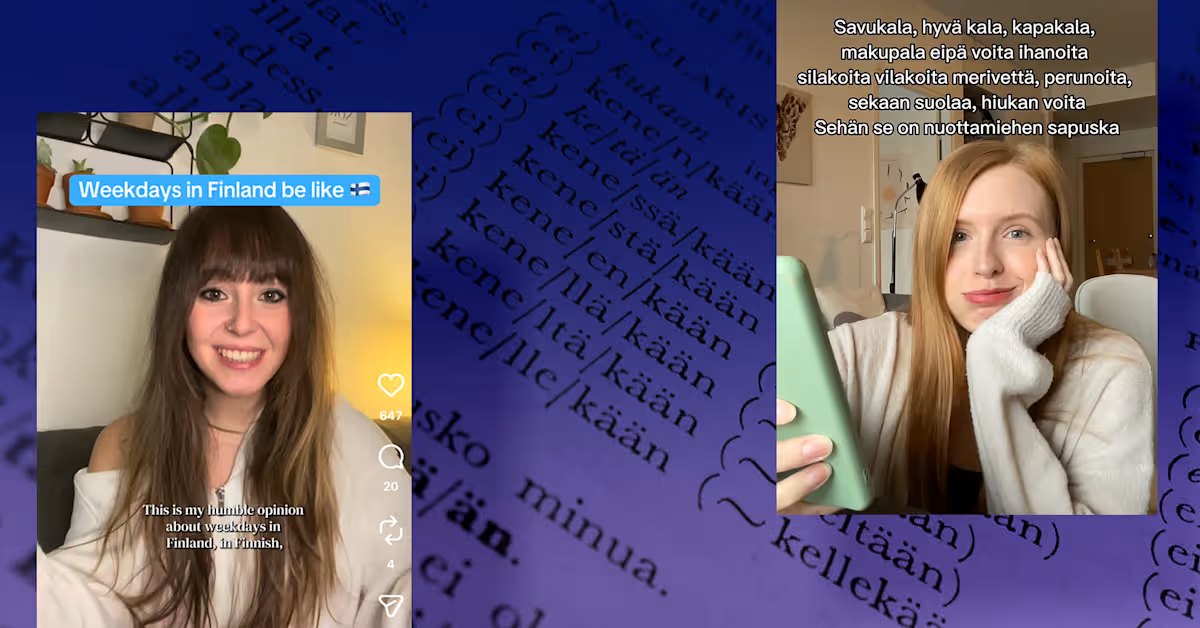
Despite its fearsome reputation as an impossible-to-learn language, many immigrants to Finland eagerly take on the challenge of learning Finnish — and audiences are increasingly keen to follow their efforts on social media.

After her first day at a Finnish language and integration course, Nerea Bartolomé was feeling overwhelmed.
Learning this language — with its never-ending noun cases, complex consonant gradation and intimidatingly long compound words — seemed impossible.
Feeling defeated, she was scrolling through social media when she stumbled across a video of a woman sharing her own story of struggling with the Finnish language — and she suddenly felt inspired to do something similar.
“I had zero followers, so I had nothing to lose,” Bartolomé told the All Points North podcast.
She created a video, posted it on social media, and went about her evening. When she checked Instagram again before going to bed that night, she was shocked to see that the video had over 6,000 likes and had gone semi-viral within just a few hours.
Since that first post, her follower count has swelled to nearly 30,000 as she continues to share her quirky and comic takes on learning the Finnish language.
“I’m just trying to expose my fears, my failures, my everything, and I think that showing that vulnerability on social media about the process of learning, or integrating, is what makes the process easier because even through that screen you feel that you’re not alone,” Bartolomé explained.
Finns join the language learning journey, too
Alicia Iredale was also finding it difficult to get a grip on the complexities of the Finnish language when she decided to turn her own Instagram account into a type of “language learning diary”.
“I felt really frustrated with my level of Finnish and I wanted to practise more in a way that would kind of hold me accountable. Like if other people are seeing it, they’ll notice if I am continuing to practise,” she told APN.
Despite initially thinking that “maybe a few hundred people” might accompany her on her language learning journey, Iredale has since amassed a following of nearly 50,000 — including Finnish comedian Ismo Leikola and Finns Party leader Riikka Purra.
“The biggest shock is that 75 percent of them [her followers] are Finnish,” she noted. “They are so interested in seeing somebody learn the language and pick out things that we think are weird or funny or interesting.”
Her impressive command of the Finnish language and her insightful ‘explainer’ videos have led to her being featured in Finnish newspapers and magazines, including Turun Sanomat and Me Naiset.
Iredale added further that she often receives complimentary comments from Finnish people for bringing a fresh perspective to the language.
“They also then understand why it’s so difficult for people learning Finnish. They’re like wow, I didn’t realise it was so complicated,” she said.
Creating a language learning community
Tuija Lehtonen, a researcher and teacher of Finnish as a second language at the University of Jyväskylä, told Yle News that the proliferation of people sharing their experiences of learning Finnish is a welcome development — both for the students and for the language itself.
“All publicity is good publicity. This kind of publicity can evoke an interest in the language and the country and the culture,” she said, noting that curiosity in the Finnish language often spikes when there is a particularly noteworthy event or a popular trend — such as Lordi winning the Eurovision or the Moomins becoming big in Japan.
While this is a bonus benefit, Lehtonen noted that the big win arising from the increase in Finnish language learning content on social media is for the students themselves.
“It can help to create a community around the language or the language learning,” she said. “And what would inspire or motivate someone more than to know that they’re not alone?”
And the advantages don’t end there. Aside from being a source of inspiration, Lehtonen added that the social media content can even be used in the classroom as a means of starting a conversation about learning styles and learning experiences.
“This is an extremely big part of language learning and if we don’t do that, then we cannot learn from each other. We know from research that this kind of peer learning is as effective or even more so sometimes than formal learning or learning on your own,” she said.
You can watch the full All Points North episode from the video below or on our YouTube channel.