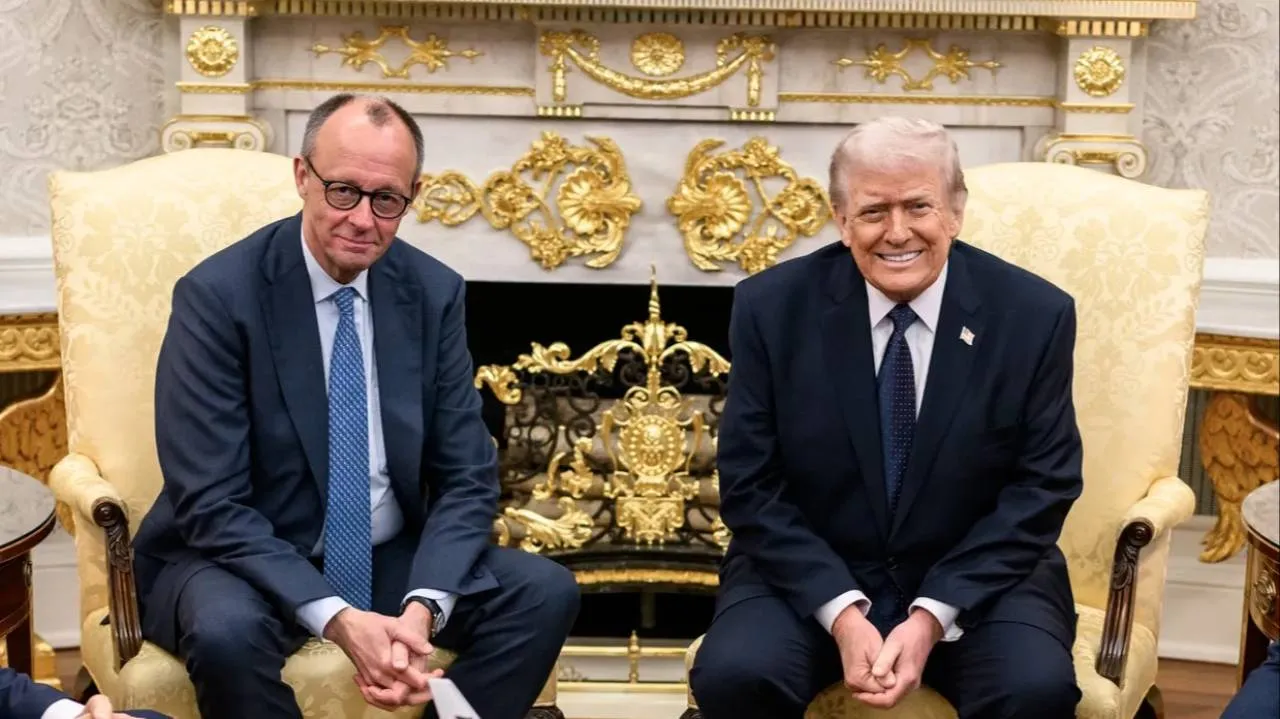
The willingness to engage in dialogue and find common ground with reasonable forces in Europe is today surprisingly greater than it was probably a year ago. There is more humility and a stronger readiness to present constructive proposals. Unfortunately, Poland does not appear to be a beneficiary of this trend, assessed Tomasz Szatkowski—returning from talks in the United States—a member of the National Security and Defense Council to the President of Poland and Secretary General of the ECR.
In a Friday interview with one of the largest Western newspapers, the Financial Times, Polish Prime Minister Donald Tusk questioned the “loyalty” of Poland’s key ally—the United States. At the same time, he called for “strengthening the EU’s mutual defense clause.” Tusk said in the interview that “the biggest and most important question for Europe is whether the United States is ready to be as loyal as described in our treaties (NATO).”
The interview can be seen as the essence of the current government’s policy—seeking to distance itself from the United States while simultaneously tightening defense cooperation within the European Union. One manifestation of this has been the ongoing dispute in Poland over the EU’s SAFE mechanism, viewed by critics as a financial boost for the German and French arms industries. This is compounded by repeated criticism of the administration of Donald Trump by the current Polish prime minister.
“This is putting our security at risk. The only demand Vladimir Putin made after the attack on Ukraine was for NATO and the United States to withdraw, among others, from Poland. That is what is at stake in this game. A Polish prime minister undermining these relations is effectively pursuing reset-style interests,” commented Michał Rachoń, program director of TV Republika, in response to the FT interview.
Pragmatic Germany—now the top performer
Tomasz Szatkowski, former Polish ambassador to NATO, currently Secretary General of the European Conservatives and Reformists and a member of the National Security and Defense Council under President Karol Nawrocki, pointed out that the current government’s stance—within the present geopolitical context—amounts to a certain squandering of favorable security conditions for Poland.
In recent days, Szatkowski met in the United States with members of Congress, administration officials, and think tanks.
“The willingness to engage in dialogue and find common ground with reasonable forces in Europe is today surprisingly greater than it was probably a year ago. There is more humility and a readiness to present constructive proposals. Unfortunately, Poland does not seem to be benefiting from this trend,” the former NATO ambassador assessed.
He added that Tusk’s interview with the Financial Times is “only one of the more widely noted elements of this phenomenon.”
“Meanwhile, at the Department of War, thanks to Merz’s pragmatic policy, Germany has already taken the place of the model ally,” Szatkowski noted.
Department of War working closely with Germany
In this context, it is worth noting the position of Elbridge Colby, U.S. Under Secretary of Defense for Policy. He posted a series of social media statements devoted to Germany’s rearmament strategy.
He assessed that Donald Trump “rightly pointed out that Europe must do more and that NATO cannot be a paper tiger,” and that Europe has begun to act accordingly.
“As NATO Secretary General Mark Rutte said—action, not words. ‘Air defense systems, drones, ammunition, radars, space capabilities—these are what will ensure our security.’ Germany is now taking the lead in this regard. After years of disarmament, Berlin is mobilizing. The Department of War is already working closely with European allies, especially Germany, to accelerate the transformation toward NATO 3.0,” Colby wrote.
“Berlin’s new military strategy clearly points the way forward. We look forward to close cooperation with Germany in its implementation,” he added.