From Budapest from our reporter Michal Dudoň.
This exhibition speaks about the importance of free creativity, creation, critical thinking and ethical responsibility of artists here and now, said curator Katarína Bajcurová at the opening in Budapest’s Ludwig Museum.
At the prestigious Museum of Modern Art, she presented an exhibition called In the End There Will Be No End. It presents the works of forty Slovak authors of contemporary art.
“In this sense, the title of the exhibition, which we can freely translate into Slovak as There will be no end, speaks of the fact that art endures, that it is capable of constant renewal. The same also applies to the ability of memory, freedom and creative energy, which cannot be silenced,” Bajcurová told an international audience on Thursday.
The art historian and curator, who worked at the Slovak National Gallery (SNG) for 30 years and also ran the gallery for a decade, decided to leave shortly after Alexandra Kusej was dismissed. She told SME at the time that she did not want to see the dismantling of expertise in live broadcast.
While on Thursday evening in Budapest, which not long ago celebrated the end of an era Viktor Orbána celebration of free Slovak art took place, the Bratislava Fashion Days ended on April 23 at SNG. The Minister of Culture also came to the fashion show Martina Šimkovičová (nom. CIS).

This exhibition talks about the importance of free creativity, creation, critical thinking and the ethical responsibility of artists here and now, Katarína Bajcurová, the curator of the exhibition In the End There Will Be No End, speaks to visitors at the Ludwig Museum in Budapest. (source: Balázs Glódi / Ludwig Museum – Museum of Contemporary Art)
They are the first to react to what is happening in the world
Bajcurová, who first spoke in English at the opening of the exhibition, addresses the guests in Slovak at the end.
She also spoke about how culture in Slovakia is subject to unprecedented, destructive pressures and the professional autonomy of institutions is being liquidated.
“I would like to express my belief that this exhibition brings confirmation of the true and authentic values of art,” she emphasized.
For example, the works of renowned Slovak artists are exhibited: Rudolf Sikora, Andrej Dúbravský, Ivana Šáteková, Erik Šille, Lucie Tallová, Emília Rigová, Ilona Németh, Kristián Németh, Denisa Lehocká.
And as the curator adds, the message of the exhibition is that it is the artists who are the first to react to what is happening in the world – no matter what happens, they hold up a mirror to reality.

(source: Balázs Glódi / Ludwig Museum – Museum of Contemporary Art)
Freedom is not just a random word
English, Hungarian, Slovak and Czech are spoken at the opening. The atmosphere of the recent ones was also transferred here Hungarian electionsin which people decided that Viktor Orbán’s regime would end after 16 years and hope that the situation can change in Slovakia too – especially on the cultural scene.
Freedom is not just a random word here, you can really feel it in every room of the museum where Slovak works are presented.

Related article
Bajcurová is leaving SNG after 30 years: I don’t want to see the dismantling of expertise in a live broadcast
Read more
The biggest challenge for Bajcurová was to come up with the name of the exhibition, she says. Finally, she was inspired by the work of Kristián Németh. In the end, there will be no end symbolizes that art, rooted in freedom, critical awareness and the courage to question power structures, cannot reach its end.
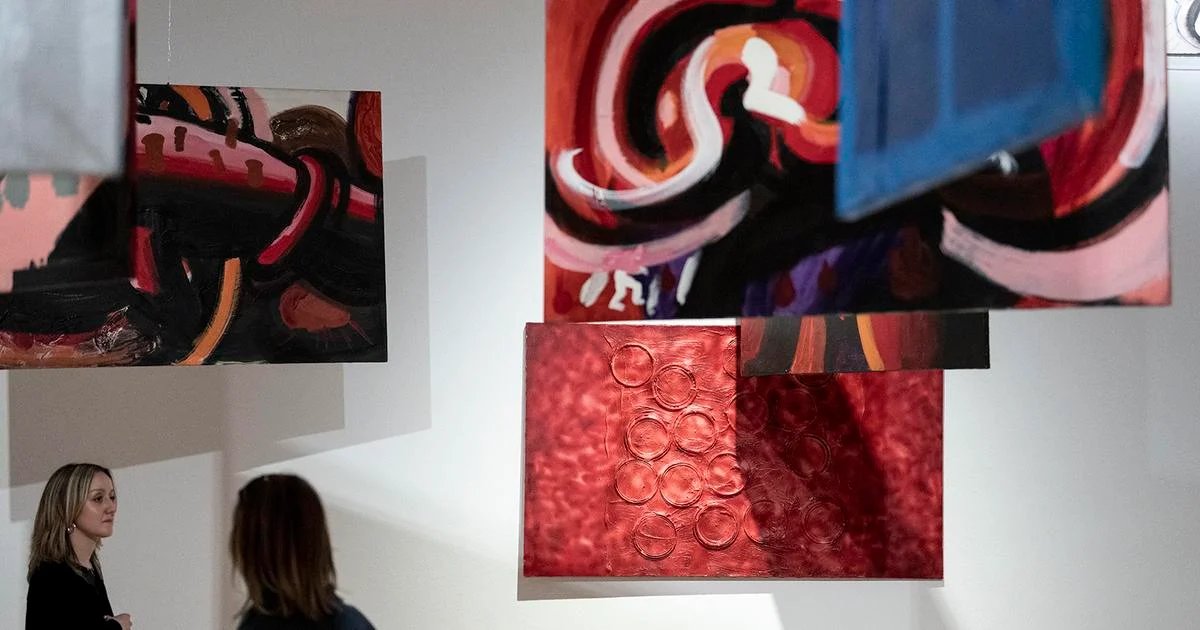
Each exhibition hall functions as one closed story and dialogue between generations.
There are always one or two classics of conceptual art in it, and among them they put curators of young authors and female authors. This gave rise to a new perspective on several works, which was also revealing for the curators themselves.

(source: Balázs Glódi / Ludwig Museum – Museum of Contemporary Art)
“For me and Lucia Gregorová Stach, it was a feeling of inner, but also professional satisfaction,” says Bajcurová. They got the chance to make an exhibition independently of state structures and the department of culture.
“It is such an island of freedom, free creation and free creativity. I see that we can do curatorial activities in other spaces with other institutions and we can create a full-fledged exhibition,” emphasizes Bajcurová.

Related article
Other exhibitions and works are also going to be destroyed at SNG, says the curator of the canceled exhibition
Read more
Even an individual can make a difference
The co-curator of the exhibition, Lucia Gregorová Stach, perceives the path of SNG already separated from itself and from the free cultural community. Sure, it can be restored, but as he says, it probably won’t be as soon as everyone thinks.
“The exhibition is therefore a signal that we are not going underground, but into the big world, which is ready for us, just like us. It is not in the power of any neo-fascists to limit what has real value and where there is authenticity and freedom,” he tells SME.
The exhibition opens various dialogues and topics – memory as a form of resistance, a trace as evidence of lived experience, the body as an object of political inscription. It shows that art persists despite repression, political regimes and restrictions.
In the current atmosphere shaped by polarization and cultural uncertainty, he emphasizes that art with a clear attitude does not disappear. He adapts, survives and continues to talk.
The fact that there is interest in this type of art from Slovakia is also confirmed by visitors. They curiously observe the individual creations, read the labels and have lively discussions with each other. Some will catch the curators or artists who came to the opening.

Rudolf Sikora during the Budapest opening. (source: Balázs Glódi / Ludwig Museum – Museum of Contemporary Art)
It’s a shame that we don’t have a similar institution in Slovakia
Gregorová Stach regrets that we do not have a similar institution in Slovakia, such as the Museum of Modern Art in Budapest. “It was my exposure at SNG that to some extent contained criticism that our company did not generate this type of institution,” recalls Gregorová Stach.
The Model: Museum of Contemporary Art exhibition was removed from SNG quietly, prematurely, and Gregorová Stach knew nothing about it.
Even then, she told SME that it was a political act that symbolized something bigger than just the cancellation of one exhibition. “It pushes the people who make up the living culture out of the public space,” she said.
Subsequently, several works were uninstalled in SNG, such as the work of the Slovak artist Denisa Lehocká. The monumental wall worth 70,000 euros, which Lehocká created in 2023 especially for SNG, was installed as an integral part of the gallery’s architecture.
The exhibition also included the video installation Vomite ergo sum! artist Emília Rigová alias Bári Raklóri. The renowned artist also appeared on a critical video of the Minister of Culture a year ago. At the time, she said that she had never experienced such a wave of hatred.

Rigová during the performance There is no freedom without victory, which is related to the video installation at the exhibition. (source: Balázs Glódi / Ludwig Museum – Museum of Contemporary Art)
Now in Budapest, Rigová presented the performance There is no freedom without victory, which is related to her video installation at the exhibition. It features a sound work that she created herself.
“It’s an original soundtrack that I once recorded at a family funeral,” she explains to SME.
It is about Halgató, during which Roma accompany their loved ones to the other world. She slowed him down and during the performance she passes the urn with the funnel, which serves as a sounding trumpet, to individuals in the audience.
“Until we know what is ours, we will never become real, full-fledged. Even the Roma themselves often do not know about our cultural wealth, since they have been cut off from their culture for a long time. By handing it to you, you are the recipient of what I am sending,” explains Rigová.

Related article
I have never experienced such a wave of hatred. Maybe one day I will be banned, says the artist Rigová
Read more
In the End There Will Be No End – Neoavantgarde and contemporary artists from the Art Fond Bratislava collection
-
Where: Ludwig Museum in Budapest.
-
Duration date: April 24 – September 20, 2026.
-
Curators: Katarína Bajcurová and Lucia Gregorová Stach.
-
Exhibiting artists: Milan Adamčiak, Peter Bartoš, Juraj Bartusz, Maria Bartuszová, Milan Dobeš, Andrej Dúbravský, Svetlana Fialová, Stano Filko, Daniel Fischer, Martin Gerboc, Milan Grygar, Vladimír Havrilla, Jozef Jankovič, Magdalena Jetelová, Peter Kalmus, Igor Kalný, Kryštof Kintera, Michal Kern, Július Koller, Milan Knížák, Matej Krén, Jaroslav Kyša, Otis Laubert, Denisa Lehocká, Karel Malich, Juraj Meliš, Alex Mlynárčik, Ilona Németh, Kristián Németh, Roman Ondak, Štefan Papčo, Emília Rigová / Bari Raklori, Peter Roller, Rudolf Sikora, Ivana Šáteková, Erik Šille, Lucia Tallová, Dezider Tóth / Monogramist T.
-
The works in the exhibition come from the Art Fond collection, which is a private non-profit collection of contemporary fine art. Its initiator and owner is Andrej Zaťko – former chairman of the board, general director and co-owner 365.bank. The collection focuses on collecting, preserving and presenting works from the 1960s to the present.
-
The curatorial concept is built on dialogues and constellations across generations. The works of artists of different ages are combined in pairs and triplets not to illustrate influence or stylistic succession, but so that the viewer can better perceive the dialogue between the works, as well as the tension and solidarity between them.
-
The exhibition is organized by the Ludwig Museum – Museum of Contemporary Art in Budapest and the ART FOND collection in Bratislava in cooperation with the Center for Art Sciences of the Slovak Academy of Sciences.