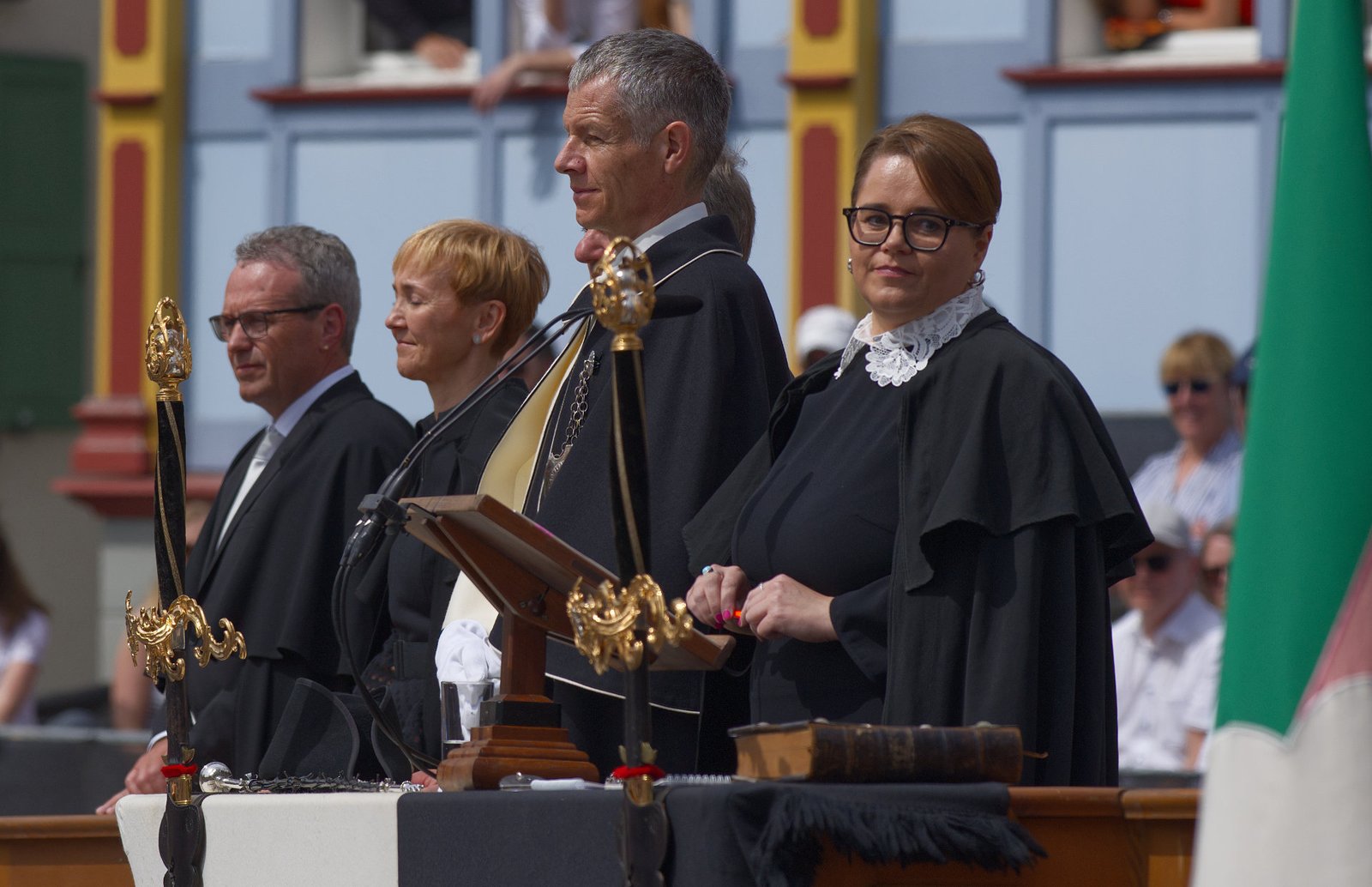
The Innerrhoden rural community made history today. Angela Koller from Schwende-Rüte was elected by the assembled voters as the governing mayor – as the first woman in the history of the canton of Appenzell Innerrhoden to hold this highest office. A turning point took place in the open air on the Landsgemeindeplatz in Appenzell, combining the traditional ritual of direct democracy with a new chapter.
Koller’s election is more than a personnel change at the top of the professional commission. Appenzell Innerrhoden, known as the last Swiss canton to only introduce women’s suffrage in 1990 under pressure from the Federal Court, has now elected a woman to its highest government office. Pius Federer from Oberegg was confirmed as the standing mayor.
The other members of the professional commission: Governor Monika Rüegg Bless (Appenzell), Sackmeister Ruedi Eberle (Gonten), State Governor Stefan Müller (Schwende-Rüte), builder Hans Dörig (Schwende-Rüte) and State Ensign Jakob Signer (Appenzell).
Police law renewed, bicycle path law rejected
In addition to the elections, three items of business were on the agenda. The total revision of the Police Act (PoIG) was accepted by the municipality, as was the revision of the Administrative Court Act (VerwGG). The canton is thus modernizing two central areas of law.
However, the introductory law to the Federal Law on Bicycle Paths (EG VWG) did not receive approval. Those entitled to vote rejected the proposal to the Grand Council. The law implements a federal framework law that obliges the cantons to plan and maintain a connected cycle path network. The Innerrhoden regional community thus signaled that the cantonal implementation presented still needs to be revised.
Living democracy
The Landsgemeinde, which takes place on the last Sunday in April, is one of the oldest forms of direct democracy in the world. Together with the canton of Glarus, Appenzell Innerrhoden maintains this tradition: those entitled to vote gather in the open air, raise their hands and decide directly on laws and members of the government. For many observers, Angela Koller’s election is a sign that the rural community is able to develop further even after centuries – without giving up its living tradition.