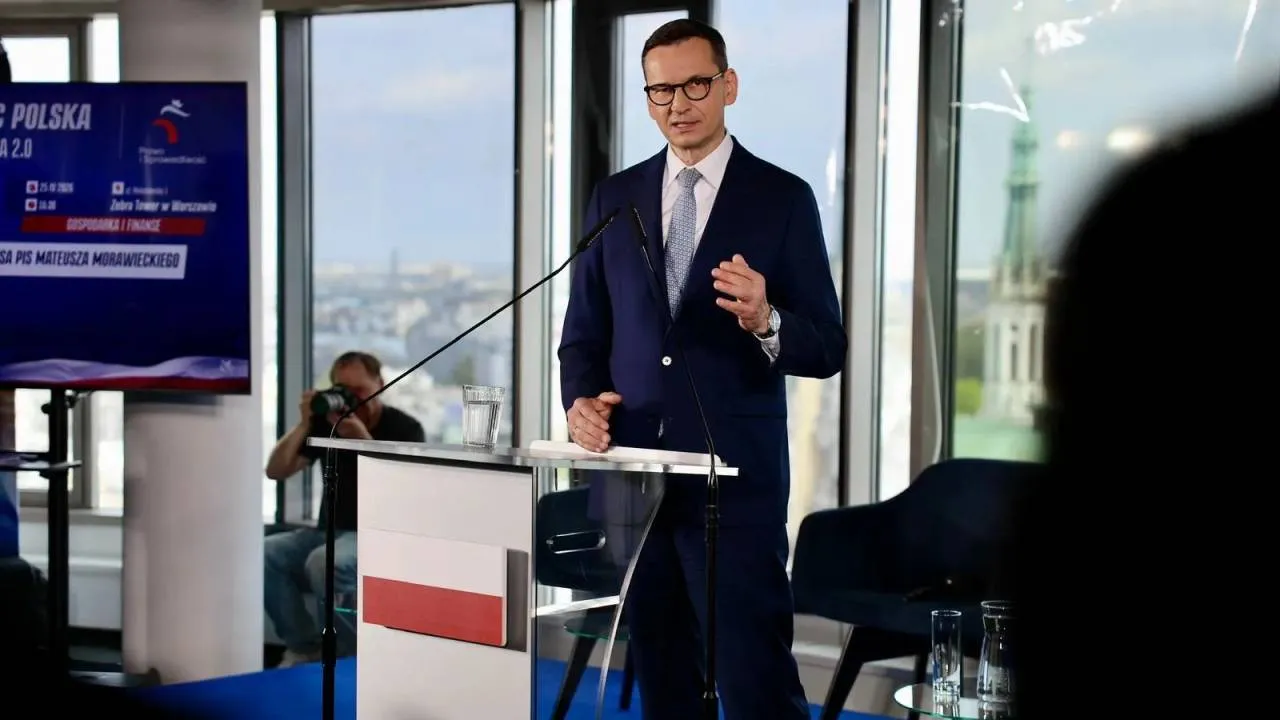
Former Polish Prime Minister and Deputy Chairman of PiS, Mateusz Morawiecki, presented a new vision for Poland’s defense sector, arguing that massive military spending must be redirected to strengthen the domestic economy.
Speaking at the “Thinking Poland 2.0” congress organized by Law and Justice (PiS), Morawiecki stressed that the country is at a historic turning point.
The congress, focused on the economy and public finances, began at 10:30 a.m.
Morawiecki argued that Poland must fundamentally rebuild its economic doctrine if it wants to benefit from current global shifts.
“We must start with a review of our economic model from the past 30 years,” he said, noting that Poland’s growth had been based on demographic advantages, low energy costs, cheap labor, open markets, and the adoption of foreign technologies.
According to him, these factors are now either disappearing or turning against Poland.
“The demographic dividend is over and is turning into a demographic collapse—we must confront that. Low energy costs are gone due to the global transformation of energy systems and electrification. Without restructuring, this will become a burden rather than an advantage, making it harder to attract modern investments that determine economic growth,” he warned.
Morawiecki also emphasized the need to build growth on a well-paid working class.
He argued that the global economic order is shifting away from globalization toward what he described as a new era of neo-mercantilism.
“Previously, the system was based on international institutions, rules, ‘values,’ the paradigm of globalization, the Washington Consensus, openness, and privatization. Today, all of that is being turned upside down,” he said.
“The Mirage of Rising GDP”
Morawiecki highlighted the difference between economic “stocks” and “flows.”
“The state is the greatest invention of the last several thousand years—a framework under which we can develop and realize our capabilities. Flows are what we generate each year from these resources—and here we are doing well,” he said.
However, he warned that while Poland’s annual output is catching up with larger economies, its accumulated wealth remains far behind.
“Compared to Japan, we have about six times less wealth per capita,” he noted.
He warned of a “mirage” of rising GDP per capita, masking a shrinking economic base.
“Our GDP is approaching 4 trillion złoty, but our GNP is lower by 155–160 billion złoty,” he said, pointing to imbalances visible in the balance of payments.
“If we do not seriously focus on building assets, we will not only fall behind but will also fail in the next decade to catch up with those we have been chasing for a thousand years,” he added.
Defense Spending: “We Need to Switch the Track”
Turning to defense policy, Morawiecki argued that Poland is failing to properly leverage its massive increase in military spending.
“Modern technologies must be purchased, but it cannot be that only 20–30 percent of the defense budget stays in Poland while 80 percent goes abroad,” he said.
He defended past purchases of armored equipment, noting that the early phase of the war in Ukraine required such capabilities.
However, he stressed that the future must look different.
“Over the next 8–10 years, 2 trillion złoty from taxpayers will be allocated to defense. This enormous resource must be invested in Poland’s own economic ecosystem,” he said.
Morawiecki pointed to global trends such as regionalization, protectionism, and fragmentation, arguing that economic interests are increasingly taking precedence over ideology.
He criticized limiting cooperation with private industry to only the most advanced stages of technological readiness (TRL 8 or 9).
“That is worse than a crime—it is a mistake,” he said.
He called for investing defense funds into Poland’s private sector, following the examples of countries such as the Czech Republic, Israel, South Korea, and the United States.
“Only then, in the long term, will we not have to rely on others. I would prefer not to rely even on proven allies—I would prefer to rely entirely on ourselves, and that is possible,” he argued.
He listed key areas where Poland already has competencies, including dual-use technologies such as rangefinders, targeting systems, sonar, ICT, AI, satellites, radars, drones, anti-drone systems, avionics, and navigation systems.
“These must all be integrated into the Polish economy,” he said.
Morawiecki concluded with a stark warning:
“If this is not embedded in both macro- and microeconomic policy, then within 2–3 years deficits will hit us so hard that the loss of sovereignty will not come through military means from the East, but through financial and economic dependence. We will become a weak country and fall easily into the hands of a stronger one.”
“We must switch the track of modernization. This powerful sector can either be a ball and chain—or an economic rocket,” he concluded.