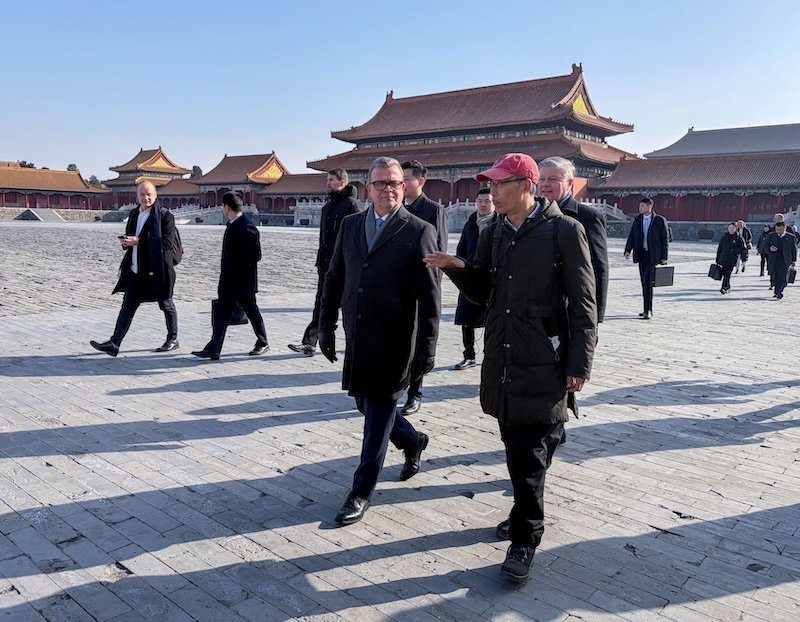
Recent visits by European leaders to Beijing have placed Finland’s relationship with China back into focus, as political and business figures call for closer coordination in trade, climate policy, and technology.
Prime Minister Petteri Orpo joined other EU leaders in China amid shifting global trade flows and rising geopolitical strain. Finnish officials frame the visits as part of ongoing engagement rather than a policy break, with emphasis on dialogue at both political and commercial levels.
In a recent interview with CGTN, Timo Vuori, director of the Confederation of Finnish Industries, said the meetings reflect wider changes in global affairs. “There are plenty of things which are changing the world as society and also the state relationship are changing,” he said. “There’s some challenges which we are facing on the political side, but also the economic side.”
Vuori said engagement with China remains necessary for Finland’s leadership. He noted that decision makers “are ready to discuss with the Chinese government both economic issues and also the political issues.” He added that questions over opportunities and tensions in economic ties remain central for both countries.
Ville Skinnari, chair of the Parliamentary China Friendship Group, rejected any split between economic and political engagement. “We shouldn’t distinguish economic security, foreign policy, or any elements of politics or collaboration,” he said. He described the visits as a sign that leaders aim to maintain and deepen ties. “It’s a clear sign that these heads of state, they will now deepen and improve and strengthen their ties with China.”
He pointed to earlier high level visits, including his own trip to Beijing and Shanghai with Finland’s president. “It’s always important to have bilateral ties, and especially at the very top level,” he said.
Attention now turns to China’s 15th Five-Year Plan, which begins in 2026 and sets long term goals for economic and social policy. Finnish officials see the plan as a chance to align priorities and expand cooperation in key sectors.
Skinnari said Europe often reacts to events rather than planning ahead. “Here in Europe, in the Western world, we tend to be more and more short term. We tend to be more and more reactive instead of being proactive,” he said. He contrasted this with China’s planning approach. “The long termism is the key. So everything is envisaged and looked at in a long term year.”
He stressed the need for joint work in areas such as climate policy and technology. “For instance, the climate change, the green technology scaling, I think China is now paving in a way, and if Europe gets along, we can do so much together for the world,” he said. He called for stronger cooperation built on trust. “The world is really lacking the true, real trust, and therefore, we are not able to co-create, co-develop, things as we used to.”
Skinnari also highlighted the position of smaller states. “Smaller, middle sized countries like Finland, it’s obvious that we have to partner. We have to create partnerships,” he said. He raised the question of how ties with China should develop at regional and local levels, as well as through direct contact between citizens.
He said Finland’s education system and technical knowledge remain valued in China. “I look forward to work, whether it’s 50 year or five year program, again, with China, and further with China,” he said.
Vuori pointed to industry cooperation in climate and technology. He said Finland and China share an interest in improving energy use and industrial systems. “What kind of technologies we are using, how to make our society and industry more energy efficient,” he said. He added that automation and digitalisation offer further scope for joint work.
He noted that China holds a leading position in several technologies. “China is technological leader in many of the critical technologies, and therefore, we are also looking for what to learn from the China,” he said. At the same time, he said Finnish firms bring expertise in clean technology and circular economy systems.
“Finnish companies are also very relevant global actors in cleantech and circular economy and energy issues,” Vuori said. He said this balance creates scope for mutual gain. “Our companies can find some positive cooperation opportunities in the future.”
Parliamentary links form another part of the relationship. Skinnari said dialogue between lawmakers helps build understanding and maintain contact beyond executive meetings. “Parliamentary collaboration is so important,” he said. He praised the role of parliamentary speakers but said more work remains. “We could do even more, because it’s so important that parliaments interact.”
He called for more visits and exchanges between Finland, China, and Europe, describing them as key to stable relations.
Business networks also play a role alongside political dialogue. Vuori said companies often lead cooperation in practice. “There’s plenty of room for that kind of business driven platforms and networks,” he said. He described forums where firms meet without political oversight to discuss specific sectors.
“The companies know what is best for the market and also what is best for the business as such,” he said.
HT