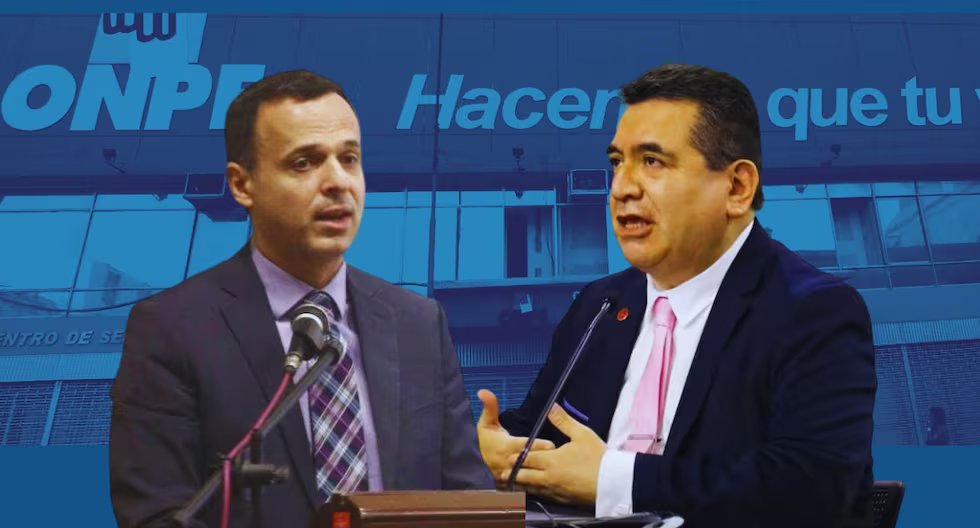

Only two candidates remain in the race in the public contest for the election of the new head of the National Office of Electoral Processes (ONPE). They are the lawyer José Pérez Duharte and the industrial engineer Carlos Loyola Escajadillo.
Both have experience in public administration, but have also faced questions or decisions from the National Board of Justice (JNJ) that marked their participation in the contest.
According to the JNJ schedule, the name of the winner will be known on December 28 and his swearing-in is scheduled for the following day.
The chosen one will replace Bernardo Pachas Serrano, current interim head of the ONPE, who assumed the position after the resignation of Piero Corvettoamid questions about the logistical problems registered during the general elections last April.
José Pérez Duharte is director of the Office of Cooperation and International Relations of the National Elections Jury (JNE). He has also been a professor at the universities of Piura and San Ignacio de Loyola, and director of the National School for the Defense of Competition and Intellectual Property of Indecopi.
He is a lawyer from the University of Lima and a doctor from the Complutense University of Madrid. There is no partisan militancy.
His participation in the contest had an unfavorable outcome on October 9. This is because he obtained 68 points in the knowledge evaluation, two less than the minimum of 70 required by the bases to continue in the process.
As all stages are eliminatory in nature, it was initially out of the competition. However, on October 23, the plenary session of the JNJ agreed to annul question 47 of the written exam, considering that it presented an imprecision in its formulation. The decision was adopted by majority and had the dissenting votes of María Teresa Cabrera, Gino Ríos Patio and Rafael Ruiz Hidalgo.
Six days later, on October 29, the plenary session approved the reformulation of the list of applicants eligible for the curricular evaluation and incorporated Pérez Duharte. This decision also had dissenting votes, this time from Cabrera and Ríos.
Already in 2020, Pérez participated in the public competition to occupy the leadership of the ONPE. He even reached the final stage, but the chosen one was Piero Corvetto, unanimously.
Now, in the current process, he obtained 83 points in the curricular evaluation. This is because it reached 42 points in experience and professional career, 35 in academic training and six in research.
Carlos Loyola Escajadillo is an industrial engineer from the University of Lima, a master’s degree in Administration from Esan University and a doctorate in Government and Public Policy from the University of San Martín de Porres. There is no partisan militancy.
Loyola was Planning and Budget Manager of the National Registry of Identification and Civil Status (Reniec). His management in that entity is related to several questions that were the subject of reports from the Comptroller’s Office and administrative procedures.
As the El Comercio Investigation Unit revealed last July, Loyola received payments for schooling, perks and bonuses that did not correspond to his employment regime, as determined by the Comptroller’s Office. These disbursements caused economic damage of more than S/104 thousand to the State, according to the same entity.
In a letter dated August 27, 2019, Loyola admitted the irregularity and promised to return the money through a payment schedule that extended until 2023. When consulted by the El Comercio Investigation Unit last July, its communication team reported that it had returned all of the amounts observed.
The Comptroller’s Office also attributed alleged administrative and civil responsibility to him for his participation in the budget allocation of just over S/80 thousand for tickets and travel expenses for officials who participated in the XIX National Olympiad in Reniec. Among the funded activities were visits to the Colca Canyon, the Sillar Route and gala dinners.
The control report questioned that these expenses were presented as service commissions, despite the fact that the activities were not related to the objectives of the entity or the functions of the commissioners. Faced with this, Loyola told El Comercio that the trip “was an institutional activity approved in the operational plan of the entity that Reniec carried out every year for almost 18 years.”
In the process for the leadership of the ONPE he has obtained 79 points in the curricular evaluation. This is because it reached 42 points in experience and professional career, 35 in academic training and 2 in research.
The JNJ published the results of the curricular evaluation on November 12. The candidates had a period from November 13 to 17 to present appeals for reconsideration against the scores obtained.
On November 24, the decisions on these resources and the list of eligible applicants will be known to move on to the next stage, the evaluation of the case study.
Candidates must present their work plans on November 27 and 30. The presentation before the plenary session of the JNJ is scheduled for December 2, the date on which the qualifications and the list of those who will go on to the personal interview, which is the last phase, will also be published.
The interviews will be held on December 28, and the grades and merit list will be given that same day. The swearing-in of the new head of the ONPE is scheduled for December 29.