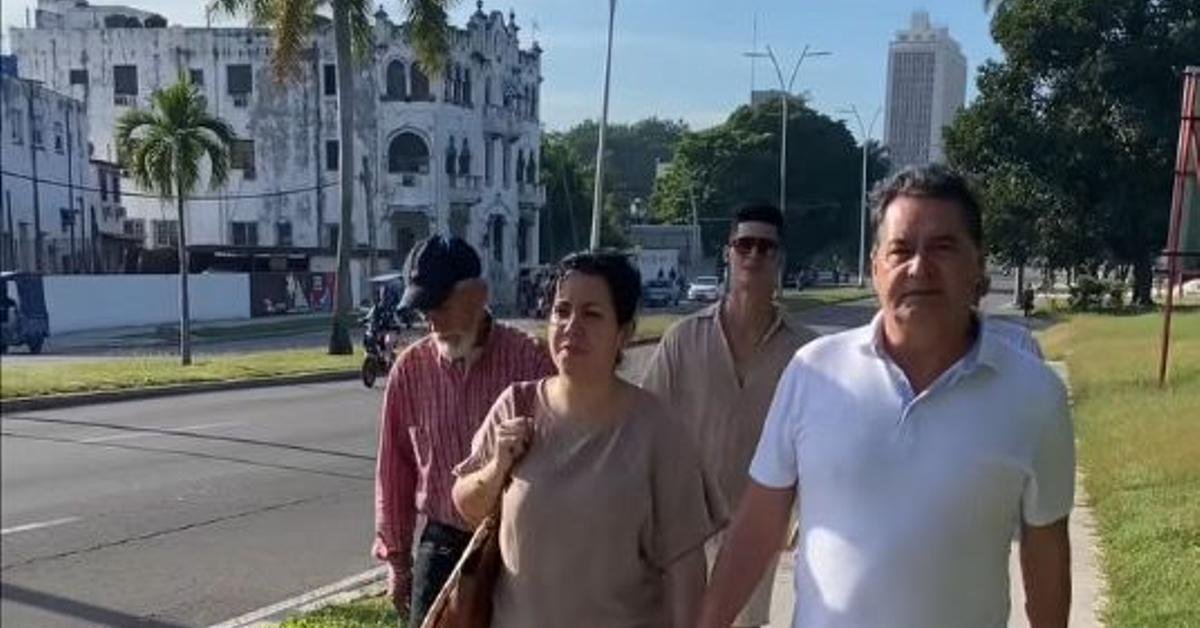
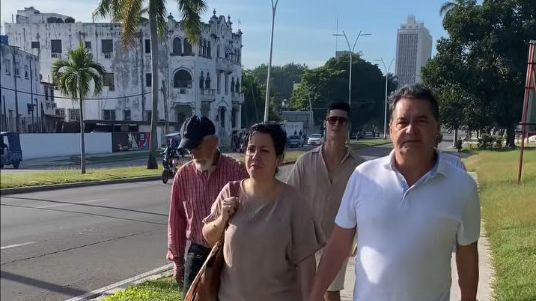
Havana/The independent journalist Camila Acosta and her husband, the writer Ángel Santiesteban Prats, face an accusation of attack which, as they learned this Thursday during a police appearance, is based on having shared publications on social networks about the recent trial against four Cuban Freemasons. The complaint was presented by Ernesto Valdés García, one of the Prosecutor’s witnesses in that process, who claims to feel threatened by the comments generated by those publications.
In a direct Cubanet Facebook pagethe reporter explained that both went on November 19 to the Zapata y C Police station, in Havana, where they were informed of the existence of an attack file. The instructor informed them that they had five days to hire a lawyer and return to give a statement. Both Acosta and Santiesteban refused to testify without legal assistance.
The journalist claims that the officer had a document of more than twenty pages on his desk, with numerous screenshots of publications and comments on social networks, but refused to allow him to examine it. According to his testimony, the file bears the number 73567/2026.
“We are not responsible now for the comments that people make on social media posts”
“I have not threatened anyone. I have not intimidated anyone. Neither on social networks nor on a personal level,” said Acosta, who questioned whether the authorities intend to hold them responsible for comments written by other people.
The accusation would be related to an investigation published by Cubanet on November 10, which identified judges, prosecutors, witnesses and State Security officials linked to the process against the Freemasons. Acosta and her husband shared that information on their profiles.
“We are not responsible now for the comments that people make in publications on social networks,” insisted the reporter, who recalled that numerous people also spread the journalistic work.
The complainant, Ernesto Valdés García, is no stranger to the disputes that have shaken Cuban Freemasonry. He was president of the Supreme Court of Masonic Justice during the institutional crisis caused by the theft of $19,000 assigned to the Llansó National Masonic Asylum, in January 2024, and also served as treasurer of that institution.
Valdés García participated in internal proceedings against Masonic leaders and was later expelled from the fraternity for treason.
According to CubanetValdés García participated in internal proceedings against Masonic leaders and was later expelled from the fraternity for treason. His testimony was also among those presented by the Prosecutor’s Office in the trial held on November 5.
In that process, the Popular Municipal Court of Diez de Octubre sentenced Santiesteban – recently elected grand commander of the Supreme Council of the 33rd Degree of Cuban Freemasonry – to two years of limitation of freedom and a fine of 20,000 pesos for currency exchange operations related to the Llansó Asylum. The other three defendants, José Ramón Viñas Alonso, Fernando Marcos García and Osvaldo Ernesto Villegas Digat, received similar sanctions of between two and four years.
The previous procedure had been instructed by the State Security Criminal Investigation Body. Furthermore, the Prosecutor’s Office included among its assessments about Santiesteban who openly expressed himself against the Cuban political system, a reference to his ideological positions within a file for alleged illegal operations with foreign currency.
For Acosta, the new complaint responds to a strategy aimed at silencing those who question the regime through accusations presented by third parties. “All this is nothing more than direct guidance from State Security,” he said. The journalist believes that Valdés García is being instrumentalized to subject them to a new judicial process and maintain the threat of prison or exile over both of them.
Initially, the journalist suspected that the procedure was related to a video in which she recorded a State Security agent who prevented her from leaving her home.
The Cuban Penal Code, approved through Law 151 of 2022, establishes sentences of two to five years in prison for the basic modality of the crime of attack. Its article 183 also sanctions threats or intimidation against witnesses, even when they occur as retaliation for their participation in a judicial procedure.
This Thursday’s appearance clarifies a mystery about the summons denounced by Acosta on Tuesday. Initially, the journalist suspected that the procedure was related to a video in which she recorded a State Security agent who prevented her from leaving her home.
The new research adds to the arrests and movement restrictions suffered by Acosta during November. Reporters Without Borders has denounced the harassment against independent journalists in Cuba, while the Cuban Observatory of Freedom of Expression documented 31 violations against Acosta and 12 against Santiesteban so far in 2026, mainly police sieges in front of his home and arbitrary arrests.
For Acosta, the authorities’ objective is to keep them under pressure. The case points to a clear State Security strategy: using third parties to present accusations that allow dissidence to be prosecuted.