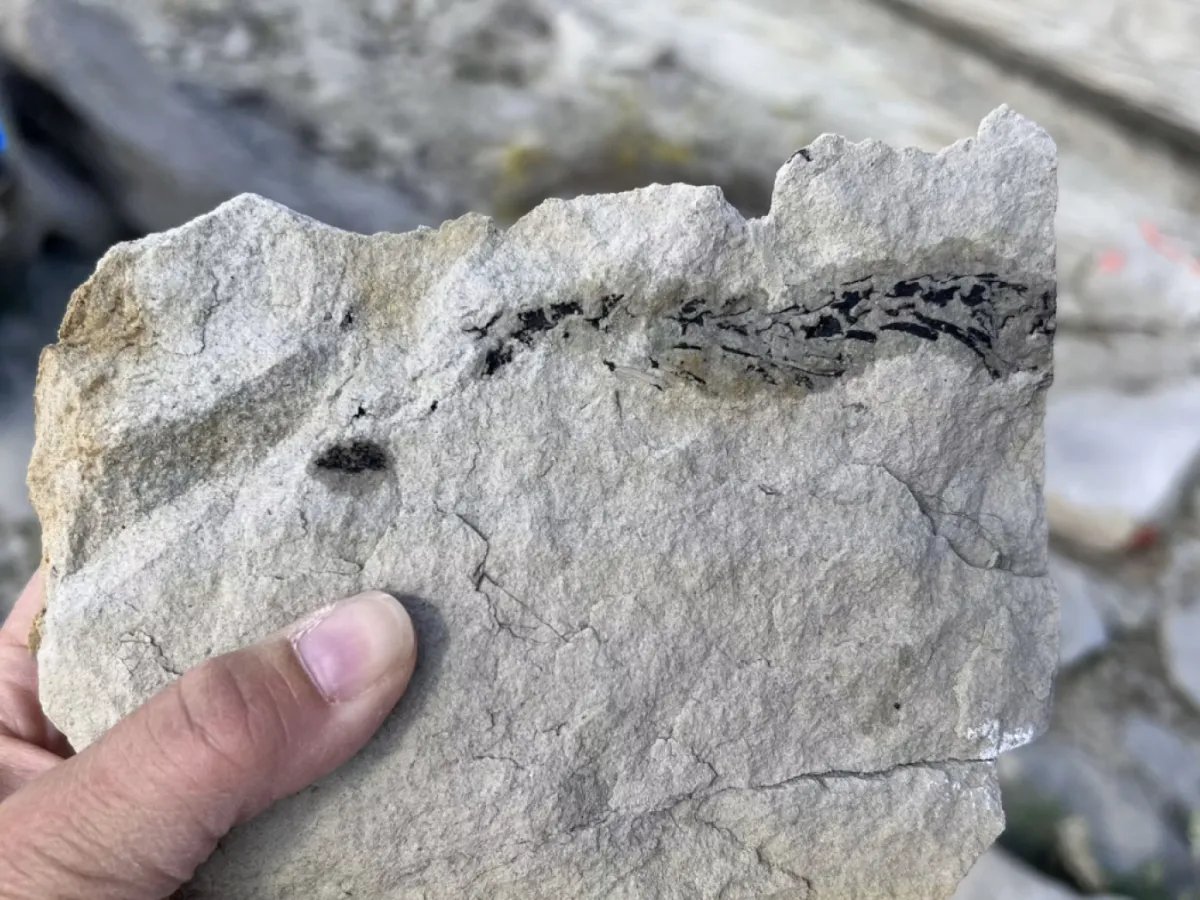

The new reptile species has been named Meilynodraco amonamarthi.
Keystone-SDA
A 156-million-year-old fossil from the United States has turned out to be a previously unknown species of reptile. Swiss researchers at the Paul Scherrer Institute (PSI) solved the mystery of this prehistoric animal using, among other tools, neutron imaging.

The little dragon is not only a new species, but also the most complete early representative of the so-called choristoderes known to date, as well as the oldest record of them in North America, the Paul Scherrer Institute (PSI) stated. The new reptile species has been named Meilynodraco amonamarthi.
The discovery began with a sandstone slab from a quarry in the US state of Wyoming, which was uncovered by an excavation team from the Aathal Dinosaur Museum of canton Zurich in 2022. The vertebrae of a tiny skeleton were visible on the slab. As the head and torso were found separately within the sandstone, the researchers suspect that a predator killed the animal 156 million years ago.
More

More
Switzerland, a paradise for dinosaur hunters. Or is it?
The excavation team brought the find to Switzerland. An international research team led by the PSI and the University of Zurich then examined the rock using neutron and X-ray tomography. In this way, the experts were able to visualise hidden bones without damaging the fossil.
Finally, they had to sift through tens of thousands of cross-sectional images from the neutron and X-ray tomography scans until the small reptile finally took shape. Pelvic bones, parts of the hind limb and a tiny skull with an almost completely preserved braincase came to light. This was “the real sensation”, said the PSI.
Clues to its relationship
According to the press release, it is precisely the skull – measuring less than two centimetres – that provides the most important clue to the kinship of the reptile, which is around 45 centimetres long. It belongs to the Choristodera, a long-extinct group of reptiles whose exact place in the family tree remains a mystery to this day.
More
More
Swiss researchers uncover why some animals become fossils and others disappear
It is the tiny bones in the inner ear region that provide a new clue. They bear a striking resemblance to those of the so-called crown group of reptiles, to which all living reptiles belong. According to the PSI, this could suggest that the choristoderes are more closely related to living reptiles than previous fossils would have suggested.
The fossil is due to be on display from early 2027 as part of a travelling exhibition at the Aathal Dinosaur Museum in Zurich.
+ How we produce news in English
Translated from German, reviewed by an English Department journalist.