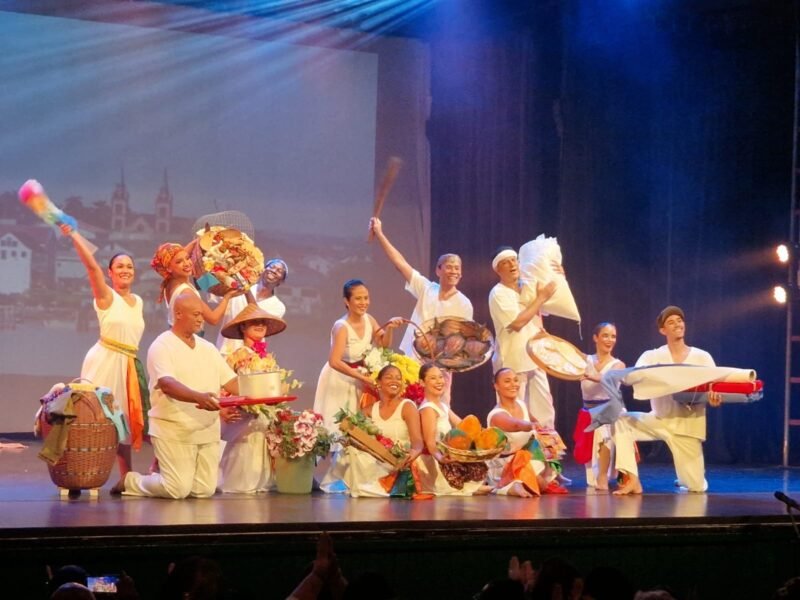
“It was worthy of Marlène. I give her a million compliments. She has done fantastic things in Suriname and especially for the youth.” Cynthia McLeod said otherwise the True Time after ‘A Legacy in Motion’, the anniversary performance of Marlène’s Dance Company on November 7 and 8 in Theater Thalia. The audience was also enthusiastic. Applause after applause, mobile phones that were constantly being held up to record the performances and even children in the audience who did not hide their comments. It was clear that the performance was well received.
Text and image Sharon Singh
With this performance, Marlène’s Dance Company celebrated its fortieth anniversary. The Dance Company is the select company in which students from the Marlène’s Ballet School, who distinguish themselves by their talent and achievements, are included. They will have the opportunity to participate in international dance productions. Ballet school Marlène celebrated its fiftieth anniversary in 2025.
“That movement must continue. It must never stop. That is actually what I want”
Marlene Lie A Ling
Surinamese colors and sounds
The recent anniversary performance brought together choreographies from different periods and showed how dance, music and the cultural diversity of Suriname have acquired an important place in the work of Marlène Lie A Ling over the years. The performance started with ‘Mi Kondre Tru’, in which Surinamese cultures came together.
This was followed by a musical and choreographic journey with recognizable Surinamese songs such as ‘Wi Na Wan’ (Kenneth Arias), ‘Prisiri’ by Ronald Snijders, ‘Ef’ A Kan’ (Powl Ameerali) and ‘Ham Toke Chahila’ (Joan Blokland). The closing with an exuberant ‘Friyari Oso Dansi’ expressed the festive atmosphere of the anniversary.
The Senegalese group Ballet Kamala Africa, which was supposed to give the celebration extra sparkle, was unable to come to Suriname at the last minute. Lie A Ling therefore had to come up with an alternative at short notice. She opted for live music by a specially selected ensemble led by Wilgo Telting.
More than just dance
For McLeod, the incorporation of the Surinamese elements was particularly special. She emphasized that Lie A Ling has contributed much more than just training dancers over the years. “Our young people have learned so much. Not only dance, but their entire attitude to life and self-discipline have been taught to them, which has served them extremely well in their later lives,” said the celebrated author.
Maikel Austen, director of Artlab.sr, was also enthusiastic. He himself was introduced to ballet in the 1970s and 1980s and has fond memories of the school. “The choreographies were simply sublime. The decoration was also very good. It’s great that they have continued like this and that there is still so much support from the past, but that a lot of new talent has also emerged. That is important. That talent must continue.”
Austen also sees Lie A Ling’s contribution in a broader social perspective. According to him, she has contributed to the identity of Surinamese society by making the cultural wealth of the country visible.
He also states that Lie A Ling shows how rich Surinamese society is in culture and how the country’s multicultural diversity can be used as a strength. “Marlène expresses this in a special way in her work, through dance,” Austen said.
(read more below the photo)

A vision on culture and dance
Tanya Frijmersum, who used to dance at the ballet school, was also impressed by the performance. She especially appreciated the diverse dance genres and age groups covered.
The ending with the ‘Friyari Oso Dansi’ especially impressed her. “That was a surprise to me with that one koto and that whole group that came together. That was really the highlight of the evening. It was cheerful, it had a vibe and you really felt that birthday atmosphere.”
Frijmersum also noted that Lie A Ling has a clear vision about the place of culture in society. “Culture and performing arts, including dance, are an important part of every society. However, in Suriname culture is not always given the place it deserves,” says Fijmersum.
Discipline keeps dancers at their best
The fact that Marlène’s Dance Company has managed to bring different generations of dancers together on stage after forty years was also visible with male dancers such as Duncan Brunings. Through a singing project he was introduced to Lie A Ling, who guided him in incorporating movements into his singing performances. “I found her way of working very fascinating and recognized her as a good teacher. As a youngster I had always wanted to do stage dance, but it never happened. When Marlène, after our introduction, said that she needed men for a dance production, I saw my opportunity and said ‘yes’. I was already 24 at the time, actually very late to start dancing. But Marlène let me take extra lessons so that I could quickly join in.”
Brunings says that maintaining a good level of dancing requires discipline, continuous training and good guidance. This applies even more to older dancers. “With the special lesson that you have to listen even more to the body, be extra careful with it and, above all, dance with pure technique, so that you do not get injuries. I have never had one myself.”
He was enthusiastic about his experience during the anniversary performance. “I loved being on stage again. We had a wonderful audience, very enthusiastic. A nice reaction I received a few times was that our movements seemed very experienced and that the Suriname feeling was fully present.”
(read more below the photo)

From generation to generation
For Glynis Williams, one of the dancers of Marlène’s Dance Company, the connection with the dance school started at an early age. When she was five or six years old, she attended the performance ‘Esde, Tide, Tamara’ by Marlène’s Ballet Company with her mother and sister. It impressed her so much that she wanted to dance herself.
At the age of six she was allowed to start taking lessons at Ballet School Marlène. Her first introduction to the stage was special: together with other young dancers, dressed as angels, she was allowed to open the curtain for the older dancers.
“Our young people have learned so much. Not only dance, but their entire attitude to life and self-discipline have been taught to them”
Cynthia McLeod
Williams attributes the fact that she has been able to continue dancing all these years primarily to discipline and love for dance. “Discipline comes first. Then love for my body and dedication to the movements and the music. This way the body continues to perform at a reasonably balanced level, despite the fact that we are all getting older,” she explained.
For Marlène Lie A Ling, the forty-year anniversary of the Dance Company is not only a moment to look back, but above all to keep looking forward. She wants to further develop and pass on the knowledge, cultural influences and dance tradition that she has inherited from previous generations. “I receive from previous generations, I work on it, I develop it and then I pass it on to the next generation. That means that movement must continue. It must never stop. That is actually what I want.”