Text Ivan Cairo
SHANWEI — Nearly 5,000 Chinese and foreign journalists are expected in the Chinese city of Shenzhen this week to cover the annual Asia-Pacific Economic Cooperation (APEC) summit. They include 105 journalists from various countries who are currently participating in the China International Press Communication Center (CIPCC), a media exchange program of China. Also the True Time is represented in Shenzhen.
The 33rd meeting of heads of government of the 21 APEC economies will be held on November 18 and 19. The summit attracts great international attention due to the presence of influential world leaders and the expected discussions on international trade, economic cooperation and geopolitical tensions.
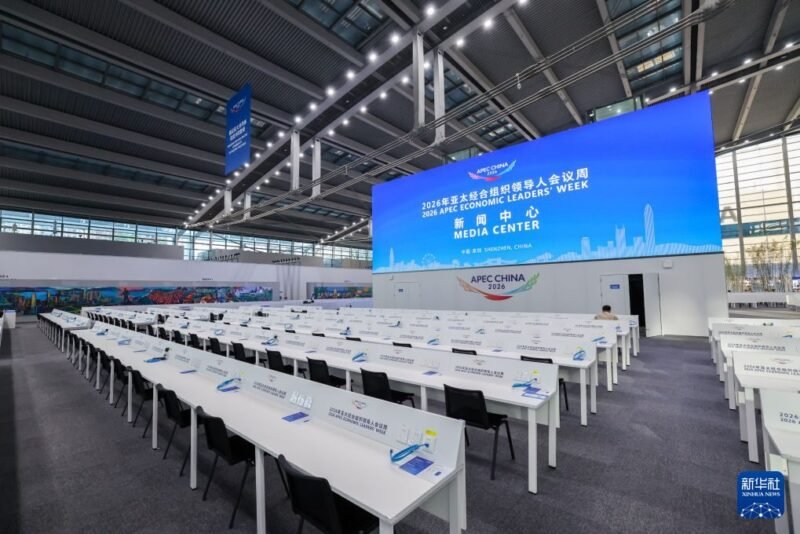
A special press center has been set up for the thousands of reporters at the Shenzhen Convention and Exhibition Center in Futian District. The complex, which was officially opened on November 11, covers approximately 15,000 square meters. It has work areas, television studios, interview facilities, press conference rooms and technical facilities for live broadcasts.
According to the Chinese state news agency Xinhua, the center is designed to support almost 5,000 domestic and foreign journalists. The central workspace has approximately 700 workstations and can accommodate almost a thousand reporters at the same time at busy times. In addition, separate rooms are available for international news organizations.
Modern technology
During the summit, China will explicitly use modern technology to facilitate the international press. Journalists can use fast internet connections, digital news facilities, automatic translation systems and equipment for image and sound production. There are also facilities for reporting using artificial intelligence.
The organization also uses 420 volunteer university students to guide the foreign press. They provide support with press conferences, registration, transport and practical questions.
The 105 CIPCC journalists will travel from three different locations in Guangdong province to Shenzhen, where they will follow the preparations and the summit. Their participation is part of a more extensive program in which foreign journalists are introduced to Chinese social, economic and political developments.
Authorities are also organizing visits to companies and other locations in Shenzhen during APEC week. This gives foreign reporters the opportunity to take a closer look at the technological and economic development of the city.
The large media presence underlines the international importance attached to the summit. China also wants to use the meeting to draw global attention to Shenzhen, one of its most important technology centers.
Broader facilities
The city’s preparations extend far beyond the media center: conference arrangements, visitor services and technology come together to welcome guests from across Asia-Pacific.
At a press conference on Saturday, Shenzhen Mayor Li Yun said all meeting locations were ready after equipment checks and full rehearsals.
Special channels for delegates have been established at nine border crossings by sea, land, air and rail. Shenzhen Bao’an International Airport has introduced advanced screening technology for hold baggage to make customs clearance smoother, Li said.
More than 100,000 foreign-language signs have been standardized across the city, and more than 7,000 AI translation devices have been installed at transport hubs, tourist attractions and shopping areas. Visitors can use foreign-issued bank cards to pay for subway travel or withdraw money from more than 3,000 ATMs across the city, while 1,360 conference volunteers and tens of thousands of city volunteers are on hand to help.-.