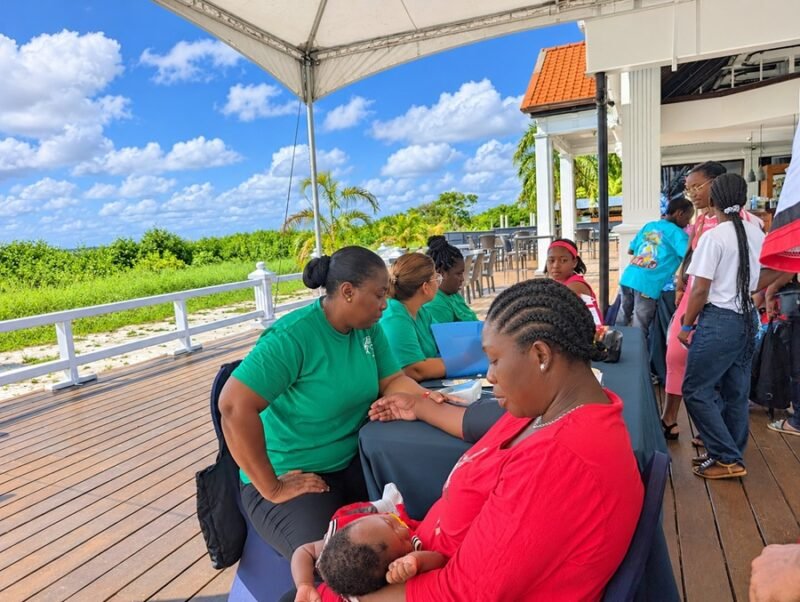
Smiling faces, playing children and busy talking parents form the relaxing backdrop to a relaxing day on the Pier of Hotel Torarica. However, the meeting on Saturday also had a serious undertone. It is World Diabetes Day and for the third time a special day is being organized for children with type 1 diabetes.
Text and image Euritha Tjan A Way
Letitia Eduards is sitting with her baby in her arm. The fresh wind makes him sleep peacefully. From her seat she has a view of the adjacent tent on the pier. Her sixteen-year-old daughter still has to measure her blood sugar and blood pressure there. That is a permanent part of this day, which is being organized for the third time for the patients of the Academic Hospital Paramaribo.
“If we have to support fellow citizens who are on dialysis, have had a stroke or have to undergo an amputation, it not only costs the country much more money, but it also disrupts entire families”
SZF director Minouche Dihal-Bromet
Eduards opposite the True Time: “I noticed when she was seven years old that something was wrong. She was in the second year of primary school and was peeing a lot. As a little girl she never really liked to eat, but suddenly she could no longer be calmed down when she was hungry.”
Mother Eduards watched it for several months, but saw the situation worsen. “At one point she could only walk short distances. She got tired very quickly and started vomiting more and more.”
Pediatrician check-up
Ultimately, a visit to the outpatient clinic of the Regional Health Service in Lelydorp provided clarity. Her daughter’s blood sugar level was so high that the measuring device could no longer indicate the value. “From then on, she was under the care of a pediatrician. We started at the Diakonessenhuis, then we went to a pediatrician at the Roman Catholic Hospital and now she is being treated by a pediatrician at the Academic Hospital Paramaribo.”
Eduards, who is a teacher, quickly realized how drastic the situation would be for her family, which then consisted of three children. “I therefore wanted to be transferred to the interior, to work in my mother’s village. But there was no electricity there and we need refrigeration for my daughter’s insulin.”
She now lives in Brownsweg, together with her mother. “I can only keep my child’s diabetes under control because the whole family cooperates. My daughter needs to be injected six times a day: three times to check her blood sugar and three times to administer insulin. Everyone helps to keep an eye on things, so that everything happens on time.”
Ten years later, her blood sugar levels are still not under control. “She has to go to the hospital more often. Sometimes we take her ourselves, but very often an ambulance is needed. It is very difficult,” says Eduards.
Treatment methods
Pediatrician Ragna Wolf, who specializes in diabetes, especially type 1 diabetes in children, notices that the disease has a major social impact on the lives of patients and their families. “We have different treatment methods. One of them is for parents to measure blood sugar and weigh their children’s food with a kitchen scale. Based on this, the amount of insulin that needs to be administered is determined in advance. But many parents cannot do that. Measuring and counting carbohydrates is difficult for them. That is why their children are sometimes given a fixed insulin schedule.”
Wolf emphasizes that it is imperative that children stick to that schedule. For children with prediabetes that she treats, the message is mainly to be conscious about nutrition and exercise. “That is the way to prevent it from developing into diabetes and from possible serious complications in the long term, such as amputations, kidney dialysis and blindness,” says the pediatrician.
She notes that diabetes and associated health problems are becoming increasingly common at younger ages. As a doctor, Wolf is committed to better insulin facilities for her patients and new measuring equipment that allows better monitoring of children’s blood sugar levels.
Prevention
Minouche Dihal-Bromet, who has been director of the State Health Insurance Fund for two months, says that the fund is open to the proposals. “We are looking at it.”
She will also be present at the meeting this year, but now in her new position. “I always say that all children should be insured, but children with diabetes more often need care from a pediatrician. Insurance enables them to receive good care. As a fund, we want to contribute to a long and healthy life for these children.”
According to Dihal-Bromet, prevention is the most important message. “People should also see exercise as something pleasant. It’s nice when you feel fit. So: less sugar and fat, more exercise and of course know what your values are. Get measured when an organization in your area organizes a measurement activity.”
Investing in prevention also saves the country a lot of costs. “If we have to support fellow citizens who are on dialysis, have had a stroke or have to undergo an amputation, it not only costs the country a lot more money, but it also disrupts entire families. So let’s not sit down, but stand up,” says Bromet. As she says those words, she puts her words into action. She walks to the children who are playing games on the tennis court of Torarica Resort under the supervision of a physiotherapist.