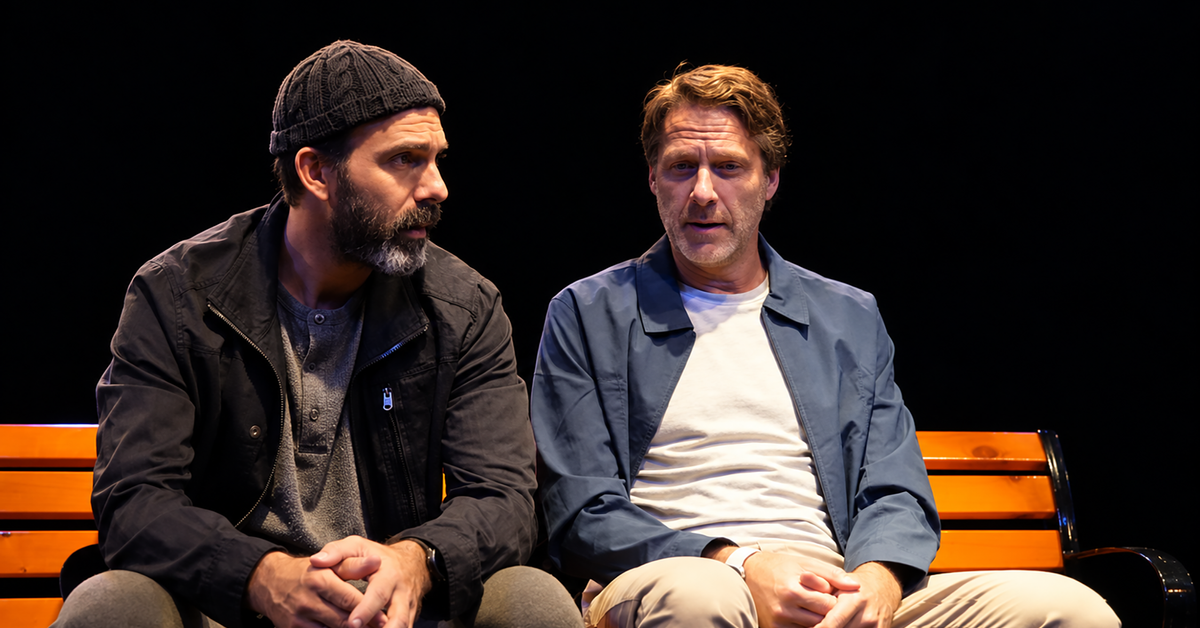
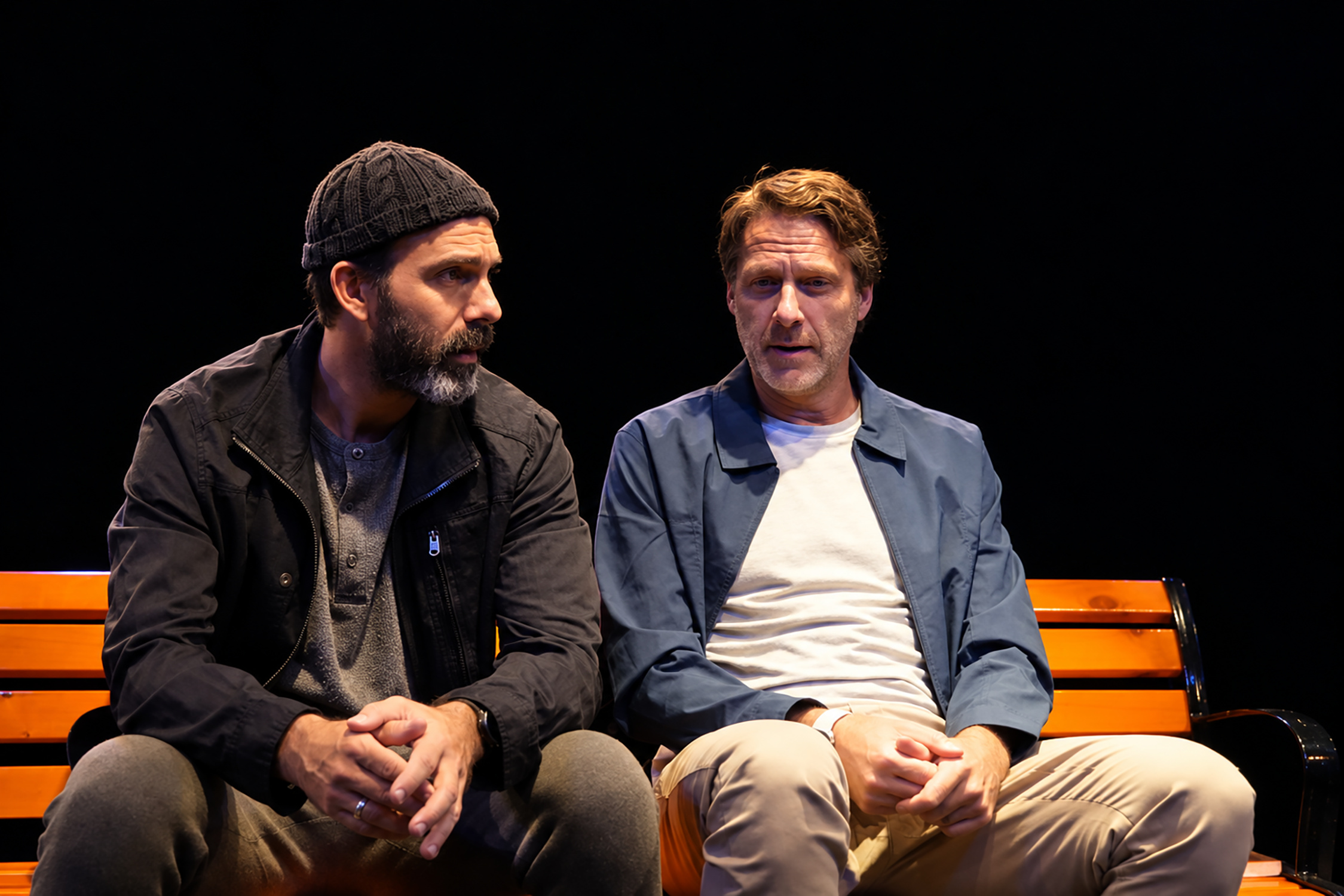
Miami/There are encounters that seem casual, but hide a tragedy. Carlos Celdrán knows this and in his version of The history of the zoo, by Edward Albee, presented by Arca Images in Miami this weekend, once again demonstrates his ability to discover the darkest areas of the human condition and turn them into an intense and disturbing scenic experience. Two actors, under his direction, bring out the tensions, silences and wounds that hide behind a seemingly trivial encounter.
The scenery is almost defiantly naked. A platform that extends into an ascending ramp and a bench where apparently nothing extraordinary happens. However, this minimum space ends up becoming a territory of dispute, an invisible border and the scene of a battle for something as elemental as the right to exist in the eyes of the other.
In Albee’s universe, that bench is much more than a scenic object. Peter, who has a family, a house and a comfortable existence, ends up defending this small public territory with unexpected ferocity. Jerry, who barely has anything he can call his own, manages to drag him into an absurd and revealing dispute. The playwright’s genius lies precisely in showing how civilization can crumble when someone questions our most insignificant privileges. In today’s Miami, that bench takes on even more uncomfortable resonances. Who has the right to sit? Who decides that the other is occupying a place that does not belong to them?
In today’s Miami, that bench takes on even more uncomfortable resonances. Who has the right to sit? Who decides that the other is occupying a place that does not belong to them?
Peter, played by the American Caleb Scott, belongs to the world of certainties. He has an organized life, a comfortable social position and the conviction that that bank belongs to him during his peaceful rest. Jerry, played by Cuban Caleb Casas, comes from the other end of the human experience, after suffering helplessness, frustration and the desperate need to find someone to listen to him.
Celdrán also introduces a decision that transforms the reading of the classic. Peter speaks English and Jerry Spanish. This is not a quaint device to please Miami’s bilingual public. The linguistic difference acquires a political and emotional dimension. Words stumble against a barrier deeper than language: the inability to recognize the other as similar.
Caleb Casas bears the most demanding part of this confrontation. Jerry speaks, insists, provokes, exposes himself. His stories seem to advance between digressions, wounds and memories, but behind this apparent disorder there is a fierce desire for communication. The Cuban actor finds in the character a territory where vulnerability and threat can coexist without canceling each other out.
Jerry has discovered that even hatred can be a form of contact, while indifference constitutes the most absolute of expulsions. His confrontation with Peter is, therefore, not a simple provocation. It is the last attempt of a distraught man to leave a mark on another human being, to force him to recognize that he exists.
Something of that tradition of Teatro Estudio and the great years of the Havana scene finds an extension here far from Cuba
Scott, for his part, gives voice to Peter who represents that comfort that feels attacked when someone breaks into its limits. A tension is established between both performers that does not need large movements to acquire a disturbing dimension.
But there is another presence that runs through this setting: Vicente Revuelta. The legendary Cuban director and actor played Jerry in Havana in 1964. Decades later, Casas played Revuelta himself in Mysteries and small piecesfrom Celdrán. Now, by returning to the character of Albee, a circle of artistic affiliations that unites two cities and several generations of creators seems to be closed.
The dedication to Revuelta thus acquires a special resonance. It is not only the memory of a teacher, but the continuity of a way of understanding the stage as a space of risk, research and commitment to the human condition. Something of that tradition of Teatro Estudio and the great years of the Havana scene finds an extension here far from Cuba.
Close to the theater of the absurd, the American playwright found in the most trivial situations a ruthless way to expose human miseries. His characters talk until they are exhausted, question each other, provoke each other and end up trapped in dialogues that seem to lead nowhere, while a violence that is difficult to contain grows beneath the words. Maybe that’s why The history of the zoo, Written almost seven decades ago, it retains its ability to make us uncomfortable.
The montage also invites us to think about today’s Miami, where languages, origins and migratory experiences coexist that cannot always be found. The stubborn defense of a bank can be read as the claim of privilege, while Jerry’s insistence recalls the desperation of those who knock on institutional and legal doors that remain closed.
The truly disturbing thing about The history of the zoo It’s understanding that Jerry has had to push another man to the limit to get him to really look at him. Celdrán rescues that wound from Albee and elevates a bank where someone wanted to be alone and another desperately needed to stop being alone to the category of universe.