Too many Barbadian children are still missing out on the benefits of organised sport, despite strong participation in a handful of popular disciplines, according to the Ministry of Sports and Community Empowerment’s latest Youth Sports Survey.
The survey, which commenced in January 2025 and covered the 2024/2025 academic year, recorded 24 099 participation instances among a student population of 35 502.
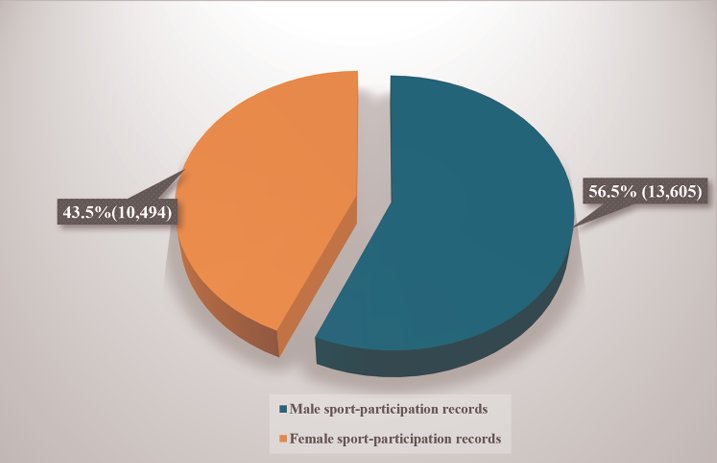
It found that just five sports accounted for nearly three-quarters of all participation, while boys accounted for 56.5 per cent of participation records compared with girls.
Sport participation by gender (Graphics credit: Ministry of Sports and Community Empowerment)
Responding to the findings, Minister of Sports and Community Empowerment Charles Griffith said more must be done to ensure every child feels there is a place for them in sport.
“One of my concerns is that we have too many young people who are not getting involved in sports. We cannot afford to have our children sitting on the sidelines when there are so many benefits to be gained from participating in sporting activities,” Griffith said.
Conducted by the ministry’s Sports Programme consultants, the survey covered 79 primary schools and 23 secondary schools and examined participation across 25 sporting disciplines.
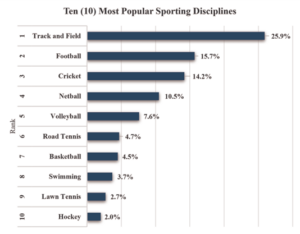
Most popular sporting disciplines (Graphics credit: Ministry of Sports and Community Empowerment )
Track and field emerged as the most popular activity, accounting for 26 per cent of all participation. Football followed with 16 per cent, while cricket represented 14 per cent. Netball accounted for 11 per cent and volleyball eight per cent.
Road tennis, Barbados’ only indigenous sport, ranked sixth among the disciplines surveyed, attracting more than 1 100 participants overall. Participation was higher among boys than girls, with primary schools accounting for the majority of players.
The survey also revealed a gender gap in participation, with boys participating at a higher rate than girls across the sports and activities surveyed.
The widest gender disparities were recorded in football and cricket, where boys outnumbered girls by roughly four to one. Football attracted more than 3 700 participants overall, but fewer than 800 were girls. A similar pattern emerged in cricket, with boys accounting for the overwhelming majority of participants. Netball, meanwhile, remained overwhelmingly female-dominated, with girls making up almost 95 per cent of those taking part.
Some sports attracted a more balanced mix of participants. Track and field recorded near-equal participation among boys and girls, while swimming was split almost evenly between the sexes.
Students also took part in a range of other disciplines, including chess, dominoes, cycling, wrestling, archery, taekwondo and karate. Among these, chess was the most popular, while dominoes participation was concentrated largely at the secondary-school level.
Overall, primary schools recorded slightly more participation than secondary schools. The ministry noted, however, that the figures should be viewed in the context of the different numbers of institutions participating at each level.
Griffith said sport offers benefits that extend far beyond physical activity and competition, helping young people develop qualities that can serve them throughout their lives.
“Sports help to build discipline, confidence, teamwork, leadership and respect. They teach young people how to work with others, how to deal with disappointment and how to set goals and work towards achieving them. These are important life skills that will benefit them both on and off the field of play,” he said.
The minister also encouraged parents and guardians to play a more active role in introducing their children to sport.
“I want to encourage parents to get their children involved in sports. Do not wait until your child shows an interest in becoming a professional athlete. Allow them to explore different sporting disciplines, discover their abilities and develop new interests. Sports can open doors for our young people and provide opportunities that can positively shape their future,” Griffith said.
The findings are expected to guide efforts to strengthen school sports programmes, improve gender inclusion, preserve and develop road tennis, and create opportunities in lesser-represented disciplines. They will also help shape planning for coaching, sporting infrastructure and stronger partnerships among schools, sporting federations and community organisations.
“We have to continue creating opportunities, but parents also have a responsibility to encourage their children to participate. Whether it is football, cricket, netball, track and field, road tennis or any other discipline, I want to see more of our young people getting involved. We are not just developing athletes; we are helping to develop well-rounded individuals who can make a positive contribution to Barbados,” the minister added.
(PR/BT)